
Habrosus Corydoras (Corydoras habrosus)
Quick Answer
Habrosus Corydoras (Corydoras habrosus) is one of the smallest corydoras catfish, reaching only 1.4 inches (3.5 cm). Native to the upper Orinoco basin in Venezuela and Colombia, it requires a minimum 10-gallon (38-liter) aquarium with fine sand substrate, pH 6.0-7.5, temperature 72-79F (22-26C), and must be kept in groups of 8 or more. This peaceful, bottom-dwelling omnivore is ideal for nano and planted community tanks.
Quick Facts
| Scientific Name | Corydoras habrosus |
|---|---|
| Common Names | Habrosus Corydoras |
| Family | Callichthyidae |
| Genus | Corydoras |
| Type | Freshwater |
| Temperament | peaceful |
| Care Difficulty | beginner |
| Lifespan | 5 years |
| Maximum Size | Up to 1.4 in (4 cm) |
| Diet | Omnivore |
| Temperature | 72–79°F (22–26°C) |
| pH | 6–7.5 |
| Hardness | 2–10 dGH |
| Minimum Size | 10 gallons |
Key Takeaways
- Maximum size of only 1.4 inches (3.5 cm) - one of the smallest corydoras
- Requires fine sand substrate; sharp gravel causes fatal barbel erosion
- Must be kept in groups of 8+ for natural shoaling behavior and health
- Extremely sensitive to copper, formalin, and salt due to scaleless body
- Breeds with cool water trigger (50% water change at 68F/20C)
- IUCN Near Threatened - prioritize captive-bred specimens
Overview
Species Overview
Corydoras habrosus, commonly known as the Habrosus Corydoras, Salt and Pepper Cory, or Dainty Cory, is one of the smallest members of the Corydoradinae subfamily. Native to the upper Rio Orinoco basin in eastern Colombia and western Venezuela, this diminutive catfish has become a staple in the nano aquarium hobby due to its manageable size, peaceful temperament, and active shoaling behavior.
Natural History and Distribution
This species occurs in the Llanos Orientales region, a vast tropical grassland plain traversed by the Orinoco River and its major left-bank tributaries. During the annual wet season, large swathes of these plains flood, forming enormous wetlands. C. habrosus displays a strong preference for lagoons, slow-moving tributary streams, inundated forest edges, and marginal zones where water flow is gentle. It forms aggregations close to submerged vegetation, tree roots, and leaf litter.
Physical Characteristics
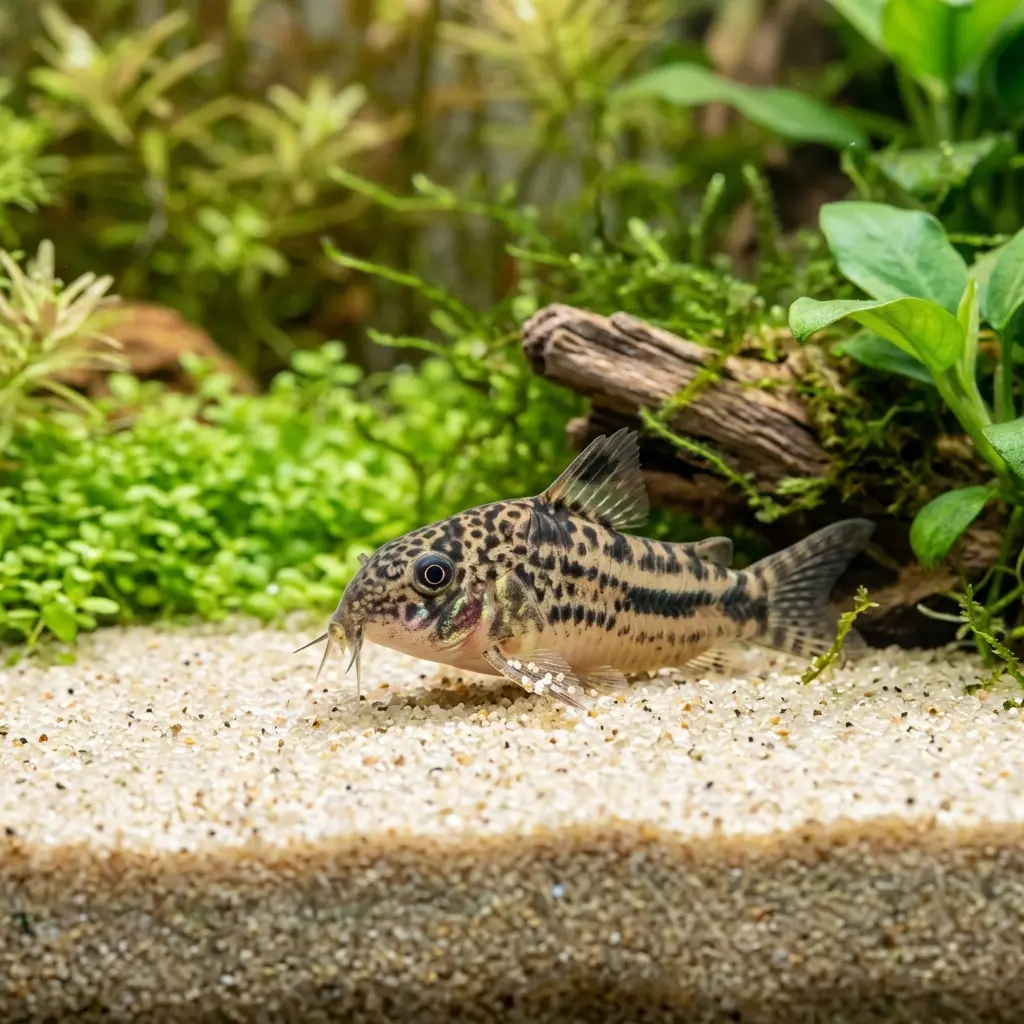
Adults reach a maximum standard length of 1.4 inches (3.5 cm), though most remain closer to 1.2 inches (3.0 cm). The body is covered in bony plates (scutes) rather than scales, giving it the armored appearance characteristic of the family Callichthyidae. The color pattern is highly variable, typically displaying 2-3 dark markings along the flank against a pale cream or tan background, creating the salt-and-pepper appearance that gives the fish its common name. Males are generally smaller and more slender than females, which develop a rounder body profile when gravid.
Conservation Status
The IUCN lists Corydoras habrosus as Near Threatened. Wild populations are vulnerable to habitat degradation from agricultural expansion in the Llanos region and seasonal droughts that can trap fish in receding pools. The aquarium trade relies primarily on captive-bred specimens, which is positive for wild population sustainability.
Diet
Diet and Feeding
Habrosus Corydoras are obligate bottom-feeding omnivores with a natural diet consisting of worms, benthic crustaceans, insect larvae, and detritus. In the aquarium, you must provide a varied diet that sinks to the substrate, as these fish rarely compete successfully for surface or mid-water food.
Health
Health and Disease Management
Habrosus Corydoras are generally hardy when their environmental needs are met, but they are highly vulnerable to specific diseases due to their scaleless bodies, bottom-dwelling lifestyle, and sensitivity to medications. Prevention through proper water quality and substrate choice is far more effective than treatment.
Barbel Erosion
Progressive dissolution of the sensory barbels caused by bacterial infection entering through micro-abrasions from rough substrate.
- Shortened, frayed, or completely missing barbels; fish appears unable to locate food; redness at barbel bases; secondary bacterial infection on the mouth.
Sharp gravel or dirty substrate causing physical damage, followed by bacterial infection (typically Aeromonas or Pseudomonas species). Poor water quality accelerates the condition.
Use only fine sand substrate. Perform weekly 25-30% water changes. Maintain nitrates below 15 ppm. Never use gravel with edges sharper than 2 mm radius.
Ich (White Spot Disease)
A parasitic infection caused by Ichthyophthirius multifiliis, appearing as tiny white salt-like dots on fins and body.
- Small white cysts (0.5-1 mm) covering body and fins; fish rubbing against substrate or decor; rapid gill movement; clamped fins.
Introduction via new fish, plants, or equipment. Stress from poor water quality or temperature fluctuations lowers immunity and allows the parasite to proliferate.
Quarantine all new additions for 2-4 weeks. Maintain stable temperature between 72-79F (22-26C). Use Ich-X for treatment at standard dose (safe for scaleless fish). Raise temperature to 84F (29C) to accelerate parasite life cycle.
Red Blotch Disease
A rapidly progressing bacterial infection characterized by hemorrhagic patches on the body, often fatal within days if untreated.
- Red or bloody patches on the flanks or belly; red streaking in fins; lethargy; loss of appetite; rapid breathing.
Gram-negative bacterial infection (Aeromonas hydrophila, Pseudomonas fluorescens) typically triggered by poor water quality, overcrowding, or injury.
Perform immediate 50% water change at first sign. Treat with Kanamycin (KanaPlex) at half the standard dose for scaleless fish. Remove carbon from filter during treatment. Maintain pristine water conditions during recovery.
Fungal Infection (Saprolegnia)
Cotton-like fungal growth on body or fins, typically secondary to an existing injury or bacterial infection.
- Fluffy white or gray cotton-ball patches on body, fins, or mouth; patches grow outward from a central point; fish may rub against objects.
Saprolegnia species opportunistically infecting wounds from rough substrate, fin nipping, or untreated bacterial infections. Poor water quality and low temperature favor fungal growth.
Treat with API Pimafix at half dose. Address the underlying injury or infection first. Maintain water temperature above 72F (22C). Ensure substrate is smooth and clean.
Internal Parasites
Worm or protozoan infections in the digestive tract causing chronic wasting despite normal appetite.
- Sunken belly (not to be confused with gravid female roundness); stringy white or clear feces; visible wasting over 2-4 weeks; lethargy; loss of color.
Introduction via live foods (particularly wild-caught blackworms) or contaminated water. Common culprits include nematodes (Camallanus, Capillaria) and protozoans (Hexamita).
Treat with Levamisole or Metronidazole mixed into food. Use a 3-day course, followed by a 25% water change, then repeat. Quarantine live foods by freezing for 48 hours before feeding.
Breeding
Breeding Habrosus Corydoras
Breeding Corydoras habrosus in captivity is moderately difficult but achievable with proper conditioning and environmental manipulation. Unlike some corydoras species that spawn readily in community tanks, Habrosus corydoras typically require specific triggers that simulate seasonal changes in their natural habitat.
Tips
Common Mistakes to Avoid
- Sharp gravel: The single most common cause of barbel erosion and premature death. If you currently have gravel, replace it with sand before adding corydoras.
- Insufficient group size: Keeping 3-4 corydoras because of tank size constraints. This causes chronic stress and immunosuppression. If you cannot keep 8+, choose a different species.
- Over-reliance on flake food: Flakes rarely sink intact and are consumed by surface feeders. Corydoras will starve in a flake-only diet.
- Skipping quarantine: Introducing new fish directly to the main tank is the leading cause of ich and parasite outbreaks.
- Using salt as a general tonic: Salt is toxic to corydoras. Never add salt to a corydoras tank for any reason.
- Full-dose medications: Treating corydoras with standard medication doses intended for scaled fish causes organ damage and death. Always halve the dose.
- Tall tanks: Column tanks and tall bowfronts look impressive but provide inadequate floor space for bottom-dwelling shoaling fish.
Expert Tips for Success
- Group size is everything: A group of 12-15 in a 20-gallon long tank will display behavior that a group of 6 in a 10-gallon never will. The investment in numbers pays dividends in activity and health.
- Target feed with a pipette: In community tanks, deliver sinking pellets directly to the corydoras' zone using a turkey baster or pipette. This prevents starvation and allows you to observe each fish eating.
- Use leaf litter: Indian almond leaves, oak leaves, or magnolia leaves provide tannins, biofilm grazing, and hiding spots. Replace monthly as they decompose.
- Dark substrate enhances color: Dark sand (black or dark brown) makes the salt-and-pepper markings pop. Light substrate washes out their coloration.
- Acclimate slowly: These fish are sensitive to parameter swings. Use drip acclimation over 45-60 minutes when introducing to a new tank.
- Test for copper: If using tap water, test for copper contamination. Municipal water supplies sometimes contain copper at levels lethal to corydoras.
Compatible Tank Mates






Species Comparison
| Feature | Habrosus Corydoras | Pygmy Corydoras (C. pygmaeus) | Panda Corydoras (C. panda) | Ember Tetra (Hyphessobrycon amandae) |
|---|---|---|---|---|
| Adult Size | 1.4 in (3.5 cm) | 1.0 in (2.5 cm) | 2.0 in (5.0 cm) | 0.8 in (2.0 cm) |
| Temperament | Peaceful, bottom-dwelling | Peaceful, mid-bottom swimmer | Peaceful, active bottom-dweller | Peaceful, mid-water schooling |
| Minimum Tank Size | 10 gal (38 L) - 15 gal (57 L) recommended | 10 gal (38 L) | 20 gal (76 L) | 10 gal (38 L) |
| Diet | Omnivore - sinking micro-pellets, frozen daphnia, live worms | Omnivore - prefers mid-water feeding | Omnivore - larger pellets, bloodworms | Omnivore - small flakes, micro-pellets |
| Ideal pH Range | 6.0 - 7.5 | 6.0 - 7.0 | 6.0 - 7.0 | 5.0 - 7.0 |
| Schooling Requirement | 8+ individuals minimum | 6+ individuals minimum | 6+ individuals minimum | 8+ individuals minimum |
| Substrate Sensitivity | High - requires fine sand only | High - requires fine sand only | Moderate - fine gravel acceptable | Low - any substrate acceptable |
| Breeding Difficulty | Moderate - requires cool water trigger | Moderate - similar trigger method | Easy - breeds readily in community tanks | Moderate - requires soft acidic water |