
Longnose Hawkfish (Oxycirrhites typus)
Quick Answer
Longnose Hawkfish (Oxycirrhites typus) is a distinctive marine predator from the Indo-Pacific. It requires a minimum 30 gallon (113 liter) saltwater aquarium with specific gravity 1.023-1.025, pH 8.1-8.4, and temperature 72-78°F (22-26°C). This semi-aggressive carnivore must be kept singly and makes an excellent reef-safe addition when paired with appropriate tank mates and robust corals.
Quick Facts
| Scientific Name | Oxycirrhites typus |
|---|---|
| Common Names | Longnose Hawkfish |
| Family | Cirrhitidae |
| Genus | Oxycirrhites |
| Type | Saltwater |
| Temperament | semi-aggressive |
| Care Difficulty | intermediate |
| Lifespan | 7 years |
| Maximum Size | Up to 5 in (13 cm) |
| Diet | Carnivore |
| Temperature | 72–78°F (22–26°C) |
| pH | 8.1–8.4 |
| Hardness | 7–12 dGH |
| Minimum Size | 30 gallons |
Key Takeaways
- Known for its semi-aggressive temperament and extreme territoriality toward conspecifics; must be kept singly.
- Requires a minimum 30 gallon (113 liter) aquarium with a tight-fitting lid; 40+ gallons strongly recommended.
- Completely lacks a swim bladder, explaining its unique perching behavior and need for stable resting structures.
- Reef safe with corals but will eat ornamental shrimp, small crabs, and small fish.
- Protogynous sequential hermaphrodite: all individuals begin as females, largest becomes male.
- Can live 5-10 years with proper care; some specimens exceed 10 years in stable systems.
Overview
Species Overview
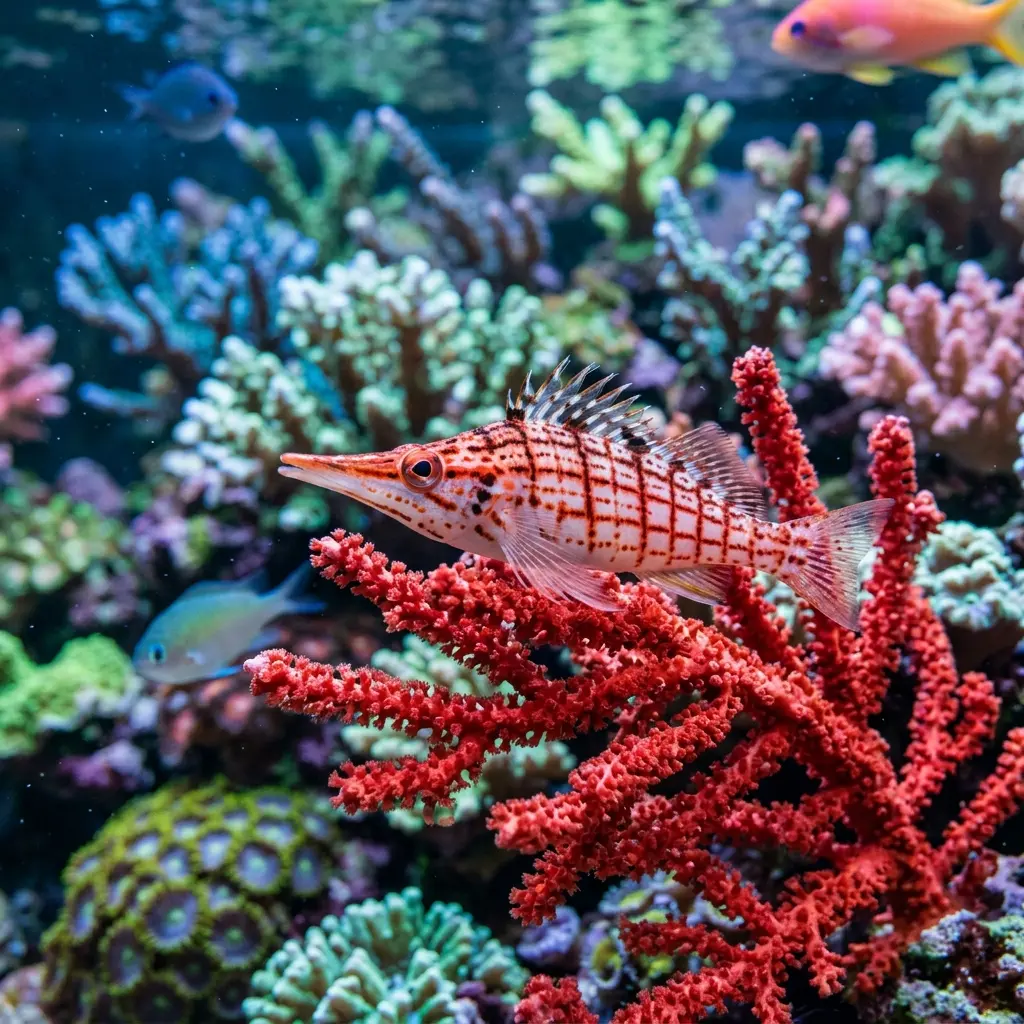
The Longnose Hawkfish (Oxycirrhites typus) is one of the most distinctive and behaviorally fascinating marine fish in the aquarium hobby. Named for its extraordinarily elongated, tapered snout and bold red-and-white crosshatch pattern, this small predator combines striking aesthetics with unique physiological adaptations that set it apart from virtually every other aquarium fish. It is the sole member of its genus, making it truly one-of-a-kind.
Natural History
Native to the tropical Indo-Pacific, from the Red Sea and eastern Africa across to southern Japan, Hawaii, New Caledonia, and the Galapagos Islands, this species inhabits steep outer reef slopes at depths of 10 to 100 meters (33 to 328 feet). Unlike most hawkfish that live in shallow water, the longnose prefers deeper zones where large gorgonian sea fans and black coral (Antipathes spp.) colonies dominate the landscape. Water at these depths is cool, highly oxygenated, and subjected to strong, steady currents.
Physical Characteristics
Adults reach a maximum length of 5.0 inches (13.0 cm), though most aquarium specimens remain closer to 4.0 inches (10 cm). The elongated snout accounts for roughly one-third of the total head length and narrows to a fine point tipped with a small, upturned mouth. The body is white to pale cream, covered in a precise grid of red horizontal and vertical lines that form a distinctive checkerboard or tartan-like pattern. The dorsal fin features characteristic cirri (small pom-pom-like tassels) at the ray tips when the fish is relaxed. The tail is truncate (squared off), and the pectoral fins have elongated, unbranched lower rays used for perching.
Key Identification Features
- Extraordinarily elongated, pointed snout (unique among hawkfish)
- Red crosshatch grid pattern on white to pale cream body
- Cirri (tassels) visible on dorsal fin ray tips
- Truncate (squared) tail fin
- Elongated pectoral fin rays for perching propulsion
- Complete absence of a swim bladder
Unique Physiological Adaptation
All members of the family Cirrhitidae, including the longnose hawkfish, lack a swim bladder entirely. This absence is not a defect but a remarkable evolutionary adaptation. Without a gas-filled bladder, these fish can rapidly change depth without experiencing decompression sickness, allowing them to move freely through the water column. However, this also means they cannot hover in place like most fish and must instead rest on solid surfaces, propelling themselves with their pectoral fins. This adaptation explains their distinctive perching behavior and their ability to be rapidly decompressed after capture by divers.
Diet
Dietary Requirements
Longnose Hawkfish are obligate carnivores with a diet consisting primarily of small benthic and free-swimming crustaceans in the wild. Their elongated snout is a precision feeding tool designed to probe into narrow crevices within gorgonian branches and black coral thickets to extract hiding shrimp, copepods, and amphipods. Their conical teeth are modified specifically for grasping crustaceans, not tearing flesh.
Recommended Foods
- Frozen mysis shrimp (staple food, highest acceptance rate)
- Fortified brine shrimp (nutritionally enriched, not plain brine shrimp)
- Chopped krill (appropriate size pieces for the small mouth)
- Chopped silversides or other marine fish flesh
- High-quality marine carnivore pellets (transition food for convenience)
- Live foods: live brine shrimp, ghost shrimp, or small marine crustaceans for enrichment
Feeding Schedule
Feed small portions 1-2 times daily. Offer only what the fish can consume in 2-3 minutes. Overfeeding leads to obesity, which is common in captive hawkfish due to their sedentary perching lifestyle. Target feeding with a pipette or feeding stick delivers food directly to the hawkfish, reducing competition from faster tank mates and minimizing waste.
Foods to Avoid
- Feeder goldfish or freshwater fish (nutritionally inappropriate, disease vectors)
- Beef heart or mammalian proteins (cannot be digested properly by marine carnivores)
- Plain, unenriched brine shrimp (nutritionally deficient as a staple)
- Large food items that cannot be swallowed whole (hawkfish have small mouths)
Transitioning Wild-Caught Specimens
Wild-caught longnose hawkfish may initially refuse prepared foods. Begin with live brine shrimp or ghost shrimp to stimulate the feeding response. Gradually mix in frozen mysis shrimp over 1-2 weeks. Be patient; some individuals require 7-14 days to accept non-live foods. Use target feeding to ensure the hawkfish receives adequate nutrition during the transition period.
Health
Health and Disease Management
Longnose Hawkfish are notably hardy and disease-resistant compared to many marine aquarium fish. In fact, other fish in a system will typically show symptoms of disease and succumb before a resident hawkfish does. They are not particularly sensitive to standard marine medications or treatments. However, their unique physiology and behavior create specific health vulnerabilities that aquarists must understand.
Snout Abrasion
The most common physical ailment in wild-caught specimens is snout abrasion. During capture, the elongated snout is often scraped against nets, rocks, or transport containers. A damaged snout heals slowly and can lead to secondary bacterial infections. You must inspect the snout closely before purchasing; avoid specimens with visible scrapes, redness, or tissue loss on the nose tip.
Physical Injury from Jumping
Because they lack a swim bladder, hawkfish can launch themselves with surprising force. Jumping from an uncovered tank often results in fatal desiccation or physical trauma. Even with a lid, repeated impact against the canopy can cause fin damage or scale loss. Ensure the lid is solid, not mesh, to cushion impacts.
Obesity
Their sedentary perching lifestyle makes obesity a common problem in captivity. Overfed hawkfish develop fatty deposits that stress internal organs and shorten lifespan. Strict portion control and a varied, protein-appropriate diet are essential.
Marine Ich (Cryptocaryon irritans)
The most common parasitic infection in marine aquariums. A ciliated protozoan that burrows into the skin and gills, causing white salt-like cysts.
Introduction via new fish, invertebrates, or contaminated equipment. Triggered by stress, temperature fluctuations, or poor water quality weakening immune response.
Quarantine all new specimens for 2-4 weeks. Maintain stable temperature between 75-77°F (24-25°C). If infected, remove to a hospital tank and treat with copper (0.15 mg/L Cupramine) for 21-30 days at stable therapeutic levels. Do not treat in the display reef tank as copper is lethal to invertebrates.
Marine Velvet (Amyloodinium ocellatum)
A dinoflagellate parasite that is more dangerous than ich due to its rapid progression and gill infestation. Often fatal if not treated immediately.
- Dusty, velvety gold or brown coating on skin, labored breathing, clamped fins, lethargy, loss of appetite, rapid death. Gill infestation may occur without visible skin symptoms.
Introduction via new fish or contaminated live foods. The parasite has a photosynthetic stage, making it particularly virulent in well-lit tanks. Spreads rapidly through the water column.
Quarantine all new specimens. Treat with copper (0.15 mg/L Cupramine) or chloroquine phosphate (15 mg/L) in a hospital tank. Marine velvet progresses faster than ich; treatment must begin within 24-48 hours of symptom observation. A 6-week fallow period is required for the display tank if velvet is diagnosed.
Bacterial Fin Rot (Vibrio / Aeromonas)
Bacterial infection causing frayed, discolored, or receding fins. Often secondary to physical injury, poor water quality, or snout abrasion.
- Frayed or ragged fin edges, redness at fin base, fins appearing shorter than normal, possible white edge on fin margins, lethargy.
Vibrio, Aeromonas, or Pseudomonas bacteria. Triggered by ammonia/nitrite spikes, high nitrates (above 20 ppm), physical damage from jumping or rough handling, or snout abrasion providing an entry point.
Maintain pristine water quality with nitrates below 15 ppm. Avoid physical injury by providing a secure lid and stable perches. Treat with broad-spectrum antibiotics (e.g., kanamycin, nitrofurazone) in a hospital tank. Hawkfish tolerate standard antibiotic treatments well.
Snout Abrasion with Secondary Infection
Physical damage to the elongated snout, common in wild-caught specimens, leading to bacterial or fungal secondary infections.
- Visible scrapes, redness, or tissue loss on the snout tip, white cottony fungal growth on damaged tissue, refusal to eat, lethargy, rapid breathing.
Capture and transport trauma. Net abrasion, scraping against rocks during collection, or rough handling by dealers. The thin skin on the snout is easily damaged and slow to heal.
Inspect the snout meticulously before purchase. Reject any specimen with visible damage. If abrasion occurs in your tank, perform daily 10% water changes and treat with a mild antiseptic bath (e.g., dilute Betadine) or broad-spectrum antibiotics if secondary infection develops. Provide pristine water conditions to promote healing.
Obesity and Fatty Liver Disease
Excessive weight gain due to overfeeding and sedentary lifestyle, leading to hepatic lipidosis and reduced lifespan.
- Bulging abdomen, loss of the streamlined body profile, reduced activity, difficulty perching, faded coloration, shortened lifespan.
Overfeeding, reliance on high-fat foods (e.g., excessive krill or silversides), lack of exercise due to insufficient tank size or poor layout, feeding too frequently.
Feed small portions 1-2 times daily only. Rotate food types to ensure nutritional balance. Provide adequate swimming space and multiple perches to encourage movement. If obesity is detected, reduce feeding frequency to once daily and increase the proportion of low-fat foods like mysis shrimp.
Breeding
Breeding Longnose Hawkfish
Breeding Oxycirrhites typus in captivity is considered extremely challenging and has never produced fry that survived to maturity. The primary obstacles are their protogynous sequential hermaphroditism, extreme territoriality, specialized pelagic spawning behavior, and the demanding larval rearing requirements.
Protogynous Sequential Hermaphroditism
All longnose hawkfish begin life as females. The largest, most dominant individual in a social group undergoes a sex change to become male, a process governed by social hierarchy and aggression-mediated suppression of brain aromatase. Males develop black margins on the pelvic and caudal fins, though this dimorphism is subtle and best observed in mature specimens. In a home aquarium, attempting to create a compatible male-female pair is exceptionally difficult because the fish will likely fight before a stable social hierarchy can establish the sex change.
Natural Spawning Behavior
Spawning occurs at sunset in the wild. The male approaches the female with his dorsal fin erect. The pair engages in a circling courtship dance with periodic rest periods (they lack a swim bladder, so sustained swimming is exhausting). Immediately before spawning, the pair lines up in parallel and swims directly upward from their coral perch. At the apex of their ascent, they turn downward, flex, and release pelagic eggs and sperm before returning to the coral. The male may then move to another female in his territory to repeat the process.
Captive Spawning Attempts
A few aquarists have reported successful courtship and egg release in large reef tanks, but the eggs are pelagic and drift into filtration systems. To attempt spawning: Condition a bonded pair (if obtainable) in a 75+ gallon (283+ liter) tank with heavy feeding of frozen mysis for 4-6 weeks. Simulate sunset with gradual dimming of lights. Provide significant vertical swimming space for the characteristic spawning rise. If eggs are released, they must be collected immediately and transferred to a dedicated larval rearing tank.
Larval Rearing
Hawkfish larvae are tiny, fragile, and pelagic. They require specialized foods including marine rotifers, copepods, and phytoplankton for 30-40 days. Metamorphosis occurs at approximately 0.6 inches (1.5 cm). The larvae are highly sensitive to water quality changes, mechanical damage from pumps, and starvation. Gentle aeration via airstones (not powerheads) is required. Water changes must be minimal in early stages. This level of specialized larval rearing is beyond the capabilities of virtually all home aquarists and has not been successfully accomplished for this species.
Commercial Reality
As of 2026, no commercial aquaculture operation has successfully closed the life cycle of Oxycirrhites typus. All specimens in the aquarium trade remain wild-caught. This underscores the extreme difficulty of captive breeding for this species.
Compatible Tank Mates
Species Comparison
| Feature | Longnose Hawkfish | Flame Hawkfish | Dwarf Hawkfish | Arc-eye Hawkfish |
|---|---|---|---|---|
| Maximum Size | 5.0 in (13.0 cm) | 3.5 in (9.0 cm) | 2.75 in (7.0 cm) | 7.9 in (20.0 cm) |
| Temperament | Semi-aggressive, solitary | Aggressive, territorial | Semi-aggressive, active | Aggressive, predatory |
| Minimum Tank Size | 30 gal (113 L); 40+ gal preferred | 30 gal (113 L) | 10 gal (38 L) | 75 gal (283 L) |
| Reef Safety (Corals) | Yes with robust corals | Yes with robust corals | Yes with robust corals | Caution - larger, more damaging |
| Shrimp Safety | No - will eat ornamental shrimp | No - will eat ornamental shrimp | No - will eat small shrimp | No - will eat all crustaceans |
| Unique Feature | Elongated snout, red grid pattern, no swim bladder | Bright scarlet red coloration | Smallest hawkfish, yellow dorsal cirri | Horseshoe arc behind eye, large size |