
Sparkling Gourami (Trichopsis pumila)
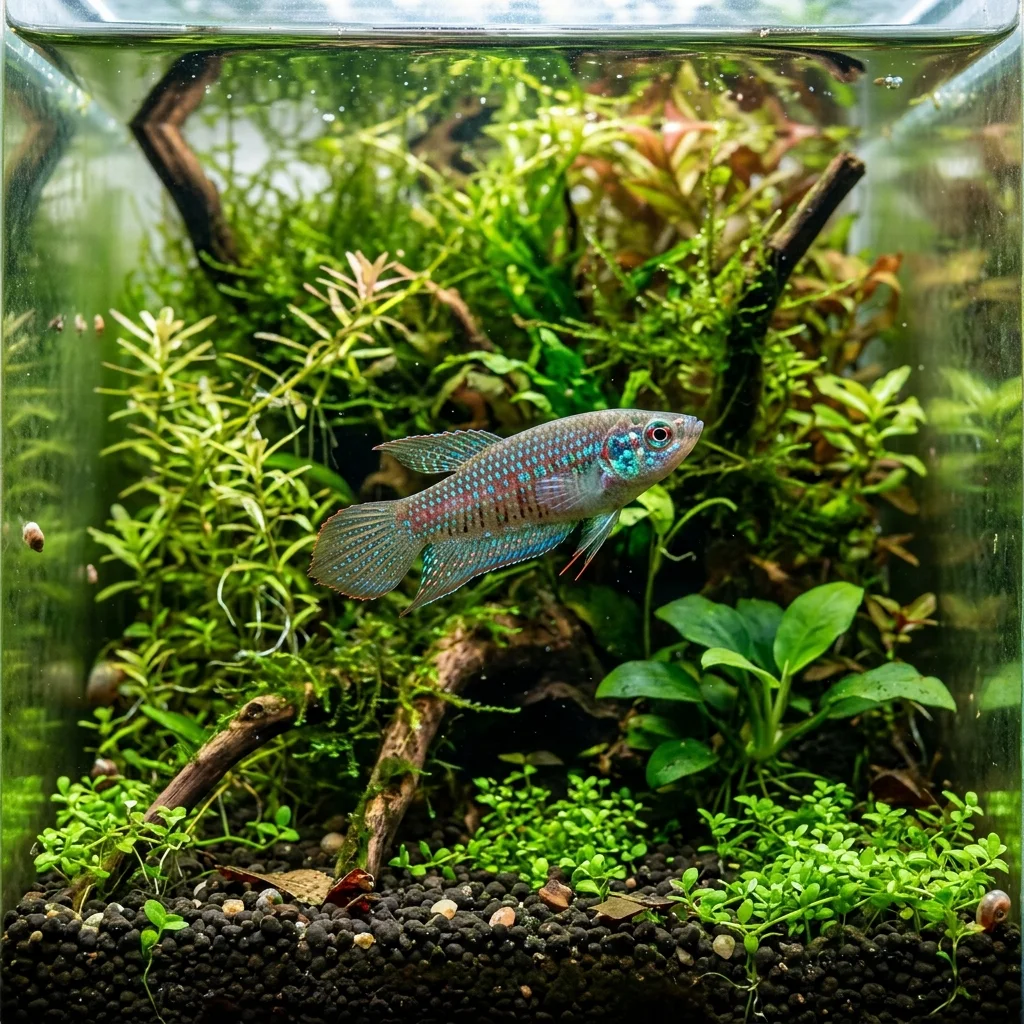
Quick Answer
The Sparkling Gourami (Trichopsis pumila) is the smallest gourami in the freshwater aquarium hobby, reaching 1.6 inches (4 cm). It requires a minimum 10-gallon nano aquarium with soft, acidic water (pH 6.0 to 7.5), temperature 76 to 82 degrees Fahrenheit (24 to 28 degrees Celsius), and dense floating plant cover. This omnivorous micro-predator produces audible croaking sounds and is immune to Dwarf Gourami Iridovirus.
Quick Facts
| Scientific Name | Trichopsis pumila |
|---|---|
| Common Names | Sparkling Gourami |
| Family | Osphronemidae |
| Genus | Trichopsis |
| Type | Freshwater |
| Temperament | peaceful |
| Care Difficulty | beginner |
| Lifespan | 5 years |
| Maximum Size | Up to 1.6 in (4 cm) |
| Diet | Omnivore |
| Temperature | 74–82°F (23–28°C) |
| pH | 6–7.5 |
| Hardness | 2–10 dGH |
| Minimum Size | 10 gallons |
Key Takeaways
- Smallest gourami species at 1.6 inches (4 cm); ideal for nano tanks.
- Produces audible croaking sounds via pectoral fin stridulation during courtship.
- Immune to Dwarf Gourami Iridovirus (DGIV), unlike Trichogaster lalius.
- Requires floating plants and calm surface water for labyrinth organ function.
- Breeds readily as a bubble nester with paternal care of 70-180 eggs per spawn.
Overview
Species Overview
The Sparkling Gourami (Trichopsis pumila) is the smallest member of the gourami family (Osphronemidae) in the freshwater aquarium hobby and one of the very few aquarium fish species that produces audible sounds audible to the human ear without specialized equipment. Adults reach a maximum of 1.6 inches (4 cm) and display a breathtaking mosaic of iridescent blue and green spots across a warm pink-tan body, with electric-blue eyes and red and blue fin margins that intensify under dim, tannin-stained conditions.
Natural History and Distribution
This species is native to the slow-moving swamps, rice paddies, forest streams, and oxbow lakes of Thailand, Cambodia, Vietnam, and southern Laos. Wild habitats are characterized by warm, soft, acidic blackwater with dense emergent and floating vegetation, submerged leaf litter, and minimal water flow. Water temperatures in native habitats range from 76 to 82 degrees Fahrenheit (24 to 28 degrees Celsius), with pH values between 5.5 and 7.0 and general hardness as low as 2 dGH. The aquarium trade relies on both captive-bred and wild-caught stock; wild-caught specimens demand strict blackwater parameters, while captive-bred fish show greater adaptability.
Physical Characteristics
Adult males reach 1.6 inches (4 cm) and females typically mature at 1.2 to 1.4 inches (3 to 3.5 cm). Sexual dimorphism is subtle but reliable: males possess more pointed dorsal and anal fins, brighter red and blue fin edging, and a slightly more slender profile. Females have a rounder abdomen, particularly when gravid, and shorter, more rounded finnage. Both sexes display the characteristic lateral iridescent speckling and the signature electric-blue eye. The croaking mechanism involves modified ctenoid teeth on the pectoral fin rays that rub against the operculum during display.
Diet
Dietary Requirements and Feeding Protocol
Sparkling Gouramis are micro-predators with small mouths and specific macronutrient needs. Their diminutive size makes them vulnerable to starvation in community tanks with faster competitors.
Health
Health Management and Disease Protocol
Sparkling Gouramis are reasonably hardy in stable, appropriate conditions, but their labyrinth organ physiology and small size create unique vulnerabilities. Proactive management is vastly superior to reactive treatment.
Piscinoodinium (Velvet Disease)
A dinoflagellate parasite that produces a golden, dust-like coating on the skin, fins, and gills. Particularly lethal to labyrinth fish due to rapid invasion of the labyrinth organ.
- Fine gold or rust-colored metallic dust visible on the body and fins, especially under flashlight; excessive mucus production; clamped fins; lethargy; respiratory distress at the water surface; loss of appetite.
Introduction via unquarantined stock; bright lighting that promotes parasite photosynthesis; stress from poor water quality or incompatible tank mates; and temperature fluctuations.
Quarantine all additions for 21 days. Dim lighting during outbreaks to reduce parasite photosynthesis. Treat with copper-free anti-parasitic medication or aquarium salt at 1 tablespoon per 5 gallons. Raise temperature to 82 to 84 degrees Fahrenheit (28 to 29 degrees Celsius) to accelerate parasite life cycle. Remove activated carbon during treatment.
Ichthyophthirius multifiliis (Ich / White Spot Disease)
A ciliated protozoan parasite that infects the skin and gills, producing characteristic white cysts. Labyrinth fish are particularly vulnerable due to gill and labyrinth organ invasion.
- White salt-like granules on fins, body, and gills; flashing against decor; rapid breathing; clamped fins; isolation from the group; and scratching against substrate.
Introduction via unquarantined fish, plants, or decor; temperature fluctuations below 74 degrees Fahrenheit (23 degrees Celsius) that compromise immune function; and stress from poor water quality or aggressive tank mates.
Quarantine all additions for 21 days. Maintain stable temperature between 76 and 82 degrees Fahrenheit (24 and 28 degrees Celsius). Use formalin-malachite green combination at quarter-strength with increased aeration. Raise temperature to 82 degrees Fahrenheit (28 degrees Celsius) to accelerate the parasite life cycle. Never use full-strength malachite green on labyrinth fish.
Bacterial Fin Rot and Septicemia
Secondary bacterial infections typically caused by Aeromonas or Pseudomonas species following physical damage, parasite infestation, or water quality decline.
- Frayed or receding fin margins; red streaks at the fin base; ulcerative lesions on the body; bloating; popeye (exophthalmia); and loss of coloration.
Maintain pristine water parameters with zero ammonia and nitrite. Treat underlying parasites before addressing secondary bacteria. Use broad-spectrum antibiotics such as kanamycin or nitrofurazone in a quarantine tank only. Never treat the display tank with antibiotics, as this crashes biological filtration. Keep the aquarium away from chemical aerosols and smoke.
Gill Flukes (Dactylogyrus)
Monogenean trematode worms that attach to gill filaments, causing respiratory compromise and secondary bacterial infection in small labyrinth fish.
- Rapid breathing; gasping at the surface; flashing against substrate; pale gills; reduced feeding response; and lethargy.
Introduction via unquarantined fish; overcrowding in nano tanks; and poor water circulation that allows fluke larvae to concentrate.
Maintain gentle surface agitation and avoid overcrowding. Treat with praziquantel at 2.5 mg/L for 3 days, followed by a 25% water change. Repeat in 7 days to catch emerging larvae. Praziquantel is safe for Sparkling Gouramis at labeled dosages.
Internal Bacterial Infection and Dropsy
Systemic bacterial infection causing fluid accumulation in the body cavity. Common in stressed labyrinth fish with compromised immune systems.
- Bloated, pinecone-like scales (dropsy); stringy white feces; loss of appetite; lethargy; and darkening of coloration.
Chronic poor water quality; overfeeding; introduction via contaminated live foods; and stress from bright lighting, strong currents, or aggressive tank mates.
Maintain nitrates below 10 ppm with weekly 20% water changes. Feed high-quality, pathogen-free foods. Treat with kanamycin in a quarantine tank at the first sign of bloating. Epsom salt baths at 1 tablespoon per 5 gallons can reduce fluid retention but are not a cure. Advanced dropsy has a poor prognosis; prevention is the only reliable strategy.
Breeding
Breeding Sparkling Gouramis in Captivity
Breeding Sparkling Gouramis is achievable for dedicated aquarists and provides one of the most fascinating displays of parental care in nano aquariums. Success depends on conditioning, environmental triggers, and meticulous fry management.
Compatible Tank Mates






Species Comparison
| Feature | Sparkling Gourami | Dwarf Gourami | Honey Gourami | Pearl Gourami |
|---|---|---|---|---|
| Scientific Name | Trichopsis pumila | Trichogaster lalius | Trichogaster chuna | Trichopodus leerii |
| Max Size | 1.6 in (4 cm) | 2 in (5 cm) | 2 to 2.5 in (5 to 6 cm) | 4 to 5 in (10 to 13 cm) |
| Temperament | Peaceful; males territorial in small tanks | Peaceful; males territorial | Very peaceful; minimal aggression | Peaceful; shy when young |
| Minimum Tank Size | 10 gal (38 L) for 4-6 | 10 gal (38 L) for pair | 10 gal (38 L) for pair | 30 gal (114 L) minimum |
| Temperature Range | 76-82 F (24-28 C) | 77-86 F (25-30 C) | 72-82 F (22-28 C) | 77-82 F (25-28 C) |
| pH Range | 6.0 - 7.5 (adaptable) | 6.0 - 7.5 | 6.0 - 7.5 | 6.5 - 8.0 |
| Water Hardness | 2-10 dGH (soft preferred) | 4-12 dGH | 2-20 dGH (very adaptable) | 5-20 dGH |
| Diet | Micro-predator; tiny foods required | Omnivore; standard flakes accepted | Omnivore; standard flakes accepted | Omnivore; larger pellets accepted |
| Disease Risk | Immune to Dwarf Gourami Iridovirus | High risk of DGIV (100% fatal) | Low risk of DGIV | Immune to DGIV |
| Unique Trait | Audible croaking via pectoral fin stridulation | Vibrant color morphs (Flame, Neon Blue) | Sexual dimorphism (male bright yellow/orange) | Largest peaceful gourami; long ventral fins |