Upside-Down Catfish (Synodontis nigriventris)
Quick Answer
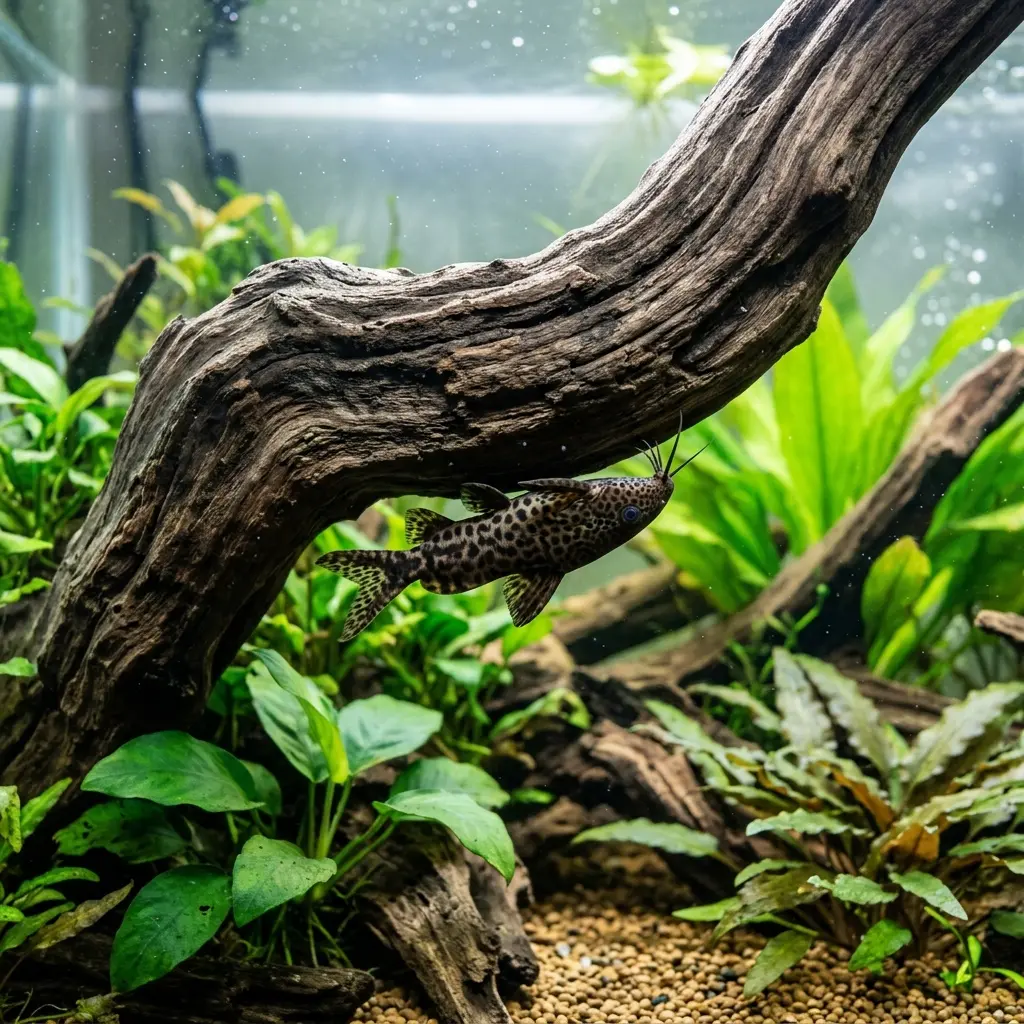
Upside-Down Catfish (Synodontis nigriventris) is a unique African catfish from the Central Congo River basin. It requires a minimum 30 gallon (113 liter) aquarium with a pH of 6.0 - 7.5 and temperature range of 72-82°F (22-28°C). This peaceful omnivore occupies all tank levels and makes an excellent addition to community setups when kept in groups of 3 or more.
Quick Facts
| Scientific Name | Synodontis nigriventris |
|---|---|
| Common Names | Upside-Down Catfish |
| Family | Mochokidae |
| Genus | Synodontis |
| Type | Freshwater |
| Temperament | peaceful |
| Care Difficulty | beginner |
| Lifespan | 10 years |
| Maximum Size | Up to 3.8 in (10 cm) |
| Diet | Omnivore |
| Temperature | 72–82°F (22–28°C) |
| pH | 6–7.5 |
| Hardness | 4–15 dGH |
| Minimum Size | 30 gallons |
Key Takeaways
- Known for its peaceful temperament and unique upside-down swimming behavior.
- Requires a minimum 30 gallon (113 liter) aquarium with a group of 3 or more.
- Sensitive to nitrates; requires weekly water changes and soft sand substrate.
- Primarily nocturnal; feed in the evening and use moonlight LEDs for observation.
- Can live 10-15 years with proper care; some specimens exceed 20 years.
Overview
Species Overview
The Upside-Down Catfish (Synodontis nigriventris) is one of the most fascinating and behaviorally unique catfish in the aquarium hobby. Named for its distinctive habit of swimming and resting belly-up, this small African catfish has captivated aquarists for centuries and is even depicted in ancient Egyptian art. It is one of the smallest members of the genus Synodontis, making it suitable for community aquariums that can accommodate its social needs.
Natural History
Native to the middle Congo River basin, including Pool Malebo (Stanley Pool) and the drainages of the Kasai and Ubangi rivers, this species inhabits densely vegetated areas along riverbanks. They are also reported from the Kouilou-Niari basin in the Republic of the Congo. In the wild, they spend most of their time swimming upside down beneath submerged branches and floating vegetation, feeding on insect larvae at the water surface.
Physical Characteristics
Adults reach a maximum length of 3.8 inches (9.6 cm). They possess large eyes, a prominent adipose fin, a forked tail, and three pairs of barbels. Their light brown bodies are marked with dark brown blotches of varying sizes. Crucially, they exhibit reverse countershading: their bellies are darker than their backs, which serves as camouflage when viewed from below while they feed at the surface.
Key Identification Features
- Dark blotched pattern on light brown base color
- Three pairs of barbels (maxillary and mandibular)
- Sharp, lockable dorsal and pectoral fin spines
- Prominent adipose fin
- Reverse countershading (dark belly, light back)
Diet
Dietary Requirements
Upside-Down Catfish are true omnivores with a strong preference for protein-rich foods. In the wild, they feed primarily on surface-dwelling insects, insect larvae, crustaceans, and plant matter. Their upside-down swimming posture is an evolutionary adaptation that allows them to access food on the undersides of submerged branches, floating vegetation, and the water surface.
Recommended Foods
- Sinking catfish pellets (high-quality, 35-40% protein)
- Sinking algae wafers for vegetable matter
- Frozen bloodworms and blackworms (2-3 times per week)
- Live foods: mosquito larvae, daphnia, brine shrimp
- Vegetables: blanched zucchini, cucumber slices, shelled peas
- Flake foods that sink slowly, allowing surface grazing
Feeding Schedule
Feed once daily in the evening when the lights dim, as these fish are primarily nocturnal. Provide only what they can consume in 2-3 minutes. They will also graze on biofilm and algae between feedings. A varied diet prevents nutritional deficiencies and maintains their vibrant coloration.
Foods to Avoid
- Beef heart and mammalian proteins (difficult to digest, can cause bloat)
- Excess fatty foods (can lead to fatty liver disease)
- Large, hard pellets that cannot be swallowed whole
Health
Health and Disease Management
Upside-Down Catfish are generally hardy but are sensitive to poor water quality, particularly elevated nitrates. Their scaleless skin and delicate barbels make them vulnerable to certain medications and rough substrates. Preventive care through pristine water conditions is far more effective than reactive treatment.
Water Quality Sensitivity
These fish are particularly sensitive to nitrate accumulation. Levels above 20 ppm can cause chronic stress, reduced immunity, and barbel erosion. Maintain weekly 25-30% water changes and ensure your filter is adequately sized for the bioload. They also require well-oxygenated water; low dissolved oxygen causes gasping and lethargy.
Scaleless Fish Medication Protocol
While scientific literature debates the scaleless fish medication sensitivity myth, conservative treatment is advised. Avoid formalin-based treatments. Copper is tolerated up to 0.15 mg/L. Use malachite green at quarter strength (0.025 mg/L). Praziquantel is safe for internal parasites. Salt treatments should not exceed 3 ppt (parts per thousand). Always quarantine new specimens with metronidazole at half-strength to prevent internal parasite introduction.
Fin Rot (Bacterial)
Bacterial infection causing frayed, discolored, or receding fins, often triggered by poor water quality or elevated nitrates.
- Frayed or ragged fin edges, redness at fin base, fins appearing shorter than normal, lethargy, loss of appetite.
Maintain nitrates below 20 ppm through regular water changes. Use smooth decorations. Quarantine new fish. Treat with broad-spectrum antibiotics (e.g., kanamycin) at standard dose; Synodontis tolerate this well.
Ich (Ichthyophthirius multifiliis)
Protozoan parasite causing white salt-like spots on body and fins. Less common in Synodontis but can occur during temperature fluctuations or stress.
- White cysts resembling salt grains on skin and fins, flashing against decor, rapid breathing, clamped fins.
Introduction via new fish, plants, or equipment. Triggered by temperature drops or stress weakening immune response.
Quarantine all new additions for 4 weeks. Maintain stable temperature between 75-79°F (24-26°C). If infected, raise temperature gradually to 82°F (28°C) maximum and treat with half-dose malachite green or copper (0.15 mg/L max). Avoid formalin.
Barbel Erosion
Gradual shortening and fraying of the sensitive barbels, severely impacting the fish’s ability to locate food and navigate.
- Shortened, frayed, or missing barbels, difficulty finding food, increased vulnerability to secondary infections.
Rough substrate (sharp gravel, crushed coral), high nitrate levels (above 20 ppm), bacterial infection in tank with poor water quality.
Use soft sand substrate exclusively. Maintain nitrates below 15 ppm. Provide pristine water conditions. Barbel damage is often permanent; prevention is the only cure.
Internal Parasites (Hexamita, Tapeworms)
Common in wild-caught specimens. Internal protozoans or worms cause wasting, stringy feces, and reduced immunity.
- Weight loss despite normal appetite, white stringy feces, sunken belly, lethargy, faded coloration.
Introduction via wild-caught fish or contaminated live foods. More common in specimens collected from the Congo basin than tank-bred fish.
Quarantine all new specimens for 4-6 weeks. Prophylactic treatment with metronidazole (half-strength) and praziquantel during quarantine. Purchase tank-bred specimens when possible.
Columnaris (Flexibacter columnaris)
Bacterial infection causing cotton-like patches on mouth, fins, or body. Can progress rapidly if water quality is poor.
- White or grayish cottony patches on mouth, fins, or body, frayed fins, lethargy, loss of appetite, rapid breathing.
Flexibacter columnaris bacteria. Triggered by stress, poor water quality, overcrowding, or temperature fluctuations above 82°F (28°C).
Maintain stable water parameters. Avoid overcrowding. Treat immediately with kanamycin or nitrofurazone. Increase aeration during treatment. Reduce feeding to minimize organic load.
Breeding
Breeding Upside-Down Catfish
Breeding Synodontis nigriventris in home aquaria is considered extremely difficult and largely accidental. The only known commercial breeding operation in the United States uses hormone injections followed by manual egg and sperm stripping. Natural spawning triggers appear to be absent in captive environments, though some hobbyists have reported accidental spawnings.
Sexual Dimorphism
Females are larger, paler, and have plumper, more rounded bodies, especially when gravid. Males are slightly smaller, darker in coloration, and have a more pointed genital papilla behind the vent. These differences are subtle and best observed in mature, well-conditioned specimens.
Natural Spawning Triggers
In the wild, breeding is believed to be triggered by the onset of the rainy season, which brings cooler water, increased water flow, and changes in water chemistry. To simulate this in captivity:
- Condition a group of 5-6 adults with live blackworms and bloodworms for 4 weeks
- Lower the water level to 8 inches (20 cm)
- Raise temperature to 80°F (27°C)
- Perform a 40% water change with cool (68°F/20°C) soft water over 2 hours
- Provide clay pots or PVC caves as spawning sites
Egg Care and Fry Rearing
If spawning occurs, the female lays 100-300 adhesive eggs inside a cave. The male tends the clutch for 4-6 days. Eggs hatch into 0.2 inch (5 mm) fry that accept baby brine shrimp and microworms. Remove the male after hatching to prevent egg/fry predation. Fry are sensitive to water quality; maintain pristine conditions and gentle filtration.
Commercial Breeding Reality
The only known U.S. commercial breeder produces 1,000-2,000 eggs per spawn using hormone-induced spawning. This underscores the difficulty of natural captive breeding. Hobbyists should not attempt breeding unless experienced with challenging catfish species.
Compatible Tank Mates
Species Comparison
| Feature | Upside-Down Catfish | Corydoras (Bronze) | Otocinclus | Bristlenose Pleco |
|---|---|---|---|---|
| Maximum Size | 3.8 in (9.6 cm) | 2.5-3 in (6.4-7.6 cm) | 1.5-2 in (3.8-5.1 cm) | 4-5 in (10-13 cm) |
| Temperament | Peaceful, shy | Peaceful, active | Peaceful, skittish | Peaceful, territorial |
| Minimum Tank Size | 30 gal (113 L) for group | 20 gal (75 L) for 6+ | 10 gal (38 L) for 6+ | 30 gal (113 L) for 1 |
| Primary Diet | Omnivore: insects, algae, pellets | Omnivore: detritus, pellets, worms | Herbivore: algae, biofilm | Herbivore: algae, wood, vegetables |
| pH Range | 6.0 - 7.5 | 6.0 - 7.5 | 6.5 - 7.5 | 6.5 - 7.5 |
| Social Behavior | Schools of 3+; upside-down swimming | Schools of 6+; active shoaling | Schools of 6+; algae grazing | Solitary; cave-dwelling |