Comet Goldfish Care Guide (Carassius auratus)
Quick Answer
Comet Goldfish are large, active cold-water cyprinids requiring a minimum 55-gallon (208-liter) aquarium per fish, temperatures between 60 and 75°F (15.5 to 24°C), and powerful filtration rated at 8 to 10 times tank volume per hour. They live 15 to 20 years, reach 12 to 14 inches (30 to 36 cm) in ponds, and thrive on a varied omnivorous diet with 30 to 40 percent protein and high vegetable fiber.
Quick Facts
| Scientific Name | Carassius auratus |
|---|---|
| Common Names | Comet Goldfish |
| Family | Cyprinidae |
| Genus | Carassius |
| Type | Freshwater |
| Temperament | peaceful |
| Care Difficulty | beginner |
| Lifespan | 20 years |
| Maximum Size | Up to 14 in (36 cm) |
| Diet | Omnivore |
| Temperature | 60–75°F (16–24°C) |
| pH | 6.5–8 |
| Hardness | 5–19 dGH |
| Minimum Size | 55 gallons |
Key Takeaways
- Minimum 55 gallons (208 L) per adult; 48-inch (122 cm) length mandatory
- Powerful filtration essential: 8 to 10x tank volume per hour
- Cold-water species: 60 to 75°F (15.5 to 24°C); incompatible with tropical tanks
- Heavy waste producers requiring 30 to 50% weekly water changes
- Live 15 to 20 years with proper care; world record exceeds 43 years
- Gregarious and intelligent; keep in groups of 3 or more for psychological health
- Sensitive to copper medications; use salt and Praziquantel as first-line treatments
- Never keep in bowls, unfiltered containers, or tanks under 30 gallons
Overview
Species Overview
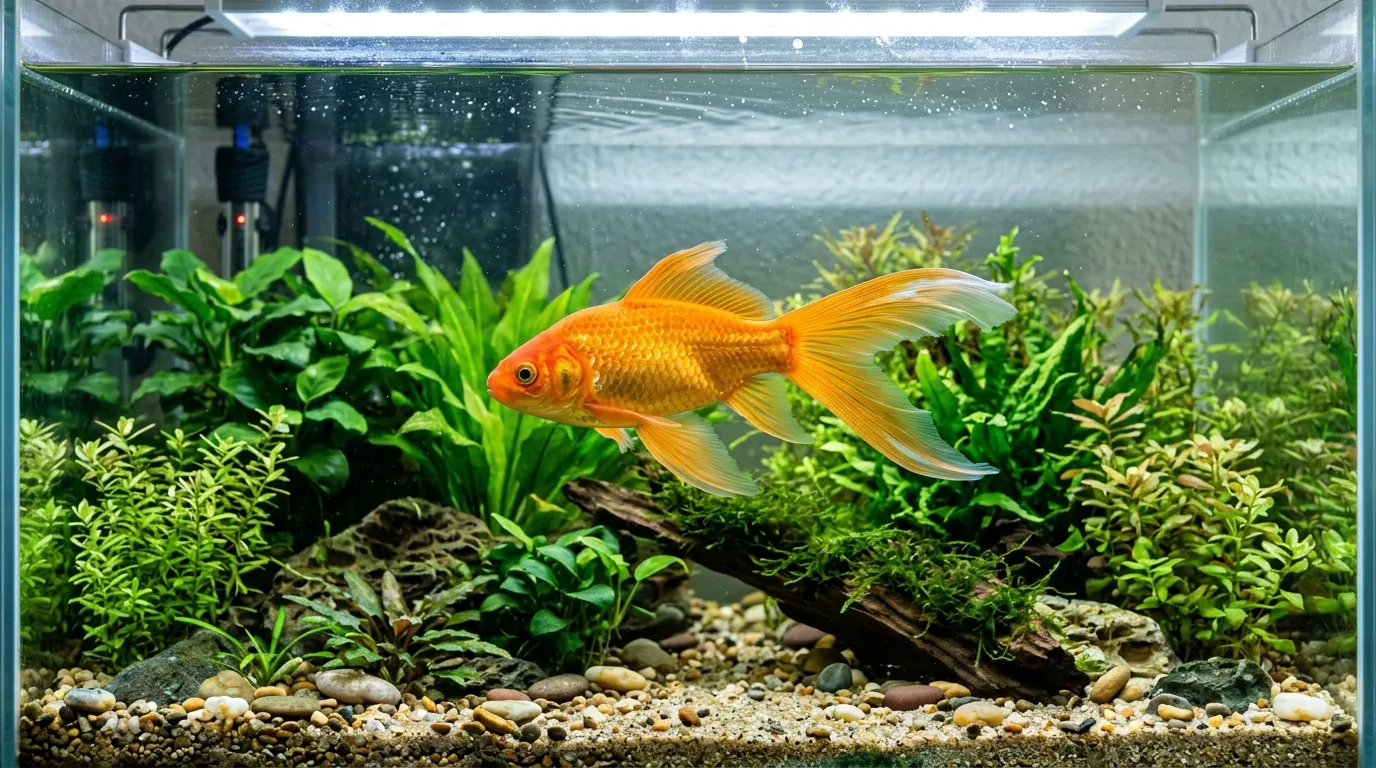
The Comet Goldfish (Carassius auratus) is the most widely kept ornamental fish variety in North America and one of the hardiest single-tail goldfish strains available to aquarists. Developed in the United States circa 1880 by Hugo Mulertt in Washington D.C., the Comet distinguished itself from the Common Goldfish through selective breeding for an elongated, deeply forked caudal fin that can equal or exceed the body length, a more streamlined fusiform body, and intensified metallic red-orange coloration.
Unlike fancy goldfish varieties with compressed bodies and delicate finnage, Comets possess robust physioplogy that tolerates temperature extremes, variable water chemistry, and less-than-perfect husbandry. However, this hardiness creates a dangerous misconception among novice aquarists that Comets survive in bowls, tiny tanks, or unfiltered containers. This is categorically false. A Comet Goldfish is a large, active, cold-water cyprinid that produces substantial metabolic waste, requires significant swimming volume, and lives 15 to 20 years under optimal conditions. The current world-record captive lifespan exceeds 43 years.
Physical Characteristics
Adult Comets reach 12 to 14 inches (30 to 36 cm) in total length in ponds, though aquarium specimens typically stabilize at 6 to 8 inches (15 to 20 cm) due to environmental constraints. They possess a single dorsal fin, a single anal fin, paired pectoral and pelvic fins, and the signature elongated caudal fin with sharply pointed lobes. The scale group is exclusively metallic; nacreous or matte scaling indicates crossbreeding with Shubunkin lines.
Color variants include the traditional metallic red, orange, yellow, white, and the highly prized Sarasa Comet, which displays deep crimson patches against a porcelain-white background. Brown or bronze juveniles often metamorphose to brighter hues within 6 to 12 months under optimal lighting and carotenoid-rich diets.
Natural History and Invasive Potential
All goldfish descend from the Prussian Carp (Carassius gibelio) or Crucian Carp, domesticated in China over 1,000 years ago for food. The Comet represents a relatively modern American cultivar. You must never release Comet Goldfish into natural waterways. They become invasive apex competitors in temperate freshwater systems, outcompeting native species for food, destroying submerged vegetation, and introducing pathogens to wild fish populations.
Care
Housing and Aquarium Requirements
Tank Size and Dimensions
The absolute minimum aquarium size for one adult Comet Goldfish is 55 gallons (208 liters) with a length of at least 48 inches (122 cm). For every additional Comet, you must add 20 to 25 gallons (75 to 95 liters) of water volume. Height is less critical than length and width; Comets are horizontal cruisers, not vertical swimmers. A tank measuring 48 inches long by 18 inches wide by 20 inches tall (122 x 46 x 51 cm) provides superior locomotor health compared to a taller, narrower tank of equal volume.
You must understand the Growth Inhibiting Hormone (GIH) mechanism. Comets secrete GIH into the water column. In confined volumes, GIH accumulates and actively suppresses somatic growth. While the fish appears smaller externally, internal organs continue developing, leading to compressed organs, shortened lifespan, and increased disease susceptibility. A large tank or pond dilutes GIH, allowing natural growth expression. A bowl or tank under 30 gallons constitutes active cruelty.
Filtration and Water Flow
Comets generate a massive bioload. You must size filtration at 8 to 10 times the tank volume per hour. A 75-gallon (284-liter) aquarium requires a filter rated for 600 to 750 gallons per hour (2,270 to 2,840 liters per hour). Canister filters are strongly recommended over hang-on-back units for their superior mechanical and biological media capacity. You must also provide surface agitation or air stones to maintain dissolved oxygen above 6.0 mg/L, particularly in warm weather when oxygen solubility drops.
Substrate and Decor
Use smooth, rounded gravel between 3 and 6 mm in diameter or bare-bottom tanks for ease of waste removal. Avoid sharp lava rock, crushed coral with jagged edges, or abrasive substrates that tear delicate finnage. Comets forage by sifting substrate through their mouths; small gravel can become lodged in the pharynx, causing suffocation. If you use sand, choose coarse-grade pool filter sand rather than fine play sand, which compacts and traps anaerobic pockets.
Decorations must have no sharp edges. Avoid plastic plants with wire cores. Live plants require careful selection: Comets uproot and consume most aquatic vegetation. Hardy options include Anubias tied to driftwood, Java Fern anchored to rocks, Cryptocoryne in protected crevices, and floating Water Sprite that regenerates faster than Comets can consume it. Vallisneria and Hornwort work well in cooler water but may be nibbled extensively.
Lighting and Photoperiod
Provide moderate lighting between 5,000 and 7,000 Kelvin for 10 to 12 hours daily. Excessive light combined with high nitrate levels triggers algal blooms. If your tank receives direct sunlight, install a UV sterilizer to control suspended algae and reduce pathogen loads. Comets do not require intense plant-growth lighting; their primary needs are circadian rhythm regulation and modest plant support.
Pond Considerations
Comets excel in outdoor ponds. A pond for Comets must be at least 3 feet (91 cm) deep to prevent total freezing in winter and provide stable thermal mass. In zones where ice covers the pond for more than 30 days, maintain an opening in the ice with a floating de-icer or bubbling aerator to prevent toxic gas accumulation. Comets enter winter dormancy at temperatures below 50°F (10°C), ceasing feeding below 40°F (4°C). You must not feed them during dormancy; undigested food rots in the gut.
Diet
Diet and Nutritional Requirements
Feeding Biology
Comet Goldfish possess a rudimentary stomach and a short digestive tract. They are continuous grazers by evolutionary design, lacking the gastric acid secretion that predigests food in true stomach-bearing fish. This anatomical reality means Comets absorb nutrients inefficiently and pass a high percentage of ingested food as waste. You must feed smaller portions multiple times daily rather than one large meal.
Protein and Fiber Ratios
Adult Comets require a diet containing 30 to 40 percent protein, with juvenile fish under 6 months benefiting from 40 to 45 percent protein for rapid somatic growth. Fiber content must remain above 5 percent to prevent constipation and the associated swim bladder dysfunction that plagues improperly fed goldfish. Fat content should not exceed 8 percent; high-lipid foods cause hepatic lipidosis and fatty liver degeneration.
Recommended Foods
- Gel Foods: Repashy Super Gold, Saki-Hikari Goldfish pellets, or homemade gel diets using fish meal, spirulina, peas, and unflavored gelatin. Gel foods mimic the soft, moist consistency of natural prey and resist dissolution longer than flakes.
- Live and Frozen Foods: Bloodworms, tubifex worms, daphnia, brine shrimp, mosquito larvae, and earthworm pieces. These provide essential amino acids and stimulate natural hunting behavior. You must source daphnia and mosquito larvae from cultured colonies, not wild collection, to avoid introducing parasites such as fish lice or anchor worm.
- Vegetable Matter: Blanched peas (skins removed to prevent choking), spirulina flakes, cucumber slices, zucchini, lettuce, and duckweed. Vegetable fiber prevents constipation and provides essential B-vitamins.
Foods to Avoid
You must never feed beef heart, mammalian meat, or bread to Comet Goldfish. Mammalian proteins contain lipids and myoglobin structures that goldfish cannot metabolize, causing severe intestinal blockage and organ damage. Bread expands in the gut and delivers no nutritional value. Avoid floating pellets if your fish gulp air at the surface; this causes chronic buoyancy disorders. Soak all dry foods in tank water for 30 seconds before feeding to prevent expansion in the gut.
Feeding Schedule
Feed adult Comets 1 to 2 percent of their body weight daily, divided into two or three feedings. A single daily feeding is acceptable if you use high-quality gel food that does not dissolve rapidly. Observe the 2-minute rule: offer only what the fish consume completely within 2 minutes. Remove all uneaten food immediately to prevent ammonia spikes.
Breeding
Breeding Comet Goldfish
Sexual Dimorphism and Selection
Comets are among the easiest goldfish varieties to breed because they lack the physical deformities that hinder spawning in fancy strains. Sexual dimorphism becomes pronounced during breeding season. Males develop small white tubercles (breeding stars) on the operculum (gill plates) and the leading rays of the pectoral fins. Females develop a noticeably rounded, soft abdomen as eggs mature. Select breeding stock at least 12 months old and 4 inches (10 cm) in body length excluding the tail.
Conditioning and Triggering
You must condition breeders separately for 2 to 4 weeks on high-protein live foods, gel diets, and spirulina. The critical spawning trigger is a temperature manipulation protocol: reduce the water temperature to 50 to 60°F (10 to 15.5°C) for 14 days, then gradually raise it to 68 to 72°F (20 to 22°C) over 7 days. This simulates spring warming and triggers hormonal cascades. Increase photoperiod to 14 hours daily during the warming phase. Perform 20 percent cool water changes every 2 days to further stimulate spawning behavior.
Spawning Setup
Use a dedicated breeding tank of at least 40 gallons (150 liters) or a shallow pond area. Install spawning mops made of yarn, fine-leaf plants like Java Moss, or synthetic mesh to collect eggs and prevent parental predation. Comets are prolific egg scatterers; a single female may release 1,000 to 2,000 eggs per spawning event. The adhesive eggs stick to vegetation and hardscape.
Introduce one female and two males to the breeding tank in the evening. Spawning typically occurs at dawn within 24 to 48 hours of introduction. Once eggs are visible, remove all adults immediately. Adult Comets exhibit no parental care and will consume eggs voraciously.
Egg and Fry Development
Eggs hatch in 4 to 7 days depending on temperature; 72°F (22°C) yields the fastest hatching at approximately 4 days. Newly hatched fry attach to surfaces for 2 to 3 days, absorbing their yolk sacs. Do not feed during this period. Once free-swimming, offer infusoria, vinegar eels, or liquid fry food for the first 7 days. Transition to newly hatched brine shrimp nauplii and microworms from day 7 to day 21. By week 4, introduce crushed high-quality flake or gel food.
Fry require pristine water conditions. Perform 20 percent daily water changes with matched temperature and pH. Maintain temperature at 70 to 75°F (21 to 24°C) for optimal growth. Cull deformed fry humanely; goldfish produce large clutches with significant genetic defects. All viable fry will display metallic scaling by 6 months of age. Fish retaining melanophores (dark coloration) beyond 8 months should be excluded from future breeding programs.
Tips
Expert Tips and Common Mistakes
Critical Success Factors
- Tank Volume is Non-Negotiable: A 75-gallon tank for one Comet is not excessive; it is the baseline for ethical husbandry. Ponds are vastly superior for groups.
- Overfiltration Saves Lives: Size your filter for double the manufacturer rating. A filter rated for 100 gallons on a 55-gallon Comet tank is appropriate, not excessive.
- Water Changes are Medicine: There is no substitute for large, frequent water changes. A 50 percent change weekly prevents more diseases than any medication.
- Salt is Your First Aid Kit: Maintain 0.1 percent aquarium salt continuously. It boosts gill function, reduces nitrite toxicity, and suppresses protozoan parasites.
Common Mistakes to Avoid
- Bowl or Tiny Tank: Keeping a Comet in a bowl, 10-gallon tank, or unfiltered container guarantees a shortened, diseased life. This practice is universally condemned by ichthyologists and veterinary professionals.
- Overfeeding: Comets act perpetually hungry. Resist the urge. Overfeeding causes obesity, fatty liver disease, and catastrophic ammonia spikes.
- Mixed-Temperature Communities: Housing Comets with tropical fish forces a compromise temperature that harms both species. Comets thrive at 65°F (18°C); most tropical fish require 78°F (25.5°C).
- Sharp Decor: Those beautiful castle decorations with spires tear Comet fins, creating entry points for bacterial infection.
- Ignoring Quarantine: Skipping quarantine introduces flukes, Ich, and bacteria that destroy established colonies. The 4-week quarantine period is mandatory, not optional.
- Beef Heart and Bread: These foods have no place in goldfish nutrition. They cause intestinal blockage and nutrient deficiencies.
Seasonal Care Calendar
Spring: Increase feeding as temperatures rise above 55°F (13°C). Begin conditioning for breeding. Inspect pond equipment and replace UV bulbs.
Summer: Monitor dissolved oxygen during heat waves. Add supplemental aeration if temperatures exceed 75°F (24°C). Shade ponds to prevent overheating.
Autumn: Gradually reduce feeding as temperatures drop. Remove excess organic debris from ponds. Prepare winter de-icers.
Winter: Cease feeding below 50°F (10°C). Maintain ice-free openings in ponds. Do not move dormant fish indoors unless absolutely necessary; the temperature shock can be fatal.