
White Cloud Mountain Minnow (Tanichthys albonubes)
Quick Answer
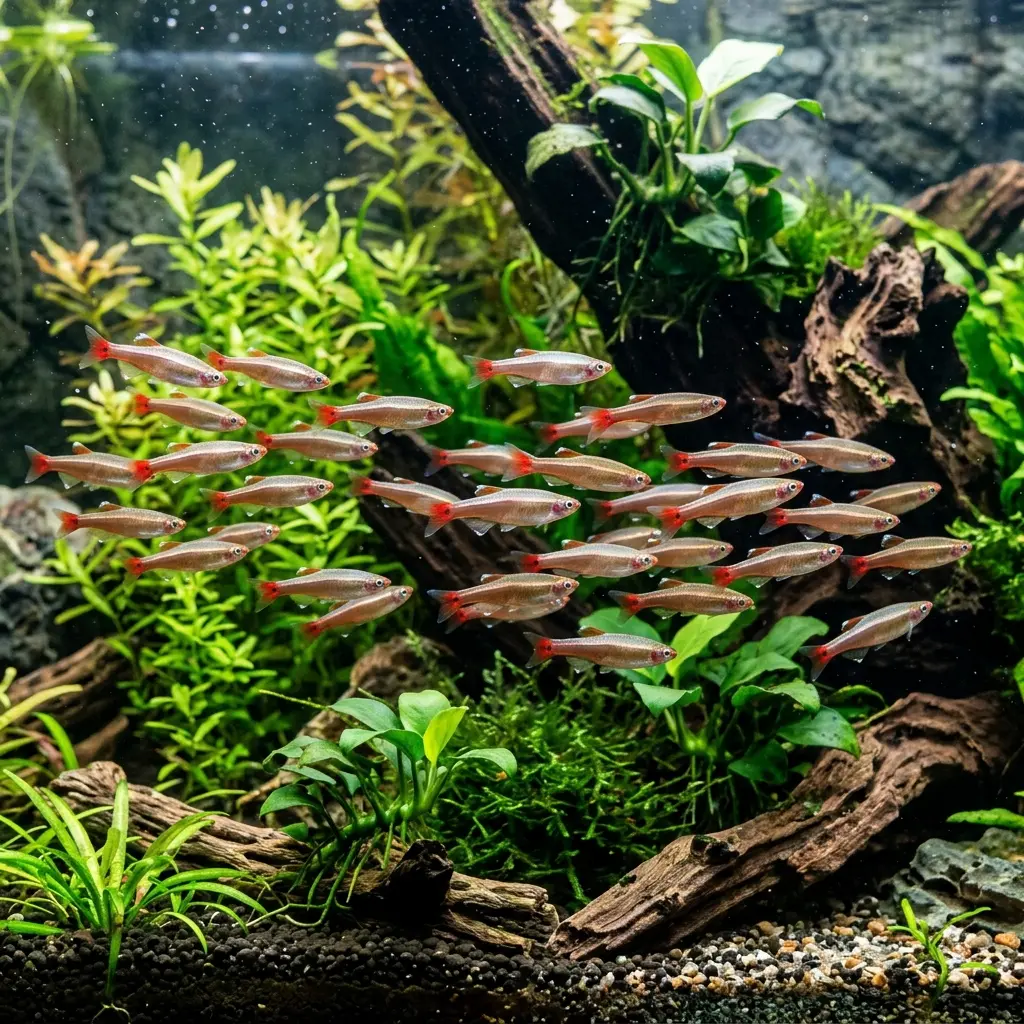
White Cloud Mountain Minnow (Tanichthys albonubes) is a small, hardy, cool-water fish native to China. It requires a minimum 10-gallon (38-liter) aquarium with a pH of 6.0-8.0 and a temperature range of 60-72 degrees Fahrenheit (15.5-22 degrees Celsius). This omnivorous, peaceful shoaling fish occupies the middle and upper water zones and thrives in unheated aquariums with subdued lighting and moderate water flow.
Quick Facts
| Scientific Name | Tanichthys albonubes |
|---|---|
| Common Names | White Cloud Mountain Minnow |
| Family | Tanichthyidae (formerly Cyprinidae) |
| Genus | Tanichthys |
| Type | Freshwater |
| Temperament | peaceful |
| Care Difficulty | beginner |
| Lifespan | 5 years |
| Maximum Size | Up to 1.5 in (4 cm) |
| Diet | Omnivore |
| Temperature | 57–82°F (14–28°C) |
| pH | 6–8 |
| Hardness | 5–20 dGH |
| Minimum Size | 10 gallons |
Key Takeaways
- Requires a school of at least 6-8 individuals; 10+ is optimal for natural behavior and color display.
- Thrives in cool water between 64-72 degrees Fahrenheit (18-22 degrees Celsius); no aquarium heater is required.
- Critically endangered in the wild in China; all aquarium specimens are commercially captive-bred.
- Confirmed jumpers; a tight-fitting lid or lowered water level is mandatory.
- Highly sensitive to heavy metals; use water conditioners that neutralize copper and zinc.
- Subdued lighting and dense plant borders along the rear and sides create the ideal environment.
Diet
Diet and Feeding Protocol
White Cloud Mountain Minnows are omnivorous micro-predators. In the wild, they consume insect larvae, zooplankton, small crustaceans, and algae films. In captivity, you must replicate this varied diet to maintain immune function, coloration, and breeding condition.
Staple Foods
Feed high-quality micro-flakes or micro-pellets as the dietary base. Crush standard flakes into a fine powder because their mouths are extremely small. The staple food should contain approximately 35% protein, 10% fat, and supplemental plant matter.
Supplemental Foods
- Frozen: Daphnia, brine shrimp, bloodworms, cyclops, and Mysis shrimp. Thaw before feeding.
- Live: Baby brine shrimp, grindal worms, microworms, vinegar eels, and cyclops. Live foods are essential for conditioning breeders.
- Vegetable Matter: Offer spirulina flakes or blanched spinach once weekly. They will graze algae from plant leaves and hardscape.
Feeding Schedule
Feed 2-3 times daily in portions consumed within 2-3 minutes. Overfeeding causes obesity and degrades water quality. Remove uneaten food after 5 minutes. During breeding conditioning, increase live food to 2-3 feedings daily for 10-14 days.
Prohibited Foods
Never feed beef heart, pork, mammalian fats, bread, or processed human foods. Cyprinids lack the digestive enzymes to process mammalian proteins and fats, leading to fatal intestinal blockages and fatty liver disease.
Health
Health and Disease Management
White Cloud Mountain Minnows are generally hardy when maintained in appropriate cool water. However, mass-farmed stock frequently exhibits inbreeding depression, resulting in weakened immunity, spinal deformities, and susceptibility to common aquarium pathogens. Their small size and cool-water preference mean that diseases progress differently than in tropical species. Temperatures above 75 degrees Fahrenheit (24 degrees Celsius) accelerate pathogen reproduction while simultaneously stressing the fish, creating a deadly combination.
Critical Sensitivity: This species is uniquely vulnerable to heavy metals (copper, lead, zinc) from aging plumbing. Always use a water conditioner that explicitly neutralizes heavy metals, or employ reverse osmosis water with a remineralizer.
Ichthyophthirius multifiliis (Ich / White Spot Disease)
A protozoan parasite that presents as white salt-like grains on the fins, body, and gills.
Introduced via new fish or plants; triggered by temperature fluctuations or stress. In White Clouds, ich is often exacerbated by temperatures above 75 degrees Fahrenheit (24 degrees Celsius) that suppress immune function.
Quarantine all new additions for 14 days. Maintain stable temperatures between 64-72 degrees Fahrenheit (18-22 degrees Celsius). Avoid sudden temperature drops during water changes.
Fin Rot (Aeromonas / Pseudomonas)
Bacterial infection causing frayed, receding, or discolored fins with possible red streaking at the fin base.
- Fins appear torn or melted at the edges, redness or inflammation at the fin base, lethargy, loss of appetite.
Poor water quality (elevated nitrates above 40 ppm), fin-nipping tank mates, or physical damage from sharp decor. Bacteria colonize damaged tissue.
Perform weekly 20-30 percent water changes. Maintain nitrates below 20 ppm. Remove fin-nipping species such as Tiger Barbs. Use only smooth-edged hardscape.
Swim Bladder Disorder
A physical or infectious condition affecting buoyancy control, causing the fish to float uncontrollably or sink to the bottom.
- Inability to maintain neutral buoyancy, floating upside down or sideways, sinking to the substrate, difficulty reaching the surface for food.
Overfeeding, constipation, physical trauma from jumping and hitting the lid, or bacterial infection of the swim bladder. Inbred stock shows higher congenital incidence.
Feed small portions 2-3 times daily rather than one large meal. Include vegetable matter to prevent constipation. Ensure a secure, padded lid or lowered water level to prevent impact injuries.
Gill Flukes (Dactylogyrus)
Monogenean parasites that attach to gill filaments, causing respiratory distress and tissue damage.
- Rapid breathing, gasping at the surface, rubbing gills against decor, pale gills, lethargy.
Introduced via contaminated water, live foods, or new fish. Flukes reproduce rapidly in cool water but are treatable.
Quarantine new fish for 14 days. Use praziquantel as a prophylactic treatment for new arrivals. Avoid collecting wild aquatic plants from natural water bodies.
Heavy Metal Toxicity
Acute or chronic poisoning from copper, lead, or zinc in tap water, often from aging municipal pipes.
- Sudden death without warning signs, gasping at the surface, erratic swimming, darkened body color, clamped fins, refusal to eat.
Old plumbing leaching metals into tap water. White Cloud Mountain Minnows are exceptionally sensitive to heavy metals compared to most tropical fish.
Use a water conditioner that explicitly neutralizes heavy metals. Test source water with a multi-parameter liquid test kit. Consider reverse osmosis water with a remineralizer for sensitive populations.
Breeding
Breeding White Cloud Mountain Minnows
White Cloud Mountain Minnows are widely regarded as one of the easiest egg-laying fish to breed in captivity. They are continuous spawners with a breeding season extending from March through October, though they will breed year-round in stable aquarium conditions. No specialized equipment is required beyond a separate breeding tank and appropriate food.
Conditioning Breeders
Select 8-10 mature fish (6-8 months or older) and separate males from females into different tanks for 10-15 days. During this period, feed live baby brine shrimp, grindal worms, and microworms 2-3 times daily. Well-conditioned females will become visibly round with eggs, and males will intensify in color and display constantly.
Breeding Tank Setup
Use a shallow tank of 10 gallons (38 liters) with a water depth of only 6 inches (15 cm). Set parameters to pH 7.0, dGH 8, and raise the temperature to 72-77 degrees Fahrenheit (22-25 degrees Celsius) to simulate the warm rainy season that triggers spawning in nature. Add a spawning mop, java moss, fine-leaf plants, smooth marbles, or a protective mesh on the substrate to shield eggs from parents.
Spawning Process
Introduce conditioned fish to the breeding tank in the evening. Spawning occurs at dawn as light levels increase. The male performs a courtship dance alongside the female, driving her into dense vegetation where she scatters 100-200 adhesive eggs. The male fertilizes them externally. Eggs stick to plants, substrate, and decor.
Remove parents after 4 hours. While some sources claim adults do not eat eggs, controlled experiments demonstrate that fry survival rates are dramatically higher when parents are removed promptly.
Egg and Fry Development
Eggs hatch in 48-72 hours at 68-72 degrees Fahrenheit (20-22 degrees Celsius). Newly hatched larvae are only 2.2-2.6 mm long and cling to glass or substrate for the first 48 hours, absorbing their yolk sacs. Once free-swimming, they require infusoria or rotifers for the first 3 days. Transition to microworms, vinegar eels, and finally baby brine shrimp by day 7. Maintain cool water; no heater is necessary for the fry tank. Perform daily 10 percent water changes with matched-temperature water. A sponge pre-filter is mandatory to prevent fry from being drawn into the filter.
Compatible Tank Mates






Species Comparison
| Feature | White Cloud Mountain Minnow | Zebra Danio | Neon Tetra | Celestial Pearl Danio |
|---|---|---|---|---|
| Adult Size | 1.5 in (3.8 cm) | 2 in (5 cm) | 1.5 in (3.8 cm) | 1 in (2.5 cm) |
| Temperament | Peaceful; shoaling | Peaceful; active shoaling | Peaceful; tight schooling | Peaceful; reclusive shoaling |
| Minimum Tank Size | 10 gal (38 L) for 10 fish | 10 gal (38 L) for 5-6 fish | 10 gal (38 L) for 6 fish | 10 gal (38 L) for 6-8 fish |
| Temperature Range | 60-72 degrees F (15.5-22 degrees C); no heater needed | 64-77 degrees F (18-25 degrees C) | 72-78 degrees F (22-25.5 degrees C); heater required | 68-78 degrees F (20-25.5 degrees C); heater required |
| Diet | Omnivore; micro-flakes, frozen foods, live foods | Omnivore; accepts all standard foods | Omnivore; prefers small foods | Omnivore; prefers live and frozen foods |
| pH Range | 6.0 - 8.0 (highly adaptable) | 6.5 - 7.5 | 6.0 - 7.0 (soft, acidic preferred) | 6.5 - 7.5 |
| Special Requirements | Subdued lighting; tight lid (jumpers); sensitive to heavy metals | High oxygen; appreciates current | Requires stable parameters; sensitive to fluctuations | Heavily planted; dim lighting; shy |