
Farlowella (Farlowella vittata)
Quick Answer
Farlowella, commonly known as Twig Catfish or Whiptail Catfish, is a long, slender Loricariid from South America reaching 6 inches (15 cm). It requires a minimum 20 gallon (76 liter) aquarium with soft, slightly acidic water (pH 6.0-7.0), temperature 75-80°F (24-27°C), and pristine water quality. This herbivore is extremely sensitive to poor water conditions, requires driftwood for grazing and digestion, and must be housed with peaceful tank mates that do not outcompete it for food.
Quick Facts
| Scientific Name | Farlowella vittata |
|---|---|
| Common Names | Farlowella |
| Family | Loricariidae |
| Genus | Farlowella |
| Type | Freshwater |
| Temperament | peaceful |
| Care Difficulty | intermediate |
| Lifespan | 8 years |
| Maximum Size | Up to 6 in (15 cm) |
| Diet | Herbivore |
| Temperature | 75–80°F (24–27°C) |
| pH | 6–7.5 |
| Hardness | 3–12 dGH |
| Minimum Size | 20 gallons |
Key Takeaways
- Requires pristine water quality with nitrates below 10 ppm; one of the most water-quality-sensitive aquarium fish.
- Needs a minimum 20 gallon (76 liter) tank; 30-40 gallons (114-151 liters) recommended for groups of 3-5.
- Driftwood is mandatory—not optional—for grazing, digestive health, and behavioral enrichment.
- Herbivorous diet: algae wafers, spirulina, blanched vegetables. Meat-heavy diets cause health problems.
- Extremely sensitive to copper (0.1 mg/L max), formalin, and salt above 2 ppt. Scaleless-fish dosages required.
- Males develop broader snouts with odontodes; females have streamlined snouts.
- Spawns on flat vertical surfaces; male guards eggs for 6-10 days. Fry are extremely difficult to raise.
- Lifespan of 5-15 years under optimal conditions; most die prematurely from poor water quality or starvation.
Overview
Species Overview
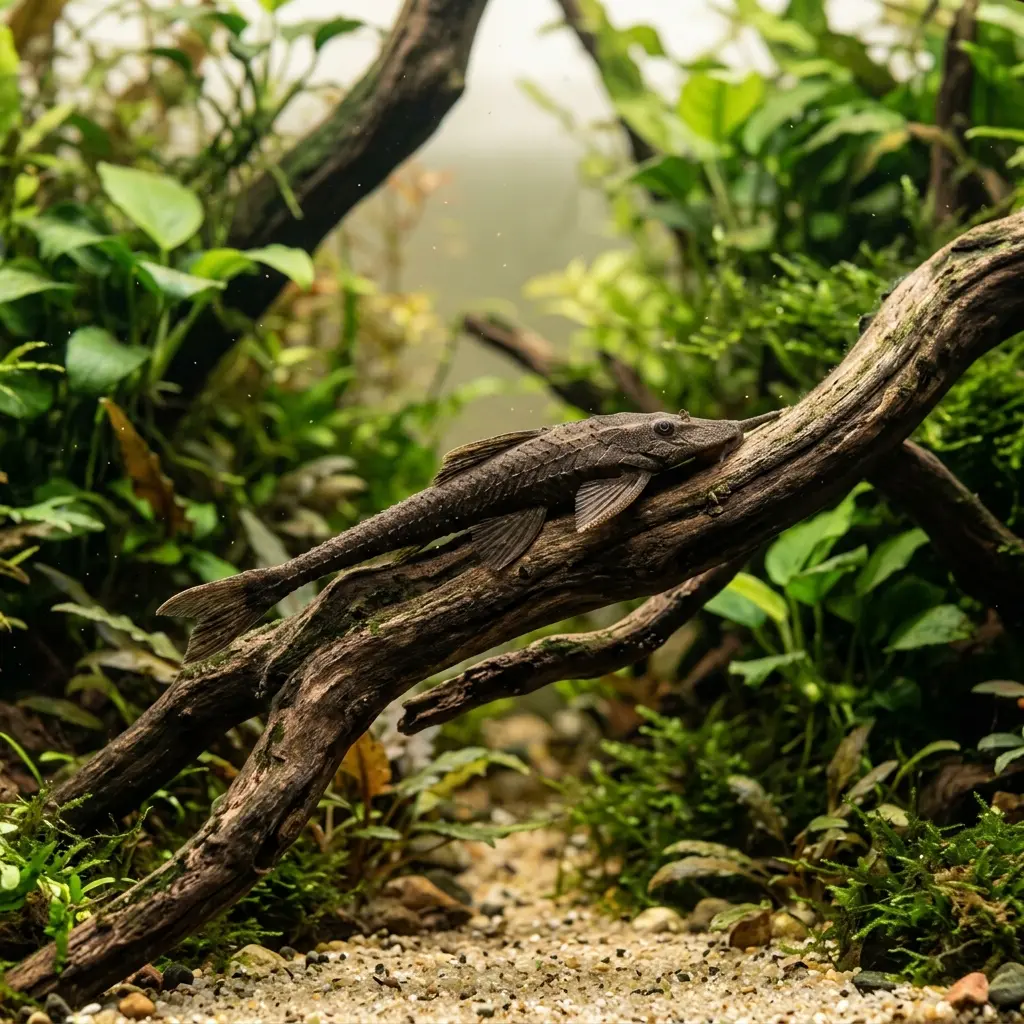
The Farlowella, commonly known as the Twig Catfish or Whiptail Catfish, is one of the most visually distinctive and fascinating catfish in the aquarium hobby. Belonging to the family Loricariidae—the largest family of catfish in the world—these remarkable fish have evolved an extraordinary camouflage strategy: their extremely elongated, slender bodies and brownish coloration with dark lateral stripes make them virtually indistinguishable from the twigs and sticks in their natural habitat. Even in the aquarium, they often remain motionless for hours, attached to driftwood or plant stems, perfectly mimicking a piece of dead wood.
The genus Farlowella contains approximately 27 described species found throughout South America, though only two are regularly exported for the aquarium trade. The most commonly encountered species is Farlowella vittata, native to the Orinoco River basin in Venezuela and Colombia. The closely related Farlowella acus is highly endangered in the wild due to pollution from industrial parks around Lake Valencia and is imported only rarely, if at all. Many specimens sold in stores as F. acus are actually F. vittata or other similar species. The easiest way to distinguish F. vittata from F. acus is by the rostrum (snout) shape: vittata has a longer, more slender rostrum.
Visual Identification
Farlowella possess an elongated, almost eel-like body covered in small bony plates rather than scales. They reach up to 6 inches (15 cm) in standard length, though some specimens may remain smaller. The body is light brown to yellowish with two prominent dark lateral stripes running from the tip of the rostrum, over the eyes, and continuing to the tail—this banded pattern gives the species its specific epithet vittata (Latin for banded). The tail fin is distinctly lyre-shaped, with the top and bottom lobes extending into individual points. Their fins are relatively small, as they are not fast swimmers.
Behavioral Highlights
Farlowella are primarily nocturnal but will become active during the day in well-planted tanks with ample hiding spots. They are extraordinarily sedentary, often staying motionless in one spot for hours. Movement is achieved not by swimming but by short hops from surface to surface, using their suckermouth to attach to driftwood, rocks, plants, or glass. When they do swim, it is accomplished through body undulations and caudal fin propulsion. Their camouflage is so effective that even when being captured, they often will not react in the hope of being mistaken for a twig.
Diet
Dietary Requirements
Farlowella are primarily herbivorous and have evolved to feed on algae, biofilm (aufwuchs), and decaying plant matter in their natural habitat. Their specialized mouthparts are designed for scraping and rasping surfaces, not for capturing meaty prey. While they will occasionally accept small live or frozen foods, the bulk of their diet must consist of vegetable matter. A meat-heavy diet causes digestive problems, fatty liver disease, and premature death.
Nutritional Composition
Target a diet comprising approximately 80% vegetable matter and 20% protein from incidental sources. The high fiber content from vegetables and driftwood is essential for proper digestive function. Farlowella have long digestive tracts adapted to processing plant matter, and they require continuous grazing rather than discrete meals.
Recommended Foods
- Primary: Premium algae wafers (Hikari, Sera, or similar high-quality brands), spirulina tablets, and vegetable-based sinking pellets
- Fresh vegetables: Blanched zucchini, cucumber, spinach, kale, romaine lettuce, and peas. Blanching softens the vegetables and makes them easier to rasp. Secure with a vegetable clip or weight
- Natural grazing: Biofilm and algae growing on driftwood, rocks, and tank walls. Leave some surfaces uncleaned to provide natural foraging opportunities
- Supplementary: Occasional small live or frozen foods such as bloodworm or daphnia—offer these sparingly, no more than once weekly, and never as a main diet component
Feeding Schedule
Feed small amounts daily. Because Farlowella are continuous grazers, food should be available at all times. Place algae wafers or vegetable pieces near their favorite perches. Remove uneaten fresh vegetables after 24 hours to prevent decomposition and water quality decline. If kept with other fish, ensure food reaches the bottom where Farlowella feed—target feeding with a turkey baster may be necessary if tank mates consume all food before it sinks.
Expert Tip: The Driftwood Factor
Driftwood is not merely decorative for Farlowella—it is a critical dietary component. The cellulose and lignin in wood provide essential fiber that aids digestion and prevents constipation. Farlowella will rasp on driftwood continuously, even when other food is available. Without wood in the diet, they are prone to digestive blockages and starvation. Always keep at least one piece of driftwood per fish, and replace it when it becomes too degraded.
Health
Health and Disease Management
Farlowella are notoriously sensitive to disease, primarily due to their scaleless nature, specialized diet, and extreme sensitivity to water quality fluctuations. The vast majority of health issues in this species stem from environmental factors rather than infectious agents. Prevention through pristine water maintenance, proper nutrition, and careful quarantine is vastly more effective than treatment. When treatment is necessary, medication dosages must be adjusted for scaleless fish to prevent lethal overdoses.
Medication Sensitivity Alert
As a scaleless Loricariid, Farlowella is extremely sensitive to several common aquarium medications:
- Copper: Maximum safe concentration is 0.1 mg/L—standard ich treatments often contain lethal doses. Even trace amounts of copper from plumbing or old pipes can be harmful.
- Formalin: Highly sensitive. Use at half-strength maximum. Full doses cause severe gill damage and death.
- Malachite Green: Safe only at quarter-strength (0.025 mg/L). Higher concentrations damage the gill epithelium and skin.
- Aquarium Salt: Tolerance is below 2 ppt (parts per thousand). Standard salt treatments are toxic. Some aquarists report success with very short-term salt baths at 1 ppt, but this is risky and not recommended.
- Safe Options: Praziquantel for internal parasites, Metronidazole at half-strength for flagellate infections, and certain antibiotics such as Kanamycin for bacterial infections.
Critical behavioral sign: When irritated by chemicals or poor water conditions, Farlowella will go to the water surface and hold their rostrum above the waterline. This is an emergency sign requiring immediate water testing and correction.
Quarantine Protocol
Quarantine all new Farlowella for a minimum of 3-4 weeks in a separate 10-gallon (38 liter) tank with a mature sponge filter. Observe for feeding response, fin condition, and signs of starvation or parasites. Do not rush acclimation—drip acclimation over 45-60 minutes is mandatory. Farlowella are often weakened from transport and may refuse food for the first week. Offer blanched vegetables and algae wafers near their hiding spot. Do not medicate prophylactically unless symptoms appear.
Starvation and Malnutrition
The single most common cause of death in captive Farlowella. These fish are continuous grazers with slow metabolisms, but they require constant access to appropriate food. In tanks with competitive feeders or inadequate vegetable matter, they slowly starve over weeks or months.
- Gradual weight loss with visible thinning along the body; sunken belly; reduced activity; faded coloration; refusal to feed even when food is presented; lethargy; death occurs slowly over 2-8 weeks.
Inadequate food supply; outcompetition by faster, more aggressive tank mates; lack of driftwood for grazing; exclusive dry food diet lacking vegetable matter; tank mates consuming all sinking food before it reaches the bottom.
Provide ample driftwood for continuous grazing; feed algae wafers, spirulina tablets, and blanched vegetables daily; target feed with a turkey baster if tank mates are competitive; maintain a species-only tank or with only peaceful, non-competitive fish; ensure food is available at all times, not just at scheduled feeding times.
Ich (White Spot Disease)
A protozoan parasite (Ichthyophthirius multifiliis) that presents as white salt-grain spots on body and fins. Highly contagious and potentially fatal in Farlowella due to their weakened condition from transport and medication sensitivity.
- White cysts 0.5-1.0 mm in diameter on fins, body, and gill covers; fish flashing against decor; rapid gill movement; clamped fins; reduced appetite; fish hanging near the surface.
Introduced via infected fish, plants, or equipment; triggered by temperature fluctuations, poor water quality, or stress from inadequate hiding spots or aggressive tank mates.
Quarantine all new additions for 4 weeks; maintain stable temperature within 75-80°F (24-27°C); avoid temperature swings exceeding 2°F (1.1°C) in 24 hours; provide ample driftwood and hiding spots to reduce stress; ensure pristine water quality with nitrates below 10 ppm.
Fin Rot (Bacterial)
Bacterial erosion of fin tissue caused by Aeromonas, Pseudomonas, or Flexibacter species. Common in Farlowella due to their delicate fin structure and sensitivity to poor water quality.
- Ragged, fraying fin edges with white or translucent margins; receding fin tissue progressing toward the body; red streaks in advanced cases; listlessness; reduced grazing activity.
Use smooth sand or fine gravel substrate; remove sharp-edged decorations; maintain nitrates below 10 ppm through weekly water changes; feed fresh, vitamin-rich foods to maintain immune function; avoid netting or handling unless absolutely necessary.
Columnaris (Mouth Fungus)
A bacterial infection caused by Flavobacterium columnare that spreads rapidly in warm water. Often mistaken for fungal infections due to cotton-like appearance around the mouth and gills.
- White or grayish patches around mouth and gills; saddleback lesion behind dorsal fin; frayed fins; rapid breathing; loss of appetite; lethargy; fish isolating from normal perches.
Stress from temperature fluctuations above 3°F (1.7°C) in 24 hours; overcrowding; poor water quality; introduction via infected fish or equipment; low dissolved oxygen levels.
Maintain stable temperature with quality heater; avoid overcrowding; sterilize nets and equipment between tanks; ensure adequate aeration and surface agitation; quarantine new arrivals for 3-4 weeks; maintain nitrates below 10 ppm.
Internal Parasites (Hexamita / Nematodes)
Protozoan or worm parasites in the intestinal tract, often introduced through contaminated live foods or poor quarantine practices.
- Emaciation despite normal feeding; stringy white feces; sunken belly; lethargy; faded colors; reduced grazing; fish hanging near the surface with rostrum protruding.
Feeding contaminated live foods; introduction via infected tank mates; poor quarantine practices; stress from poor water quality weakening immune function.
Source live foods from reputable suppliers; rinse frozen foods thoroughly before feeding; quarantine all new fish for 4 weeks; treat live food cultures with praziquantel prophylactically; maintain pristine water conditions to support immune function.
Oxygen Deprivation
Farlowella have high oxygen requirements due to their sedentary lifestyle and specialized respiration. Low oxygen levels cause acute distress and can be fatal, particularly in warm water or tanks with poor surface agitation.
- Fish hanging at the water surface with rostrum protruding above the waterline; rapid, labored gill movement; lethargy; refusal to feed; darkened coloration; gasping at the surface.
Inadequate surface agitation; high water temperature (above 82°F / 28°C); overstocking; decomposing organic matter consuming oxygen; filter failure; power outage; excessive algae blooms.
Provide adequate surface agitation with air stones, sponge filters, or filter outflow; maintain temperature below 80°F (27°C); avoid overstocking; remove uneaten food and decaying plant matter promptly; use battery-powered air pumps as backup during power outages; test dissolved oxygen levels if symptoms appear.
Breeding
Breeding Farlowella
Farlowella are relatively easy to breed compared to many other Loricariids, and they will often spawn spontaneously in well-maintained community tanks. The primary challenges are sexing the fish, providing appropriate spawning surfaces, and raising the extremely delicate fry. Successful breeding is a strong indicator that water parameters, nutrition, and tank conditions are optimal.
Sexing
Mature males develop a noticeably broader, thicker snout covered with short bristle-like odontodes (tooth-like skin projections). Females maintain a slender, streamlined rostrum without these bristles. Males are generally larger and more robust than females. Sexing is only reliable in mature fish over 3 inches (7.5 cm); juveniles cannot be reliably sexed by external characteristics.
Conditioning Breeders
Condition a group of 4-6 adults with heavy feedings of algae wafers, spirulina tablets, and blanched vegetables for 2-3 weeks. Maintain pristine water quality with weekly 20% water changes. Simulate the rainy season to trigger spawning: perform a 40% water change with slightly cooler (72°F / 22°C), soft RO water over 2 hours, and increase aeration. This temperature drop and influx of fresh, soft water mimics the natural breeding triggers in their wild habitat.
Spawning Setup
No special breeding tank is required if conditions are suitable in the community tank. Provide flat, vertical spawning surfaces such as:
- Smooth aquarium glass (eggs are often deposited directly on the glass)
- Flat rocks or slate leaned against the aquarium wall
- Broad, flat leaves of Anubias or Cryptocoryne
- Smooth driftwood pieces with flat surfaces
The spawning surface should be in a relatively shaded area with gentle water flow. Bright light and strong currents discourage spawning.
Spawning Process
Spawning typically occurs at night after lights have been shut off. The female deposits 50-200 adhesive eggs in neat, parallel rows on the chosen vertical surface. The eggs are approximately 2-3 mm in diameter and pale yellow to cream in color. The male immediately assumes sole parental care, guarding the eggs aggressively, chasing away all intruders including the female, and fanning the eggs continuously with his fins to maintain water circulation and oxygen supply.
Incubation and Hatching
Eggs hatch in 6-10 days at 78°F (25.5°C). The male continues to guard and fan throughout the entire incubation period, rarely leaving the eggs even to feed. During this time, target feed the male near the eggs with algae wafers. If the male is removed or stressed, the eggs are vulnerable to fungal infection and predation by tank mates. After hatching, the fry remain attached to the spawning surface for 2-3 days, absorbing their yolk sacs.
Fry Rearing
Raising Farlowella fry is extremely challenging and has a high mortality rate even for experienced breeders:
- First foods: Fry require microscopic foods immediately after yolk sac absorption. Infusoria, green water, and powdered algae wafers are essential. They also need to graze on algae-covered surfaces and biofilm.
- Days 5-14: Gradually introduce microworms, vinegar eels, and finely crushed algae wafers.
- Weeks 2-4: Newly hatched baby brine shrimp can be introduced, but many fry will not accept them initially. Continue offering powdered and crushed vegetable foods.
- Critical requirement: Fry need access to driftwood and algae-covered rocks from day one. The cellulose and biofilm on these surfaces are essential for digestive development.
Perform daily 10% water changes with water from the parents' tank. Use airline tubing to siphon waste without removing fry. Survival rates of 10-30% are considered good. The fry grow slowly, reaching 1 inch (2.5 cm) in 3-4 months under optimal conditions.
Tips
Common Mistakes
Expert Tips
Compatible Tank Mates






Species Comparison
| Feature | Farlowella | Otocinclus | Bristlenose Pleco | Siamese Algae Eater |
|---|---|---|---|---|
| Maximum Size | 6 inches (15.2 cm) | 2 inches (5 cm) | 4-5 inches (10-12 cm) | 6 inches (15 cm) |
| Temperament | Peaceful, shy, sedentary | Peaceful, active, schooling | Peaceful, territorial to conspecifics | Peaceful when young; semi-aggressive as adult |
| Minimum Tank Size | 20 gallons (76 L); 30+ gal for group | 10 gallons (38 L) | 20 gallons (76 L) | 30 gallons (114 L) |
| Diet Type | Herbivore (80% vegetable matter) | Herbivore (algae and biofilm) | Omnivore (algae, vegetables, some protein) | Omnivore (algae, some protein) |
| Driftwood Requirement | Mandatory for digestion and grazing | Beneficial but not mandatory | Mandatory for digestion and grazing | Not required |
| Water Quality Sensitivity | Extremely high (nitrates <10 ppm) | High (nitrates <20 ppm) | Moderate (nitrates <40 ppm) | Moderate (nitrates <40 ppm) |
| Activity Level | Very low; sedentary grazer | High; active schooling | Moderate; active at night | High; very active swimmer |
| Medication Sensitivity | Extremely high (scaleless Loricariid) | High (scaleless catfish) | Moderate (scaleless Loricariid) | Low (scaled fish) |
| Special Considerations | Needs continuous grazing; easily starved | Needs established algae; often dies in new tanks | Males territorial; may rasp plant leaves | Becomes aggressive with age; stops eating algae |