
Green Neon Tetra (Paracheirodon simulans)
Quick Answer
Green Neon Tetra (Paracheirodon simulans) is a tiny, peaceful blackwater characin reaching 0.8 to 1.2 inches (2 to 3 cm). It requires a minimum 15 gallon (57 liter) aquarium with very soft, acidic water (pH 5.0 to 6.5, GH 0 to 4 dGH) and temperature range of 74 to 82 degrees Fahrenheit (23 to 28 degrees Celsius). This omnivorous micro-predator occupies the upper to mid-water levels and makes an excellent addition to soft-water planted community setups.
Quick Facts
| Scientific Name | Paracheirodon simulans |
|---|---|
| Common Names | Green Neon Tetra |
| Family | Characidae |
| Genus | Paracheirodon |
| Type | Freshwater |
| Temperament | peaceful |
| Care Difficulty | intermediate |
| Lifespan | 4 years |
| Maximum Size | Up to 1.2 in (3 cm) |
| Diet | Omnivore |
| Temperature | 74–82°F (23–28°C) |
| pH | 5–6.5 |
| Minimum Size | 15 gallons |
Key Takeaways
- Reaches only 0.8 to 1.2 inches (2 to 3 cm), smaller than neon or cardinal tetras.
- Requires a minimum 15 gallon (57 liter) tank for schools of 10 to 15 fish.
- Must be kept in groups of 10 or more to prevent stress and display natural behavior.
- Blackwater specialist requiring very soft, acidic water (pH 5.0 to 6.5, GH 0 to 4 dGH).
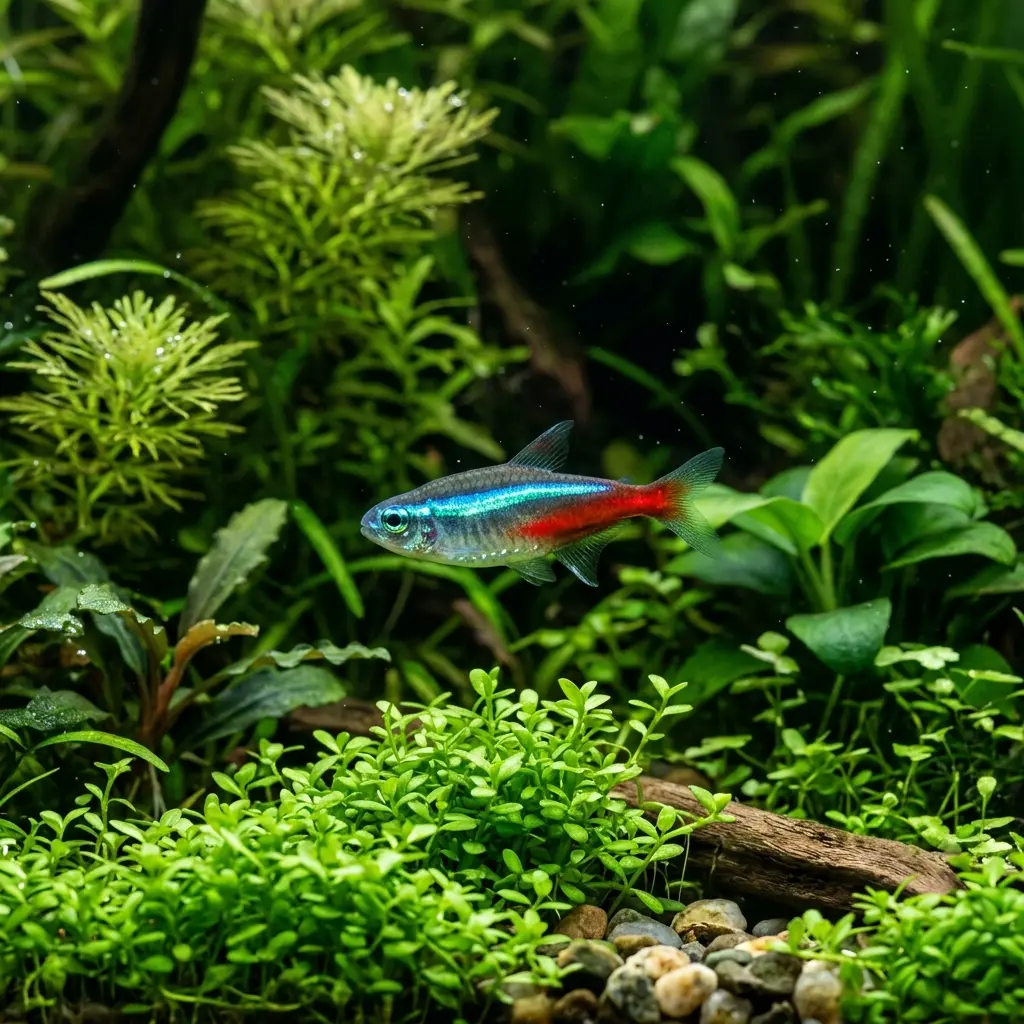
- Brilliant turquoise-green iridescent stripe changes color from blue to green depending on lighting.
- More delicate than neon or cardinal tetras; hard water causes kidney failure.
- Eggs are extremely light-sensitive; breeding requires near-total darkness.
- Most shrimp-safe tetra; rarely bothers adult shrimp, baby shrimp, or shrimplets.
- Unique physiology allows 100 percent survival in extreme low-oxygen, low-pH conditions.
Overview
Species Overview
The Green Neon Tetra (Paracheirodon simulans) is the smallest and most specialized member of the Paracheirodon genus, which includes the more commonly known Neon Tetra and Cardinal Tetra. Native to the upper Rio Negro and Orinoco basins in Brazil and Colombia, this tiny characin is often overlooked by beginners in favor of its larger cousins. However, experienced aquarists prize the green neon for its extraordinary iridescent turquoise-green stripe that shifts between blue and green depending on lighting angle, creating a living jewel effect that no other tetra can replicate.
Why They Are Misunderstood
The single greatest mistake in the aquarium hobby is treating green neon tetras as interchangeable with neon tetras. They are not. Green neons are blackwater specialists that require very soft, acidic water (pH 5.0 to 6.5, GH 0 to 4 dGH) to thrive long-term. Keeping them in hard, alkaline water causes chronic physiological stress, kidney failure, and premature death. Their small size (0.8 to 1.2 inches / 2 to 3 cm) also makes them more vulnerable to predation and competition. This guide provides the definitive care protocol for this delicate but rewarding species.
Natural History and Conservation
Green Neon Tetras inhabit shaded, slow blackwater creeks (igarape) in the upper Rio Negro and Orinoco systems. The water is stained dark brown by tannins from decomposing leaf litter, driftwood, and peat, with a sandy substrate and dense overhead vegetation. They occupy the upper to mid-water levels, darting in and out of plant cover. The species is less commonly exported than neon tetras, with approximately 17,000 individuals exported in 2002, but remains abundant in its native habitat. Their unique physiology makes them remarkably resistant to climate change effects, showing 100 percent survival in experiments with lower dissolved oxygen, lower pH, higher carbon dioxide, and higher temperature.
Diet
Diet and Nutrition
Green Neon Tetras are omnivorous micro-predators that feed on tiny invertebrates, insect larvae, zooplankton, and biofilm in the wild. Their small size requires appropriately tiny food, but their nutritional needs are the same as larger fish. A varied, high-quality diet is essential for coloration, immune function, and breeding condition.
Health
Health and Disease Management
Green Neon Tetras are more delicate than neon or cardinal tetras and require pristine water conditions to maintain health. Their small size makes them vulnerable to medications, and their blackwater specialization means they are less tolerant of water parameter fluctuations than hardier community fish. Proactive disease prevention is essential.
Ich (White Spot Disease)
The most common external parasite affecting green neon tetras, caused by Ichthyophthirius multifiliis.
- White salt-like spots on body and fins, rubbing against decor, rapid breathing, lethargy, clamped fins, loss of appetite.
Introduced via new fish or plants; triggered by temperature drops below 72 degrees Fahrenheit (22 degrees Celsius), poor water quality, transport stress, or inadequate acclimation.
Quarantine all new additions for 2 to 4 weeks. Maintain temperature at 76 to 80 degrees Fahrenheit (24 to 26.7 degrees Celsius). Avoid sudden temperature fluctuations. Use a UV sterilizer for prevention in display tanks.
Neon Tetra Disease (Pleistophora hyphessobryconis)
A devastating microsporidian parasite that affects all Paracheirodon species. There is no cure.
- Cysts visible as white patches under the skin, difficulty swimming, loss of color, curved spine (scoliosis), segregation from tank mates, rapid wasting.
Spores from the microsporidian parasite Pleistophora hyphessobryconis, often introduced via infected live foods (tubifex worms are common vectors) or new fish.
Avoid tubifex worms and other potentially contaminated live foods. Quarantine all new fish for 4 weeks. There is no cure; remove and euthanize infected fish immediately to prevent spread.
Fin Rot
Bacterial infection of the fins causing progressive erosion and tissue death.
- Frayed, ragged, or receding fin edges, redness at fin base, white or blackened fin edges, lethargy.
Aeromonas, Pseudomonas, or Flavobacterium columnare bacteria. Triggered by poor water quality, aggressive tank mates, or physical damage from sharp decor.
Maintain nitrates below 10 ppm with regular water changes. Avoid sharp-edged decor. Remove aggressive tank mates. Treat with aquarium-safe antibiotics (kanamycin, nitrofurazone) at half-strength for these small fish.
Fungal Infections
Cotton-like fungal growth on body, fins, or mouth, often secondary to injury or stress in blackwater conditions.
- White, cottony patches on body or fins, frayed fins, lethargy, loss of appetite.
Saprolegnia and other water molds. Triggered by physical injury, poor water quality, or stress from inadequate plant cover.
Maintain pristine water quality with tannins from botanicals. Avoid rough handling and sharp decor. Quarantine new fish. Treat with methylene blue at half-strength.
Internal Parasites (Nematodes, Tapeworms)
Roundworms and flatworms that compromise nutrient absorption and cause chronic wasting.
- Gradual weight loss despite normal appetite, bloating, visible worms in feces, stringy white feces, reduced activity.
Introduced via live foods (especially wild-caught invertebrates) or contaminated substrate. More common in wild-caught specimens.
Avoid wild-caught live foods. Freeze all live foods for 48 hours before feeding to kill parasites. Prophylactic deworming with praziquantel during quarantine.
Breeding
Breeding and Reproduction
Breeding green neon tetras in home aquariums is challenging but achievable with precise conditions. They are egg-scatterers with extremely light-sensitive eggs, making the breeding setup more demanding than neon or cardinal tetras. Success requires patience, attention to detail, and strict adherence to water parameters.
Tips
Common Mistakes to Avoid
- Treating them like neon tetras: They are not interchangeable. Green neons require softer, more acidic water and dimmer lighting. Applying neon tetra care to green neons results in chronic stress and premature death.
- Buying too few: Groups of 5 to 6 result in stressed, hiding fish that never display natural behavior. Minimum 10 is mandatory; 15 to 20+ is recommended.
- Light substrate and bright lights: The most common complaint is they look gray and boring. They are not boring; your tank setup is wrong. Fix the lighting, substrate, and botanicals first.
- Hard tap water: Keeping them in hard water (above 6 dGH) causes kidney failure over 6 to 12 months. Test your water and adjust before purchasing.
- Skipping botanicals: Bare tanks with bright lights and no tannins are completely unsuitable for this species.
- Overfeeding: Their tiny stomachs cannot handle large meals. Multiple tiny feedings are far better than one large feeding.
- Mixing with larger tetras: Neon tetras and cardinal tetras will outcompete green neons for food and space. If mixing, ensure green neons have their own school of 15+.
- Ignoring quarantine: New fish almost always carry ich or parasites. For a species this delicate, quarantine is not optional.
Expert Tips for Success
- Invest in a larger school: A group of 20 to 30 green neons in a 29-gallon blackwater planted tank is one of the most stunning nano displays in the hobby. The shimmer effect of their color-changing stripe is exponential with numbers.
- Use RO water or rainwater: If your tap water is hard (above 6 dGH), you must use reverse osmosis water, rainwater, or a mix to achieve the softness they require. This is non-negotiable for long-term health.
- Botanicals are essential, not optional: Indian almond leaves, alder cones, and driftwood are not decorations; they are critical components of their environment. The tannins reduce stress, inhibit pathogens, and enhance coloration.
- Feed live foods weekly: Even a small amount of daphnia or baby brine shrimp weekly dramatically improves coloration and triggers natural hunting behavior.
- Acclimate carefully: Green neons are sensitive to pH and temperature shifts. Drip acclimate for 2 to 3 hours when introducing new fish.
- Quarantine is mandatory: Due to their small size and sensitivity, new green neons must be quarantined for 4 weeks minimum. Ich or neon tetra disease in a display tank is devastating.
- Combine with other soft-water species: Chili rasboras, ember tetras, and pygmy corydoras create a multi-species blackwater community that is visually spectacular and ecologically appropriate.
Compatible Tank Mates






Green Neon Tetra vs. Similar Tetra Species
| Feature | Green Neon Tetra | Neon Tetra | Cardinal Tetra | Black Neon Tetra |
|---|---|---|---|---|
| Scientific Name | Paracheirodon simulans | Paracheirodon innesi | Paracheirodon axelrodi | Hyphessobrycon herbertaxelrodi |
| Max Size | 0.8 to 1.2 inches (2 to 3 cm) | 1.5 inches (3.8 cm) | 2 inches (5 cm) | 1.5 inches (3.8 cm) |
| Temperament | Peaceful, timid schooling | Peaceful, timid schooling | Peaceful, moderate schooling | Peaceful, bold schooling |
| Minimum Tank Size | 15 gallons (57 L) | 10 gallons (38 L) | 20 gallons (76 L) | 20 gallons (76 L) |
| Schooling Requirement | 10 to 15+ individuals | 6 to 10 individuals | 6 to 10 individuals | 8 to 12+ individuals |
| Diet | Omnivore; micro-predator | Omnivore; micro-foods | Omnivore; micro-foods | Omnivore; micro-foods |
| pH Range | 5.0 to 6.5 | 5.0 to 7.0 | 5.5 to 7.5 | 5.5 to 7.5 |
| Hardness (dGH) | 0 to 4 (very soft) | 2 to 10 (soft) | 2 to 10 (soft) | 2 to 10 (soft) |
| Temperature Range | 74 to 82 degrees F (23 to 28 degrees C) | 70 to 81 degrees F (21 to 27 degrees C) | 73 to 81 degrees F (23 to 27 degrees C) | 72 to 82 degrees F (22 to 28 degrees C) |
| Difficulty Level | Intermediate (specialized water) | Beginner to Intermediate | Intermediate | Beginner |