
Keyhole Cichlid (Cleithracara maronii)
Quick Answer
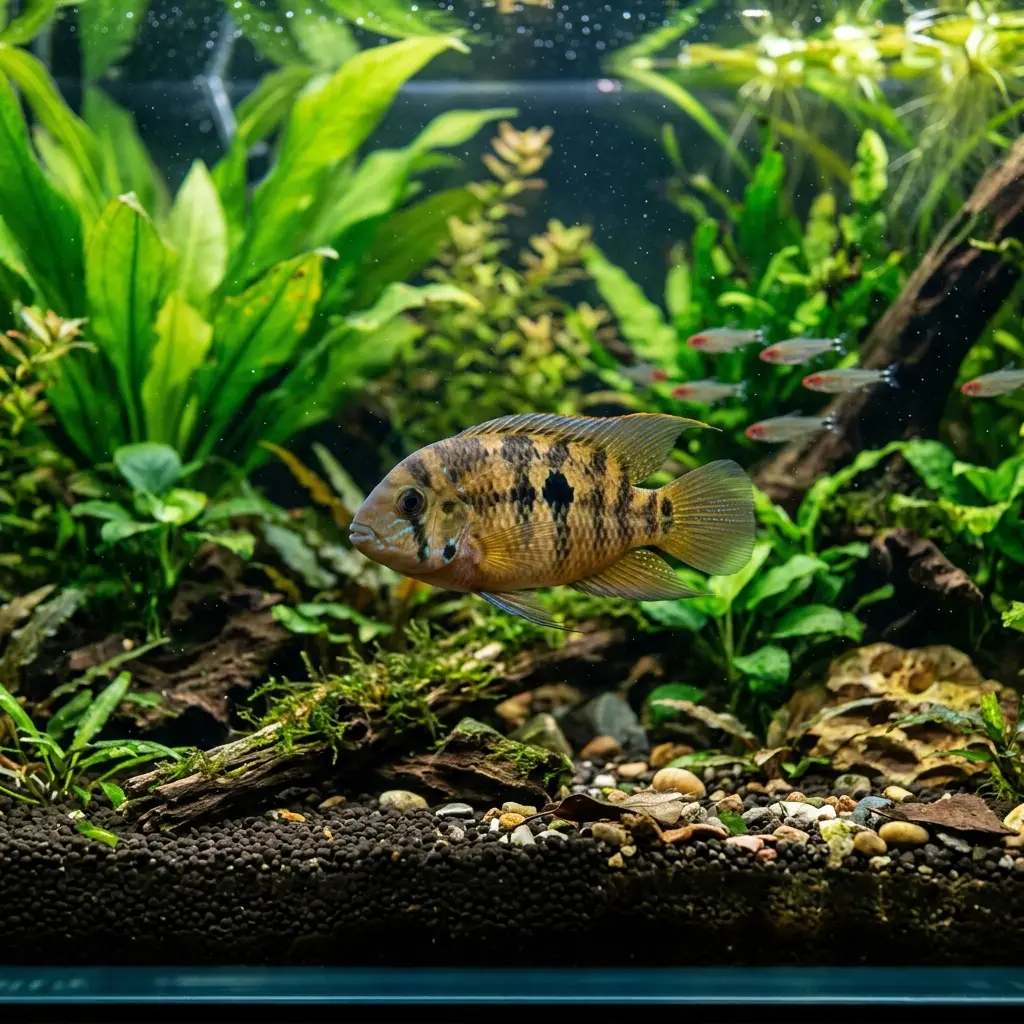
Keyhole Cichlid (Cleithracara maronii) is a small, peaceful South American cichlid named for the distinctive keyhole-shaped marking on its flank. It requires a minimum 30-gallon (113-liter) aquarium for a pair, with water parameters of pH 6.0-7.5 and temperature 72-82 degrees Fahrenheit (22-28 degrees Celsius). This shy, omnivorous bottom/middle dweller thrives in heavily planted tanks with subdued lighting, driftwood caves, and peaceful community tank mates.
Quick Facts
| Scientific Name | Cleithracara maronii |
|---|---|
| Common Names | Keyhole Cichlid |
| Family | Cichlidae |
| Genus | Cleithracara |
| Type | Freshwater |
| Temperament | peaceful |
| Care Difficulty | beginner |
| Lifespan | 8 years |
| Maximum Size | Up to 4 in (10 cm) |
| Diet | Omnivore |
| Temperature | 72–82°F (22–28°C) |
| pH | 6–7.5 |
| Hardness | 3–12 dGH |
| Minimum Size | 30 gallons |
Key Takeaways
- Requires a minimum 30-gallon (113-liter) tank for a pair; 40+ gallons recommended for community setups.
- One of the most peaceful cichlids; must never be housed with aggressive species.
- Named for the distinctive black keyhole marking on its upper flank.
- Exhibits stress-camouflage color change and pressing behavior when frightened.
- Forms monogamous pairs and displays devoted biparental care of eggs and fry.
- Extremely sensitive to nitrates; maintain below 15 ppm to prevent Hole in the Head disease.
- Subdued lighting and dense planting are essential for natural behavior and color display.
Diet
Diet and Feeding Protocol
Keyhole Cichlids are omnivores with a strong carnivorous tendency. In the wild, they consume worms, small crustaceans, insect larvae, and incidental plant matter. In captivity, a varied diet is essential for immune health, coloration, and prevention of Hole in the Head disease.
Staple Foods
Feed high-quality cichlid flakes or sinking pellets as the dietary base. The staple should contain approximately 40% protein, 10% fat, and supplemental plant matter. Sinking pellets are preferred because these fish are bottom-to-midlevel feeders.
Supplemental Foods
- Frozen: Bloodworms, brine shrimp, daphnia, Mysis shrimp, and blackworms. Thaw before feeding.
- Live: Blackworms, bloodworms, brine shrimp, and daphnia. Live foods are excellent for conditioning breeders.
- Vegetable Matter: Blanched zucchini, spinach, peas, and cucumber. Offer spirulina wafers weekly. Vitamin C-rich vegetables are particularly important for cichlid health.
Feeding Schedule
Feed 2 times daily in portions consumed within 2-3 minutes. Overfeeding degrades water quality and causes obesity. Remove uneaten food after 5 minutes. During breeding conditioning, increase live food to 2-3 feedings daily for 10-14 days.
Prohibited Foods
Never feed beef heart, pork, mammalian fats, bread, or processed human foods. Cichlids lack the digestive enzymes to process mammalian proteins, leading to fatal intestinal blockages and fatty liver disease. Avoid high-fat commercial foods marketed for color enhancement, as these contribute to Hole in the Head disease.
Health
Health and Disease Management
Keyhole Cichlids are generally hardy when maintained in clean, stable water with appropriate tank mates. However, as members of the cichlid family, they share a heightened susceptibility to certain diseases, particularly those linked to water quality. Their shy temperament also makes them vulnerable to stress-related illnesses if housed with aggressive fish or kept in bare tanks without adequate cover.
Critical Sensitivity: Cichlids are extremely sensitive to nitrate accumulation. Levels above 20 ppm cause chronic stress that manifests as Hole in the Head disease, fin erosion, and immune suppression. You must maintain nitrates below 15 ppm through regular water changes and thorough gravel vacuuming.
Hole in the Head / Head and Lateral Line Erosion (HITH/HLLE)
A progressive condition caused by the protozoan parasite Hexamita, characterized by pits and lesions on the head and along the lateral line. Strongly associated with elevated nitrates and poor water quality in cichlids.
- Small pits or craters on the head and face, erosion along the lateral line, faded coloration, lethargy, weight loss, refusal to eat, stringy white feces.
Protozoan infection (Hexamita) exacerbated by chronic elevated nitrates above 20 ppm, poor diet lacking vitamins C and B, and organic waste accumulation in the substrate.
Maintain nitrates below 15 ppm with weekly 25-30 percent water changes and thorough gravel vacuuming. Feed a varied, vitamin-enriched diet including vegetable matter. Avoid high-fat foods.
Ichthyophthirius multifiliis (Ich / White Spot Disease)
A protozoan parasite that presents as white salt-like grains on the fins, body, and gills.
- White cysts visible on skin and fins, flashing against substrate, rapid breathing, clamped fins, rubbing against decor, loss of appetite.
Introduced via new fish or plants; triggered by temperature fluctuations or stress from bullying, bright light, or poor water quality.
Quarantine all new additions for 14 days. Maintain stable temperatures between 75-78 degrees Fahrenheit (24-25.5 degrees Celsius). Keep water pristine with regular changes.
Fin Rot (Aeromonas / Pseudomonas)
Bacterial infection causing frayed, receding, or discolored fins with possible red streaking at the fin base.
- Fins appear torn or melted at the edges, redness or inflammation at the fin base, lethargy, loss of appetite, faded body color.
Poor water quality (elevated nitrates above 40 ppm), fin-nipping tank mates such as Tiger Barbs, or physical damage from sharp decor.
Maintain nitrates below 15 ppm. Remove fin-nipping species. Use only smooth-edged hardscape. Treat promptly with broad-spectrum antibiotics if detected.
Bloat / Dropsy
A serious condition involving fluid retention and swelling of the abdomen, often caused by intestinal blockage or bacterial infection of the kidneys.
- Severely swollen, pinecone-like scales (if advanced), bloated abdomen, raised scales, lethargy, refusal to eat, floating or sinking abnormally.
Overfeeding, constipation from a diet lacking vegetable fiber, internal bacterial infection, or ingestion of unsuitable foods such as mammalian meats or high-fat pellets.
Feed small portions 2 times daily. Include blanched vegetables and spirulina regularly. Never feed beef heart or processed human foods.
Gill Flukes (Dactylogyrus) and Skin Flukes (Gyrodactylus)
Monogenean parasites that attach to gill filaments or skin, causing irritation, respiratory distress, and tissue damage.
- Rapid breathing, gasping at the surface, rubbing gills against decor, pale or inflamed gills, clamped fins, excessive mucus production.
Introduced via contaminated water, live foods, or new fish. Flukes reproduce rapidly in warm water and can overwhelm fish with weakened immunity.
Quarantine new fish for 14 days. Use praziquantel as a prophylactic treatment for new arrivals. Avoid collecting wild aquatic plants from natural water bodies.
Breeding
Breeding Keyhole Cichlids
Keyhole Cichlids are substrate spawners with exemplary biparental care, making them one of the most rewarding cichlids for home breeders. They are relatively easy to breed compared to other cichlids, provided they are housed in appropriate conditions and fed a high-quality conditioning diet.
Sexual Maturity and Pair Formation
Sexual maturity is reached at 8-12 months of age. The most reliable method for obtaining a breeding pair is to purchase 4-6 juveniles and allow them to form natural pair bonds. Once a pair bonds, they will become inseparable, swimming together and defending a chosen territory. Remove the extra fish promptly, as the bonded pair will attack them once spawning begins.
Conditioning Breeders
Condition the pair with live blackworms, bloodworms, and high-protein frozen foods 2-3 times daily for 2 weeks. Well-conditioned females will become visibly round with eggs, and males will intensify in color and display constantly. The pair will begin cleaning potential spawning sites obsessively.
Environmental Triggers
Simulate the onset of the rainy season to trigger spawning. Raise the temperature to 80 degrees Fahrenheit (27 degrees Celsius) and perform a 30 percent water change with slightly cooler (75 degrees Fahrenheit / 24 degrees Celsius) soft water at dGH 4. Increase the photoperiod to 12 hours. These changes signal the pair that conditions are optimal for reproduction.
Spawning Process
Provide a flat stone, slate tile tilted at 30 degrees, a broad leaf, or a cleaned section of aquarium glass as a spawning site. The pair will clean the surface for several days. Courtship includes the distinctive kissing behavior where the pair presses mouths together repeatedly. The female lays 200-400 adhesive eggs (up to 600 in large, well-conditioned females), which the male fertilizes externally. Both parents guard the eggs, fanning them with pectoral fins to prevent fungal growth and ensure oxygenation.
Egg and Fry Development
Eggs hatch in 60-72 hours at 78 degrees Fahrenheit (25.5 degrees Celsius). The wrigglers remain attached to the substrate for 5-7 days, absorbing their yolk sacs. Once free-swimming, feed crushed flakes, baby brine shrimp, and microworms. Do not remove the parents; Keyhole Cichlids are devoted caregivers and will herd and protect the fry for several weeks. Perform weekly 20 percent water changes to maintain pristine conditions. A sponge pre-filter is mandatory to prevent fry from being drawn into the filter intake.
Compatible Tank Mates






Species Comparison
| Feature | Keyhole Cichlid | Blue Acara | Angelfish | Ram Cichlid |
|---|---|---|---|---|
| Adult Size | 4 in (10 cm) | 6-8 in (15-20 cm) | 6 in (15 cm) tall | 2-2.5 in (5-6.5 cm) |
| Temperament | Peaceful; shy; pair-forming | Semi-aggressive; territorial | Semi-aggressive; territorial when breeding | Peaceful; pair-forming |
| Minimum Tank Size | 30 gal (113 L) for a pair | 55 gal (208 L) for a pair | 30 gal (113 L) for a pair | 20 gal (75 L) for a pair |
| Temperature Range | 72-82 degrees F (22-28 degrees C) | 72-82 degrees F (22-28 degrees C) | 78-84 degrees F (25.5-29 degrees C) | 78-85 degrees F (25.5-29.5 degrees C) |
| Diet | Omnivore; flakes, pellets, frozen, vegetables | Omnivore; accepts all standard foods | Omnivore; prefers small live and frozen foods | Omnivore; requires high-quality varied diet |
| pH Range | 6.0 - 7.5 (adaptable) | 6.5 - 8.0 | 6.5 - 7.5 | 5.5 - 7.0 (soft, acidic preferred) |
| Special Requirements | Subdued lighting; caves; low nitrates; peaceful tank mates only | Caves; driftwood; tolerates harder water | Tall plants; vertical swimming space; breeding aggression | Soft, acidic water; very stable parameters; heat required |