
Convict Cichlid (Amatitlania nigrofasciata)
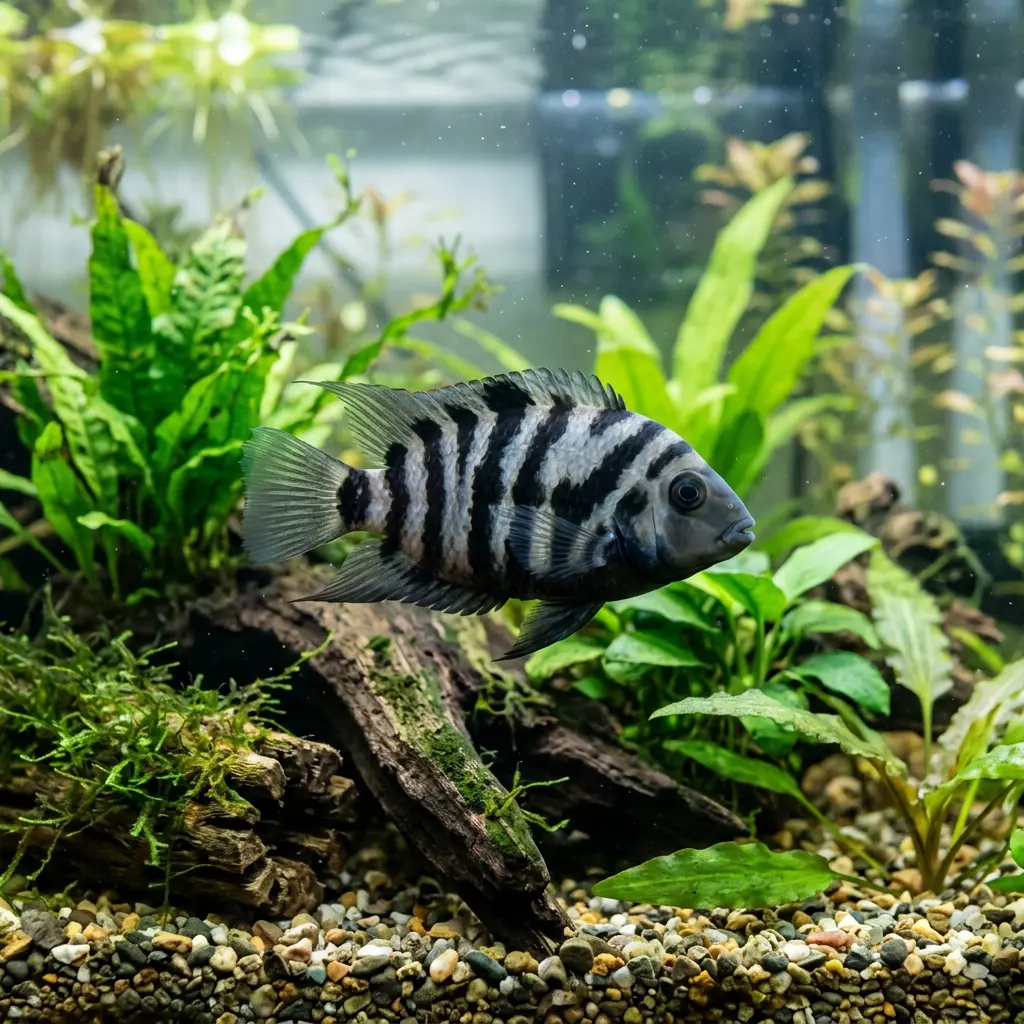
Quick Answer
Convict Cichlid (Amatitlania nigrofasciata) is a hardy, prolifically breeding Central American cichlid. Males reach 6 inches (15.2 cm), females 4 inches (10.2 cm). Requires a minimum 30 gallon (113 liter) aquarium for a pair, with pH 6.5 to 8.0 and temperature 68 to 82 degrees Fahrenheit (20 to 28 degrees Celsius). Not suitable for community tanks due to extreme territorial aggression, especially during breeding.
Quick Facts
| Scientific Name | Amatitlania nigrofasciata |
|---|---|
| Common Names | Convict Cichlid |
| Family | Cichlidae |
| Genus | Amatitlania |
| Type | Freshwater |
| Temperament | aggressive |
| Care Difficulty | intermediate |
| Lifespan | 10 years |
| Maximum Size | Up to 6 in (15 cm) |
| Diet | Omnivore |
| Temperature | 68–82°F (20–28°C) |
| pH | 6.5–8 |
| Hardness | 6–15 dGH |
| Minimum Size | 30 gallons |
Key Takeaways
- Extremely territorial; a breeding pair attacks fish twice their size.
- Among the easiest aquarium fish to breed; any male and female will spawn.
- Males reach 6 inches (15.2 cm); females 4 inches (10.2 cm) with orange bellies.
- Requires over-filtration due to constant digging and high waste production.
- Vegetable fiber in diet is essential to prevent hole-in-the-head disease.
- Best kept as a species-only pair; unsuitable for standard community tanks.
Overview
Taxonomy and Classification
Convict Cichlid, scientifically known as Amatitlania nigrofasciata, belongs to the family Cichlidae within the order Cichliformes. The species was originally described by Albert Günther in 1867 from specimens collected by Frederick DuCane Godman and Osbert Salvin in Central America. The genus has undergone multiple revisions; the species was formerly classified under Archocentrus, Cichlasoma, Cryptoheros, and Heros. A 2007 study by Schmitter-Soto established the current genus Amatitlania, though a 2008 study by Říčan proposed moving it to Hypsophrys, a classification not widely adopted in the aquarium trade.
The common name convict cichlid derives from the distinctive vertical black stripes on the body, reminiscent of historical British prison uniforms. The species epithet nigrofasciata literally translates to black-striped. Synonyms include Archocentrus nigrofasciatus, Cichlasoma nigrofasciatum, Cryptoheros nigrofasciatus, and Heros nigrofasciatus. Regional variants once considered subpopulations are now recognized as separate species, including A. siquia (Honduran red point cichlid) from the Atlantic slope of Honduras to Costa Rica, and A. kanna from Panama's Atlantic slope. True A. nigrofasciata is restricted to the northern population from El Salvador to Guatemala on the Pacific slope and from Honduras to Guatemala on the Atlantic slope.
Natural Distribution and Habitat
The Convict Cichlid is native to Central America along both the Pacific and Atlantic slopes. On the Pacific side, it ranges from the Río Sucio in El Salvador to the Río Suchiate in Guatemala. On the Atlantic side, it occurs from the Río Patuca in Honduras to the Río Jutiapa in Guatemala. The species inhabits lakes, streams, rivers, and creeks with moderate to strong water flow. It prefers habitats with abundant cover in the form of submerged rocks, sunken branches, and aquatic vegetation.
Convict Cichlids are remarkably adaptable and can colonize volcanic lakes at elevations up to 1,500 meters (4,900 feet), tolerating cooler temperatures than typical tropical cichlids. In their natural habitat, water parameters range from pH 6.6 to 7.8, carbonate hardness from 63 to 77 ppm CaCO3, and daily temperatures from 26 to 29 degrees Celsius (79 to 84 degrees Fahrenheit). The species has become a problematic invasive in numerous countries including the United States, Australia, Japan, Mexico, Colombia, the Philippines, and Israel, often establishing populations in warm effluent from power stations or thermal springs.
Physical Characteristics
Adult male Convict Cichlids reach a maximum total length of 6 inches (15.2 cm), while females remain smaller at approximately 4 inches (10.2 cm). The body is moderately deep and laterally compressed with a steep forehead and a mouth capable of protruding 4.2 percent of its standard length, an adaptation for varied feeding. The base coloration is blue-gray to olive, overlaid with 8 to 9 distinct vertical black stripes that extend from the dorsal fin to the belly, giving the fish its convict appearance.
Females develop a vivid pink to orange-red coloration on the belly when sexually mature, which is the most reliable visual characteristic for sexing adult specimens. Males possess longer, more pointed dorsal and anal fins and may develop a slight nuchal hump during breeding condition. An albino variety exists in the aquarium trade, displaying white to pink bodies with faint lavender barring. The caudal fin is rounded to slightly forked, and the lateral line is interrupted, typical of cichlids.
Care
Aquarium Requirements
Convict Cichlids demand an aquarium that accommodates their digging behavior and territorial nature. A single individual requires a minimum 20 gallon (75 liter) tank. A bonded pair requires 30 gallons (113 liters) minimum, with 40 gallons (151 liters) being strongly recommended to provide adequate territory and reduce aggression toward tank mates. If housing multiple pairs or attempting a community of robust cichlids, provide at least 75 gallons (284 liters) with heavy rockwork creating visual barriers.
Filtration and Water Flow
Over-filtration is essential. Convict Cichlids are messy fish that dig constantly, stirring up substrate and producing substantial waste. Use a canister filter or hang-on-back filter rated for at least 8 times the tank volume per hour. Add a sponge filter for supplemental biological filtration, particularly when breeding, as fry require pristine water quality. Moderate water movement is preferred; strong current is unnecessary but adequate surface agitation ensures oxygenation.
Substrate and Hardscape
Use sand or very fine smooth gravel as substrate. These fish are obsessive diggers that excavate pits, move substrate, and uproot plants. Sharp gravel injures their mouths during digging. Pool filter sand or play sand is ideal. All hardscape must be anchored firmly. Use heavy clay pots, large river rocks, and driftwood that cannot be toppled. Stack rockwork using aquarium-safe silicone to bond pieces together, preventing cave-ins when the fish dig underneath. Provide at least 2 to 3 caves per fish using clay pots, PVC pipes of 2 to 3 inch (5 to 7.5 cm) diameter, or rock piles with 3 to 4 inch (7.5 to 10 cm) openings.
Plant Decor
Plants must be robust and well-anchored. Java Fern and Anubias attached to rocks or wood survive well because they do not root in substrate. Cryptocoryne may be uprooted but often recovers if protected by rockwork. Floating plants such as Amazon Frogbit or Salvinia diffuse overhead light and provide security. Avoid delicate stem plants such as Rotala, Ludwigia, or Cabomba, which will be shredded and floated within days.
Water Parameter Stability
Convict Cichlids are remarkably adaptable and tolerate a wide range of standard tap water conditions. However, stability remains important. Sudden pH crashes below 6.0 or temperature drops below 65 degrees Fahrenheit (18 degrees Celsius) induce stress. Perform weekly water changes of 25 to 30 percent to maintain nitrates below 25 ppm. They can tolerate mildly brackish conditions up to 10 percent seawater salinity, though this is unnecessary in standard freshwater setups. Hardness above 20 dGH reduces breeding frequency.
Diet
Dietary Requirements
Convict Cichlids are opportunistic omnivores with a highly adaptable digestive system. In the wild, their diet consists of small insects, worms, crustaceans, plant matter, algae, and occasionally small fish. The ability to protrude their jaw 4.2 percent of standard length allows them to exploit diverse food sources. In captivity, they accept virtually any aquarium food offered, but a balanced diet is essential for long-term health and disease prevention.
Staple Foods
Provide high-quality cichlid pellets or flakes as the dietary foundation. Select products with 35 to 40 percent protein and visible vegetable content. Feed 2 to 3 small meals daily rather than one large meal, offering only what the fish can consume in 2 to 3 minutes. Overfeeding causes obesity and pollutes the water, exacerbating their already high bioload.
Supplemental Foods
Supplement with frozen foods including bloodworms, brine shrimp, and daphnia twice weekly. These protein sources enhance growth, coloration, and breeding readiness. Live foods such as mosquito larvae, black worms, and earthworm pieces are particularly favored and stimulate natural hunting behavior. Vegetable matter is non-negotiable for this species. Offer blanched spinach, zucchini, peas, and spirulina-based foods at least twice weekly. Vegetable fiber prevents hole-in-the-head disease, which is prevalent in cichlids fed exclusively on protein-rich foods.
Feeding Behavior and Competition
Convict Cichlids are enthusiastic, aggressive feeders. In community setups, they dominate feeding time and may consume food intended for other fish. Target feeding with tongs or placing food in multiple locations ensures all tank inhabitants receive nutrition. During breeding, the pair may fast for 24 to 48 hours while guarding eggs, then resume voracious feeding.
Prohibited Foods
Never feed beef heart, pork, or other mammalian proteins. Cichlids lack the digestive enzymes to process mammalian fats efficiently, leading to fatty liver degeneration. Avoid feeder goldfish, which introduce parasites and provide poor nutrition. Do not rely solely on flake foods, as vitamin degradation after 6 months reduces nutritional value significantly.
Health
General Health and Immunity
Convict Cichlids are generally robust and resistant to most common aquarium diseases when maintained in clean, stable water with adequate filtration. However, their high waste production and digging behavior can degrade water quality rapidly if maintenance lapses. They are particularly susceptible to hole-in-the-head disease, a condition prevalent in cichlids fed protein-heavy diets lacking vegetable fiber. All new specimens must undergo a 14-day quarantine in a bare-bottom hospital tank with sponge filtration.
Quarantine Protocol
Quarantine all new fish for 14 days minimum. Perform a 7-day treatment with methylene blue at 3 mg per liter to eliminate external protozoans and fungal spores. Observe for intestinal worms; treat with praziquantel if white segments are visible in feces. During quarantine, feed a medicated food containing metronidazole at 2 mg per gram to eliminate subclinical hexamita infections before they enter the display tank.
Hole in the Head Disease (Hexamita)
A progressive condition caused by the protozoan parasite Hexamita (also called Octomitus or Spironucleus), characterized by lesions on the head and lateral line.
- Small pits or holes on the head, particularly around the sensory pores; white stringy feces; loss of appetite; darkening of skin color; lethargy; emaciation with distended abdomen; lesions along the lateral line and at fin bases.
Poor water quality with inadequate biofiltration; diet deficient in vegetable fiber and chitin; chronic stress from overcrowding or aggression; introduction via infected live foods or new fish.
Provide robust biological filtration with at least 100 square feet of biomedia surface area per pound of fish. Feed a varied diet including regular vegetable matter and spirulina. Perform weekly 25 to 30 percent water changes. Quarantine new specimens for 14 days.
Ich (White Spot Disease)
A protozoan infection caused by Ichthyophthirius multifiliis, characterized by white cysts on fins and body.
- Small white salt-like granules on fins, body, and gills; rubbing against decor; rapid breathing; clamped fins; flashing against substrate.
Introduced via infected fish or plants; triggered by temperature fluctuations or stress from poor water quality and inadequate filtration.
Quarantine all new arrivals for 14 days. Maintain stable temperature between 74 and 80 degrees Fahrenheit. Ensure robust filtration and weekly water changes. Avoid sudden temperature drops below 68 degrees Fahrenheit.
Velvet (Gold Dust Disease)
A parasitic infection caused by Piscinoodinium or related dinoflagellates, presenting as a fine yellow-gold dust on the body.
- Yellowish gold or rust-colored dusting on body and fins; scratching against substrate; lethargy; rapid gill movement; difficulty breathing; clamped fins; loss of appetite.
Introduced via new fish or contaminated equipment; exacerbated by poor water quality, low oxygen, and stress from bright lighting or inadequate hiding places.
Quarantine new fish. Maintain excellent water quality with nitrates below 25 ppm. Provide adequate surface agitation and aeration. Use dim lighting with floating plants to reduce stress.
Fin Rot and Tail Rot
A bacterial infection typically caused by Aeromonas, Pseudomonas, or Flexibacter species, attacking the fin rays and tail tissue.
- Frayed or ragged fin edges; white or blackened fin margins; receding fin tissue; red streaks at fin base in advanced cases; lethargy; loss of appetite.
Poor water quality with elevated nitrates or ammonia; fin nipping from territorial disputes; injury on sharp decor; stress from overcrowding or aggressive tank mates.
Maintain weekly 25 to 30 percent water changes. Use smooth substrate and decor. Avoid overcrowding. Provide adequate territory space with rockwork and caves to reduce aggression.
Columnaris (Mouth Fungus)
A bacterial infection caused by Flavobacterium columnare, often mistaken for fungal growth due to its cottony appearance.
- White or grayish cotton-like patches on mouth, fins, or body; frayed fins; ulcers on body; rapid breathing; loss of appetite; clamped fins; lethargy.
High organic load from uneaten food and waste; overcrowding; temperature spikes above 82 degrees Fahrenheit; stress from transport or poor acclimation.
Avoid overfeeding and remove uneaten food after 3 minutes. Maintain robust filtration. Perform regular gravel vacuuming to remove organic waste. Keep temperature stable between 74 and 80 degrees Fahrenheit.
Bacterial Septicemia
A systemic bacterial infection caused by Aeromonas or Pseudomonas species entering the bloodstream, often secondary to physical injury or chronic stress.
- Red streaks on body and fins; hemorrhaging under scales; bloated abdomen; popeye; loss of appetite; lethargy; rapid breathing; darkened coloration.
Physical injury from fighting or sharp decor; poor water quality with high ammonia or nitrite; chronic stress from inadequate territory; introduction via infected fish or live foods.
Maintain pristine water quality with zero ammonia and nitrite. Use smooth decor and substrate. Provide adequate space and territories to minimize fighting. Quarantine new fish for 14 days. Treat injuries immediately with topical antiseptic.
Breeding
Captive Breeding Overview
Convict Cichlids are legendary in the aquarium hobby for their ease of breeding. They are among the simplest cichlids to spawn in captivity, often breeding spontaneously without any special triggers. Any healthy male and female placed together in adequate conditions will usually form a pair bond and spawn within a matter of weeks. Their exceptional parental care makes them fascinating observation subjects, though their extreme aggression during breeding demands careful management.
Pair Formation
Convict Cichlids do not selectively pair off in the way some cichlids do. Any male and female placed together will usually bond and breed. Juveniles raised together often pair naturally as they mature. The most reliable method for obtaining a pair is to purchase 6 to 8 juveniles of similar size, raise them together, and allow natural pair bonds to form. Once a pair is established, remove the extras immediately before serious aggression develops.
Conditioning and Triggering
Condition the pair with high-quality foods including live blackworms, bloodworms, and brine shrimp for 1 week. Raise the temperature to 78 degrees Fahrenheit (25.5 degrees Celsius) and perform a 30 percent water change with slightly warmer water. Provide a suitable spawning site such as an overturned clay pot, a cave of stacked rocks, or a PVC pipe with a 3 to 4 inch (7.5 to 10 cm) opening. The pair will select and vigorously clean the site, removing all substrate and plants from the immediate area.
Spawning Behavior
The pre-spawning courtship involves head shaking, circling, and lateral displays. The male positions himself vertically, darkening to vivid colors, while the female flares her fins and displays her orange belly. The female lays 100 to 300 adhesive eggs on the roof or wall of the cave. The male fertilizes them immediately. Both parents then guard the nest with extraordinary ferocity, attacking anything that approaches including fish many times their size and human hands.
Egg and Fry Development
Eggs hatch in approximately 72 hours at 78 degrees Fahrenheit (25.5 degrees Celsius). The parents may relocate the wrigglers to a pre-excavated pit in the substrate. Fry become free-swimming in 4 to 5 days. At this stage, feed crushed flake food, baby brine shrimp, and microworms 3 to 4 times daily. The parents continue to guard the fry, herding them away from danger and fanning them with their fins. After 2 to 3 successful spawns, remove the parents, as they may eventually cannibalize subsequent broods. Convicts can spawn every 2 to 3 weeks, producing hundreds of fry annually.
Fry Rearing
Grow-out tanks must be at least 20 gallons (75 liters) with sponge filtration. Perform daily 15 percent water changes to maintain pristine water quality. Sort fry by size weekly to prevent cannibalism among siblings. By 8 weeks, juveniles reach 1 inch (2.5 cm) and begin showing adult coloration. By 6 months, they reach sexual maturity and 2 to 3 inches (5 to 7.5 cm) in length.
Tips
Expert Tips for Long-Term Success
Species-Only is Safest
The single most important decision when keeping Convict Cichlids is tank composition. A species-only tank with one confirmed pair eliminates 99 percent of aggression-related problems. Community attempts with peaceful fish end in death. Even large, aggressive cichlid communities require 75 gallons (284 liters) minimum with elaborate rockwork. For 99 percent of aquarists, the species-only pair tank is the only viable option.
Over-Filter Religiously
Convict Cichlids are messy. Their constant digging stirs up detritus, and their heavy feeding produces substantial waste. Under-filtration leads to chronic elevated nitrates, which causes hole-in-the-head disease and bacterial infections. Use a canister filter rated for double your tank volume, or pair a hang-on-back filter with a sponge filter. Clean mechanical media monthly but never replace all biological media simultaneously.
Fiber Prevents Hole-in-the-Head
Hole-in-the-head disease is the number one health threat to captive cichlids, and it is almost entirely preventable through diet. A protein-heavy diet of pellets and frozen meaty foods without vegetable fiber creates the perfect environment for Hexamita to proliferate. You must offer blanched vegetables, spirulina flakes, or algae wafers at least twice weekly. This simple dietary addition prevents a disease that kills thousands of cichlids annually.
Anchor Everything
These fish dig with astonishing power. A stack of rocks that looks stable to you is a landslide waiting to happen under a determined Convict. Use aquarium-safe silicone to bond rockwork together. Place heavy clay pots directly on the tank bottom before adding substrate, so the fish cannot dig underneath and topple them. Floating plants must be contained within feeding rings or they will be shredded and scattered.
Juvenile Pairing Method
Do not attempt to force-pair two adult fish of unknown compatibility. Instead, purchase 6 to 8 juveniles of similar size and raise them together. Natural pair bonds form as the fish mature. Once a pair is confirmed through courtship behavior, remove all other fish immediately. This method yields the strongest, most stable pair bonds and avoids the violence of introducing two random adults.
Parent Removal Timing
While Convict parents provide exceptional care for the first 2 to 3 broods, they eventually tire and may eat subsequent spawns. Remove the parents after the second or third successful batch of free-swimming fry. Alternatively, if you wish to observe parental care continuously, provide a large tank with multiple caves so the parents can establish new territories away from growing juveniles.
Compatible Tank Mates






Species Comparison
| Feature | Convict Cichlid | Jack Dempsey | Firemouth Cichlid | Oscar |
|---|---|---|---|---|
| Maximum Size | 6 inches (15.2 cm) male; 4 inches (10.2 cm) female | 10 inches (25 cm) | 6.5 inches (16.5 cm) | 14 inches (35 cm) |
| Temperament | Highly aggressive; attacks fish 3x their size | Aggressive; territorial but less frenetic | Moderately aggressive; displays more than attacks | Moderately aggressive; predatory toward small fish |
| Minimum Tank Size (Pair) | 30 gallons (113 L); 40 gal (151 L) recommended | 55 gallons (208 L) | 30 gallons (113 L) | 75 gallons (284 L) |
| Diet | Omnivore; pellets, vegetables, frozen foods, insects | Carnivore; pellets, worms, crustaceans, small fish | Omnivore; pellets, vegetables, frozen foods | Carnivore; pellets, live fish, crustaceans, worms |
| pH Range | 6.5 to 8.0 | 6.5 to 8.0 | 6.5 to 7.5 | 6.5 to 7.5 |
| Breeding Difficulty | Very Easy; any male and female will spawn | Moderate; requires specific conditions | Moderate; cave spawners with specific triggers | Difficult; requires very large tank and specific pairing |