
Firemouth Cichlid (Thorichthys meeki)
Quick Answer
Firemouth Cichlid (Thorichthys meeki) is a semi-aggressive, omnivorous Central American cichlid native to the Yucatan Peninsula. Males reach 6 inches (15.2 cm), females 4 to 5 inches (10 to 12.7 cm). Requires a minimum 30 gallon (113 liter) aquarium for a pair, with pH 6.5 to 8.5 and temperature 70 to 82 degrees Fahrenheit (21.1 to 27.8 degrees Celsius). Famous for dramatic red throat flaring during territorial and courtship displays.
Quick Facts
| Scientific Name | Thorichthys meeki |
|---|---|
| Common Names | Firemouth Cichlid |
| Family | Cichlidae |
| Genus | Thorichthys |
| Type | Freshwater |
| Temperament | semi-aggressive |
| Care Difficulty | intermediate |
| Lifespan | 10 years |
| Maximum Size | Up to 6 in (15 cm) |
| Diet | Omnivore |
| Temperature | 70–82°F (21–28°C) |
| pH | 6.5–8.5 |
| Hardness | 6–18 dGH |
| Minimum Size | 30 gallons |
Key Takeaways
- Famous for dramatic red throat flaring during territorial and courtship displays.
- Relatively peaceful for a Central American cichlid; uses displays before attacking.
- Males reach 6 inches (15.2 cm); females 4 to 5 inches (10 to 12.7 cm).
- Requires sand substrate for natural sifting and foraging behavior.
- Forms monogamous pairs with strong parental care and cooperative fry defense.
- Vegetable fiber in diet is essential to prevent hole-in-the-head disease.
Overview
Taxonomy and Classification
Firemouth Cichlid, scientifically known as Thorichthys meeki, belongs to the family Cichlidae within the order Cichliformes. The species was described by Brind in 1918 and named in honor of American ichthyologist Seth Eugene Meek (1859 to 1914), compiler of the first book on Mexican freshwater fishes. The genus name Thorichthys derives from the Ancient Greek throsko meaning to leap or spring, and ikhthys meaning fish. The type locality is given as Near Progreso, Yucatan, Mexico.
Synonyms include Thorichthys helleri meeki, Cichlasoma meeki, Herichthys meeki, and Cichlasoma hyorhynchum. The species has been a staple of the aquarium trade for well over a century and remains one of the most popular Central American cichlids due to its manageable size, relatively docile temperament for a cichlid, and spectacular coloration.
Natural Distribution and Habitat
The natural range extends eastward from the Rio Tonala system near Coatzacoalcos on Mexico's Atlantic slope, through the states of Veracruz, Chiapas, and Tabasco, around the Yucatan Peninsula, then southward into northern Belize and Guatemala. Naturalized invasive populations exist in Hawaii since 1940, Puerto Rico since the late 2000s, and there are reports from Arizona and Florida in the United States.
Their habitat is extraordinarily diverse. They inhabit lowland biotopes characterized by still to moderately-flowing, relatively shallow water less than 1.5 meters deep, ranging from crystal clear to muddy, fresh to slightly brackish. Specific habitats include cenotes, lagoons, roadside pools, spring-fed ponds, ditches, streams, and minor tributaries. Substrates may be sand, mud, marlstone, or travertine limestone. Aquatic vegetation may be absent or composed of algae, Myriophyllum, Potamogeton, Eichhornia, Nymphaea, Carex, and Typha species. Beds of leaf litter and submerged woody structures are common features. They share their range with species such as Amphilophus robertsoni, Rocio octofasciata, Parachromis friedrichsthalii, Thorichthys helleri, and various livebearers including Poecilia mexicana and Xiphophorus hellerii.
Physical Characteristics
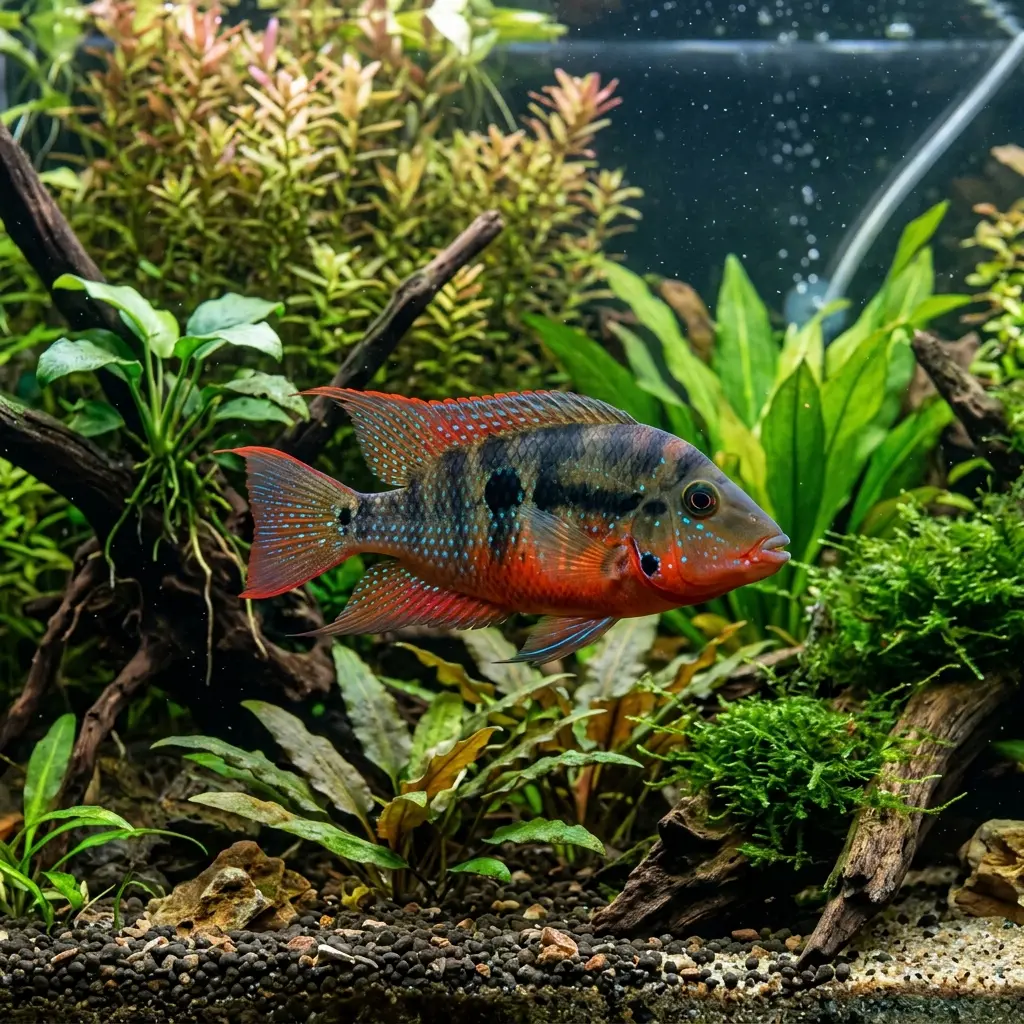
Adult male Firemouth Cichlids reach a maximum total length of 6 inches (15.2 cm), while females remain smaller at 4 to 5 inches (10 to 12.7 cm). The standard length typically ranges from 3.9 to 4.7 inches (10 to 12 cm). The body is moderately deep and laterally compressed with a greyish-green to olive base coloration overlaid with darker vertical barring. The underside of the jaw, throat, and belly develop a brilliant red to orange-red coloration, which intensifies dramatically during spawning and territorial disputes.
Males develop longer, more pointed filaments on the dorsal and anal fins. Females possess a rounder, fuller body profile, especially when gravid. The mouth is moderately large and slightly protrusible, adapted for sifting substrate and capturing small prey. The caudal fin is moderately forked. Under optimal conditions, the red throat coloration becomes a vivid crimson that extends from the lower jaw to the pectoral fin bases. The species lacks an adipose fin, typical of cichlids. Average lifespan in captivity is 8 to 10 years, with documented cases exceeding 15 years.
Care
Aquarium Requirements
Firemouth Cichlids demand an aquarium that accommodates their digging behavior and territorial nature while providing adequate swimming space. A single individual requires a minimum 30 gallon (113 liter) tank. A bonded pair requires 30 gallons (113 liters) minimum, with 55 gallons (208 liters) being strongly recommended to provide adequate territory and space for potential tank mates. If housing multiple pairs or attempting a community of robust cichlids, provide at least 75 gallons (284 liters) with elaborate rockwork and driftwood. The minimum tank footprint for a pair is 47 inches by 12 inches (120 cm by 30 cm).
Filtration and Water Flow
Robust filtration is essential. Firemouth Cichlids are messy fish that dig constantly, stirring up substrate and producing substantial waste. Use a canister filter or hang-on-back filter rated for at least 8 times the tank volume per hour. Water flow should be moderate; these fish prefer slow-moving water and do not require strong current. A filter turnover rate of 4 to 5 times the tank volume is adequate for water movement. Add a sponge filter for supplemental biological filtration, particularly when breeding, as fry require pristine water quality.
Substrate and Hardscape
Use sand at a depth of 1 to 2 inches (2.5 to 5 cm). Firemouth Cichlids are obsessive sifters that scoop mouthfuls of substrate and expel it through their gills to extract edible particles. Sharp or coarse gravel abrades their gill rakers and mouth tissues. Pool filter sand or play sand is ideal. Dark-colored sand enhances their red throat coloration. All hardscape must be anchored firmly. Use heavy clay pots, large river rocks, and driftwood that cannot be toppled. Stack rockwork using aquarium-safe silicone to bond pieces together, preventing cave-ins when the fish dig underneath. Provide at least 2 to 3 caves per fish using clay pots, PVC pipes of 2 to 3 inch (5 to 7.5 cm) diameter, or rock piles.
Plant Decor
Plants must be robust and well-anchored. Java Fern and Anubias attached to rocks or wood survive well because they do not root in substrate. Cryptocoryne may be uprooted but often recovers if protected by rockwork. Potted Sagittaria with protected roots can work. Floating plants such as Amazon Frogbit, Salvinia, or Water Lettuce diffuse overhead light and provide security. Avoid delicate stem plants such as Rotala, Ludwigia, or Cabomba, which will be shredded and uprooted within days. In nature, vegetation is often sparse, so a lightly planted tank with emphasis on hardscape is more biologically appropriate than a densely planted aquascape.
Water Parameter Stability
Firemouth Cichlids are remarkably adaptable and tolerate a wide range of standard tap water conditions from slightly acidic to mildly alkaline, and from soft to very hard. However, stability remains important. Sudden pH crashes below 6.0 or temperature drops below 65 degrees Fahrenheit (18 degrees Celsius) induce stress. Perform weekly water changes of 25 to 30 percent to maintain nitrates below 20 ppm. They can tolerate mildly brackish conditions up to slightly brackish salinity, though this is unnecessary in standard freshwater setups. Hardness below 4 dGH reduces breeding frequency.
Diet
Dietary Requirements
Firemouth Cichlids are opportunistic omnivores with a highly adaptable digestive system. In the wild, their diet consists primarily of crustaceans and invertebrates, with the occasional addition of plant matter and organic detritus. Their ability to sift substrate through their gills allows them to extract microscopic food items from the sand and mud. In captivity, they accept virtually any aquarium food offered, but a balanced diet is essential for long-term health, vibrant coloration, and disease prevention.
Staple Foods
Provide high-quality cichlid pellets or flakes as the dietary foundation. Select products with 35 to 40 percent protein and visible vegetable or spirulina content. Feed 2 to 3 small meals daily rather than one large meal, offering only what the fish can consume in 2 to 3 minutes. Overfeeding causes obesity and pollutes the water, exacerbating their already significant bioload.
Supplemental Foods
Supplement with frozen foods including bloodworms, brine shrimp, daphnia, and blackworms twice weekly. These protein sources enhance growth, coloration, and breeding readiness. Live foods such as mosquito larvae, blackworms, wingless fruit flies, daphnia, copepods, and cut-up earthworms are particularly favored and stimulate natural hunting and sifting behavior. Vegetable matter is non-negotiable for this species. Offer blanched spinach, zucchini, peas, lettuce, cucumber, and spirulina-based foods at least twice weekly. Vegetable fiber and chitin prevent hole-in-the-head disease, which is prevalent in cichlids fed exclusively on protein-rich foods.
Natural Foraging Behavior
These fish are enthusiastic feeders that constantly patrol the substrate. In aquariums with sand, you will observe them scooping mouthfuls of substrate and expelling it through their gills, a natural filter-feeding behavior that extracts detritus and small organisms. This behavior is not only fascinating to observe but also serves as a form of enrichment. Ensure that any live plants with exposed roots are protected, as the fish may pick at them during foraging.
Prohibited Foods
Never feed beef heart, pork, or other mammalian proteins. Cichlids lack the digestive enzymes to process mammalian fats efficiently, leading to fatty liver degeneration. Avoid feeder goldfish, which introduce parasites and provide poor nutrition. Do not rely solely on flake foods, as vitamin degradation after 6 months reduces nutritional value significantly.
Health
General Health and Immunity
Firemouth Cichlids are generally robust and resistant to most common aquarium diseases when maintained in clean, stable water with adequate filtration. However, their constant digging and substrate-sifting behavior can degrade water quality rapidly if maintenance lapses. They are particularly susceptible to hole-in-the-head disease, a condition prevalent in cichlids fed protein-heavy diets lacking vegetable fiber. All new specimens must undergo a 14-day quarantine in a bare-bottom hospital tank with sponge filtration.
Quarantine Protocol
Quarantine all new fish for 14 days minimum. Perform a 7-day treatment with methylene blue at 3 mg per liter to eliminate external protozoans and fungal spores. Observe for intestinal worms; treat with praziquantel if white segments are visible in feces. During quarantine, feed a medicated food containing metronidazole at 2 mg per gram to eliminate subclinical hexamita infections before they enter the display tank. Because Firemouths are sensitive to poor water quality, ensure the quarantine tank receives the same filtration standards as the display tank.
Hole in the Head Disease (Hexamita)
A progressive condition caused by the protozoan parasite Hexamita (also called Octomitus or Spironucleus), characterized by lesions on the head and lateral line.
- Small pits or holes on the head, particularly around the sensory pores; white stringy feces; loss of appetite; darkening of skin color; lethargy; emaciation with distended abdomen; lesions along the lateral line and at fin bases.
Poor water quality with inadequate biofiltration; diet deficient in vegetable fiber and chitin; chronic stress from overcrowding or aggression; introduction via infected live foods or new fish.
Provide robust biological filtration with at least 100 square feet of biomedia surface area per pound of fish. Feed a varied diet including regular vegetable matter, spirulina, and chitin sources. Perform weekly 25 to 30 percent water changes. Quarantine new specimens for 14 days.
Ich (White Spot Disease)
A protozoan infection caused by Ichthyophthirius multifiliis, characterized by white cysts on fins and body.
- Small white salt-like granules on fins, body, and gills; rubbing against decor; rapid breathing; clamped fins; flashing against substrate.
Introduced via infected fish or plants; triggered by temperature fluctuations or stress from poor water quality and inadequate filtration.
Quarantine all new arrivals for 14 days. Maintain stable temperature between 74 and 80 degrees Fahrenheit. Ensure robust filtration and weekly water changes. Avoid sudden temperature drops below 68 degrees Fahrenheit.
Velvet (Gold Dust Disease)
A parasitic infection caused by Piscinoodinium or related dinoflagellates, presenting as a fine yellow-gold dust on the body.
- Yellowish gold or rust-colored dusting on body and fins; scratching against substrate; lethargy; rapid gill movement; difficulty breathing; clamped fins; loss of appetite.
Introduced via new fish or contaminated equipment; exacerbated by poor water quality, low oxygen, and stress from bright lighting or inadequate hiding places.
Quarantine new fish. Maintain excellent water quality with nitrates below 20 ppm. Provide adequate surface agitation and aeration. Use moderate lighting with floating plants to reduce stress.
Fin Rot and Tail Rot
A bacterial infection typically caused by Aeromonas, Pseudomonas, or Flexibacter species, attacking the fin rays and tail tissue.
- Frayed or ragged fin edges; white or blackened fin margins; receding fin tissue; red streaks at fin base in advanced cases; lethargy; loss of appetite.
Poor water quality with elevated nitrates or ammonia; fin nipping from territorial disputes; injury on sharp decor; stress from overcrowding or aggressive tank mates.
Maintain weekly 25 to 30 percent water changes. Use smooth substrate and decor. Avoid overcrowding. Provide adequate territory space with rockwork and caves to reduce aggression.
Columnaris (Mouth Fungus)
A bacterial infection caused by Flavobacterium columnare, often mistaken for fungal growth due to its cottony appearance.
- White or grayish cotton-like patches on mouth, fins, or body; frayed fins; ulcers on body; rapid breathing; loss of appetite; clamped fins; lethargy.
High organic load from uneaten food and waste; overcrowding; temperature spikes above 84 degrees Fahrenheit; stress from transport or poor acclimation.
Avoid overfeeding and remove uneaten food after 3 minutes. Maintain robust filtration. Perform regular gravel vacuuming to remove organic waste. Keep temperature stable between 74 and 80 degrees Fahrenheit.
Bacterial Septicemia
A systemic bacterial infection caused by Aeromonas or Pseudomonas species entering the bloodstream, often secondary to physical injury from territorial fighting or chronic stress.
- Red streaks on body and fins; hemorrhaging under scales; bloated abdomen; popeye; loss of appetite; lethargy; rapid breathing; darkened coloration.
Physical injury from fighting or sharp decor; poor water quality with high ammonia or nitrite; chronic stress from inadequate territory; introduction via infected fish or live foods.
Maintain pristine water quality with zero ammonia and nitrite. Use smooth decor and substrate. Provide adequate space and territories to minimize fighting. Quarantine new fish for 14 days. Treat injuries immediately with topical antiseptic.
Breeding
Captive Breeding Overview
Firemouth Cichlids are among the easier cichlids to breed in captivity and are often recommended as a beginner's introduction to cichlid breeding. They form monogamous pair bonds and frequently spawn spontaneously without any special environmental manipulation. Their exceptional parental care, combined with their relatively manageable aggression compared to other Central American cichlids, makes them fascinating observation subjects for aquarists interested in natural breeding behavior.
Pair Formation
Firemouth Cichlids form monogamous pairs that typically bond for life. Juveniles raised together often pair naturally as they mature. The most reliable method for obtaining a pair is to purchase 6 to 8 juveniles of similar size, raise them together in a spacious tank, and allow natural pair bonds to form. Once a pair is confirmed through courtship behavior, remove the extras immediately before serious aggression develops. Alternatively, any healthy male and female placed together in adequate conditions will usually form a bond and spawn within weeks.
Conditioning and Triggering
Condition the pair with high-quality foods including live blackworms, bloodworms, and brine shrimp for 1 to 2 weeks. Raise the temperature to 78 to 80 degrees Fahrenheit (25.5 to 27 degrees Celsius) and perform a 30 percent water change with slightly warmer water. Provide a suitable spawning site such as a flat stone, an overturned clay pot tilted on its side, a smooth section of driftwood, or even the aquarium glass. The pair will select and vigorously clean the site, removing all substrate and debris from the immediate area.
Spawning Behavior
The pre-spawning courtship involves head shaking, circling, and lateral displays with intense throat flaring. The male darkens and intensifies his red throat to a brilliant crimson, fully extending his dorsal and anal fins. The female responds with less intense but noticeable coloration. The female lays 100 to 500 adhesive eggs on the chosen flat surface. The male fertilizes them immediately. Both parents then guard the nest; the female stays closest to the eggs, fanning them with her fins, while the male patrols the perimeter and attacks any intruders.
Egg and Fry Development
Eggs hatch in approximately 48 to 72 hours at 78 degrees Fahrenheit (25.5 degrees Celsius). The parents may relocate the wrigglers to a pre-excavated pit in the substrate. Fry become free-swimming in 5 to 7 days. At this stage, feed crushed flake food, baby brine shrimp, and microworms 3 to 4 times daily. The parents continue to guard and herd the fry, leading them to food and protecting them from threats. Young, inexperienced pairs may eat or abandon their first spawn if threatened or stressed, so minimize disturbance during the initial breeding attempts. After 2 to 3 successful spawns, the parents may begin to show reduced care; at this point, you may remove them if you wish to raise subsequent broods separately.
Fry Rearing
Grow-out tanks must be at least 20 gallons (75 liters) with sponge filtration. Perform daily 15 percent water changes to maintain pristine water quality. Sort fry by size weekly to prevent cannibalism among siblings. By 8 weeks, juveniles reach 1 to 1.5 inches (2.5 to 3.8 cm) and begin showing the characteristic red throat coloration. By 6 months, they reach sexual maturity at 2 to 3 inches (5 to 7.5 cm) in length.
Tips
Expert Tips for Long-Term Success
Dither Fish Are Essential
The single most effective technique for reducing skittishness and encouraging natural behavior in Firemouth Cichlids is the use of dither fish. These are active, robust fish that swim openly in the water column, signaling to the cichlids that the environment is safe. Swordtails are the classic and most effective dither fish for Firemouths, as they share similar water parameter preferences, are fast enough to avoid predation, and their fry provide natural supplemental food. Giant Danios, Colombian Tetras, and Silver Dollars also serve as excellent dither fish.
Sand is Non-Negotiable
Firemouth Cichlids are substrate sifters by nature. Watching them scoop sand and expel it through their gills is one of the most fascinating behaviors in the aquarium hobby. This natural foraging behavior is not merely aesthetic; it provides mental stimulation and allows them to extract nutrients from detritus that other fish miss. Sharp gravel prevents this behavior and causes chronic mouth and gill injuries. Use pool filter sand or play sand at 1 to 2 inches depth.
Fiber Prevents Hole-in-the-Head
Hole-in-the-head disease is the number one health threat to captive cichlids, and it is almost entirely preventable through diet. A protein-heavy diet of pellets and frozen meaty foods without vegetable fiber creates the perfect environment for Hexamita to proliferate. You must offer blanched vegetables, spirulina flakes, or algae wafers at least twice weekly. This simple dietary addition prevents a disease that kills thousands of cichlids annually and is missed by most beginner guides.
Anchor Everything
These fish dig with surprising power. A stack of rocks that looks stable to you is a landslide waiting to happen under a determined Firemouth. Use aquarium-safe silicone to bond rockwork together. Place heavy clay pots directly on the tank bottom before adding substrate, so the fish cannot dig underneath and topple them. PVC pipes of 2 to 3 inch diameter make excellent, inexpensive caves that are too heavy to move.
Juvenile Pairing Method
Do not attempt to force-pair two adult fish of unknown compatibility. Instead, purchase 6 to 8 juveniles of similar size and raise them together. Natural pair bonds form as the fish mature. Once a pair is confirmed through courtship behavior, remove all other fish immediately. This method yields the strongest, most stable pair bonds and avoids the violence of introducing two random adults.
Monitor Spawning Aggression
While Firemouths are relatively peaceful outside of breeding, they become fiercely territorial during spawning. In community tanks, this sudden aggression can shock aquarists who assumed their fish were docile. Watch for intensified throat flaring, excavation of large pits, and coordinated attacks on specific tank mates. If aggression becomes lethal, remove the object of aggression or separate the breeding pair to a dedicated spawning tank. A 20 gallon (75 liter) bare-bottom tank with a sponge filter serves as an excellent temporary breeding quarters.
Compatible Tank Mates






Species Comparison
| Feature | Firemouth Cichlid | Jack Dempsey | Convict Cichlid | Blue Acara |
|---|---|---|---|---|
| Maximum Size | 6 inches (15.2 cm) male; 4 to 5 inches (10 to 12.7 cm) female | 10 inches (25 cm) | 6 inches (15.2 cm) male; 4 inches (10.2 cm) female | 7 inches (18 cm) |
| Temperament | Semi-aggressive; displays more than attacks | Aggressive; highly territorial | Highly aggressive; attacks fish twice their size | Moderately aggressive; relatively peaceful for cichlid |
| Minimum Tank Size (Pair) | 30 gallons (113 L); 55 gal (208 L) recommended | 55 gallons (208 L) | 30 gallons (113 L); 40 gal (151 L) recommended | 30 gallons (113 L); 55 gal (208 L) recommended |
| Diet | Omnivore; pellets, vegetables, frozen foods, sifted detritus | Carnivore; pellets, worms, crustaceans, small fish | Omnivore; pellets, vegetables, frozen foods, insects | Omnivore; pellets, vegetables, frozen foods |
| pH Range | 6.5 to 8.5 | 6.5 to 8.0 | 6.5 to 8.0 | 6.5 to 8.0 |
| Community Suitability | Moderate; compatible with robust, similar-sized fish | Low; best in species-only or large cichlid community | Very Low; species-only pair tank strongly recommended | Moderate; more peaceful than most Central American cichlids |