
Threadfin Rainbowfish (Iriatherina werneri)
Quick Answer
Threadfin Rainbowfish (Iriatherina werneri) is a delicate, graceful species requiring a minimum 15 gallon (57 liter) aquarium with soft, slightly acidic water (pH 6.0-7.0), temperature 75-82°F (24-28°C), and gentle filtration. This omnivore occupies the top/middle zone, must be kept in schools of 8-12, and makes an excellent addition to peaceful planted community setups.
Quick Facts
| Scientific Name | Iriatherina werneri |
|---|---|
| Common Names | Threadfin Rainbowfish |
| Family | Melanotaeniidae |
| Genus | Iriatherina |
| Type | Freshwater |
| Temperament | peaceful |
| Care Difficulty | intermediate |
| Lifespan | 4 years |
| Maximum Size | Up to 2 in (5 cm) |
| Diet | Omnivore |
| Temperature | 75–82°F (24–28°C) |
| pH | 5.5–8 |
| Hardness | 1–12 dGH |
| Minimum Size | 15 gallons |
Key Takeaways
- Requires a minimum school of 8-12 individuals for natural behavior and color display.
- Needs a 15 gallon (57 liter) long tank minimum; 20-30 gallons (76-114 liters) recommended for larger groups.
- Extremely sensitive to copper, formalin, and aquarium salt above 2 ppt.
- Males develop spectacular elongated dorsal, anal, and pelvic fins up to body length.
- Spawns daily when conditioned; eggs hatch in 10-14 days at 75°F (24°C).
- Fry require microscopic foods (infusoria, rotifers) for the first 10-14 days.
- Hard water above 12 dGH (215 ppm) reduces breeding success and fin extension.
Overview
Species Overview
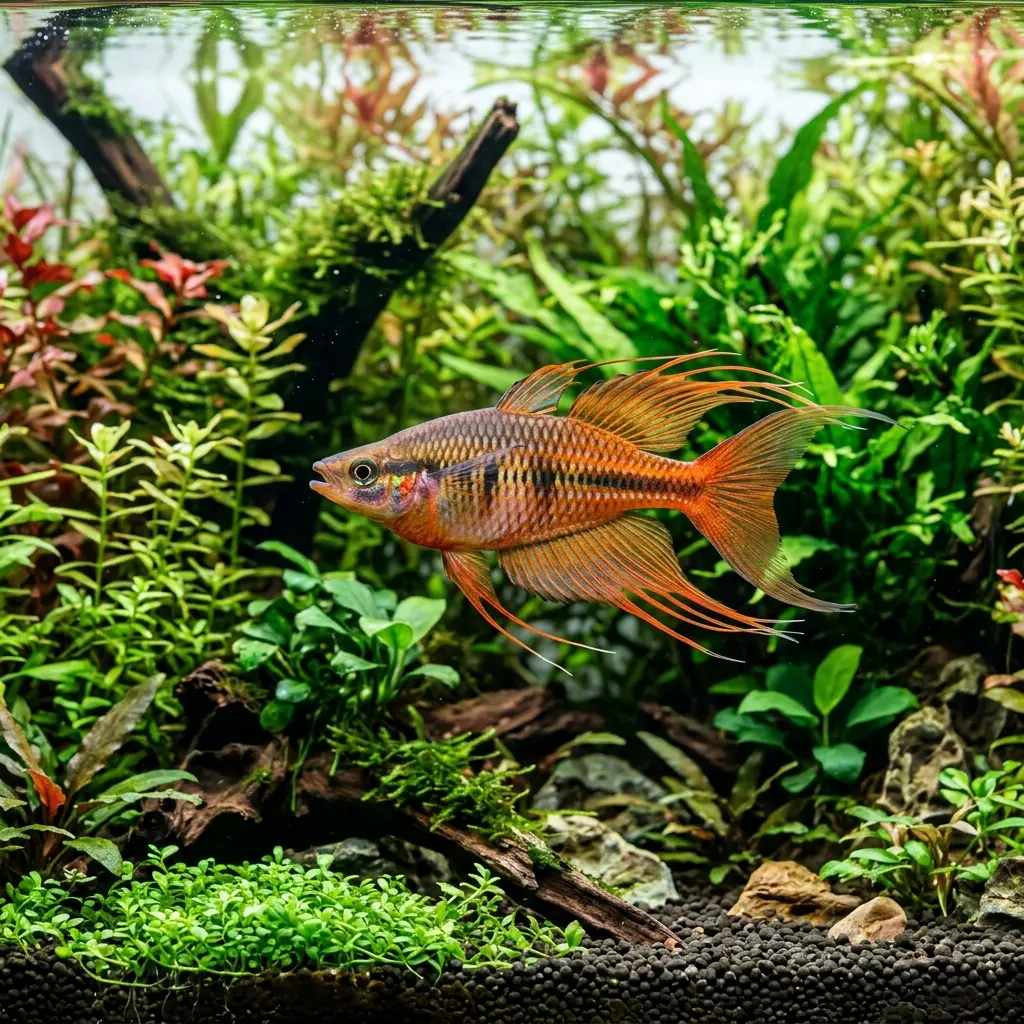
The Threadfin Rainbowfish (Iriatherina werneri) stands as one of the most visually striking small freshwater species in the aquarium hobby. Males develop extraordinarily elongated dorsal, anal, and pelvic fins that can extend nearly the full length of their body, creating a feather-like appearance that gives this species its common names: Featherfin Rainbowfish and Forktail Rainbowfish. This species is currently the sole member of its genus, though morphological variations between geographic populations suggest potential future taxonomic revisions.
Native to the slow-moving swamps, wetlands, and lily pad pools of Papua New Guinea and Northern Australia, I. werneri has adapted to life in still, vegetation-choked waters with minimal current. Their natural habitats are characterized by soft, slightly acidic water stained dark with tannins from decaying leaf litter. These environmental conditions must be replicated in captivity to unlock their full color potential and encourage natural spawning behavior.
Visual Identification
Sexual dimorphism is pronounced in this species. Males display silver bodies with iridescent blue and red highlights, complemented by their signature black, thread-like fin extensions. The first and second dorsal fins, pelvic fins, and anal fins all elongate dramatically. Females remain smaller, exhibit a golden-olive base coloration, and completely lack the extravagant finnage. Interestingly, research has demonstrated that females actively prefer males with longer fins, driving sexual selection for increasingly elaborate display structures.
Behavioral Highlights
When maintained in proper schools of 8-12 individuals, males engage in continuous courtship displays, rapidly opening and closing their fins to attract females and intimidate rival males. This behavior transforms a well-planted aquarium into a living display of avian-like courtship rituals. Their constant activity in the upper water column makes them excellent dither fish for shy species, provided tank mate selection respects their delicate constitution.
Diet
Dietary Requirements
Threadfin Rainbowfish possess exceptionally narrow throats and tiny mouths, restricting them to food particles under 0.5 mm in diameter. In their natural habitat, they feed on suspended phytoplankton, diatoms, and microzooplankton in the water column. This specialized feeding ecology demands careful food selection in captivity.
Nutritional Composition
Target a diet comprising approximately 40% protein, 12% fat, and 48% plant matter. High protein levels maintain the vibrant colors and fin development in males, while plant matter supports digestive health. Avoid beef heart, tubifex worms, or large pellets entirely—these items cannot be consumed and will foul water quality.
Recommended Foods
- Primary: Finely powdered high-quality flake food (crush between fingers), micro-pellets sized 0.3 mm or smaller
- Live foods: Baby brine shrimp (Artemia nauplii), Moina water fleas, micro worms, vinegar eels, and copepods
- Frozen options: Frozen cyclops, daphnia, and baby brine shrimp—thaw and rinse before feeding
- Supplementary: Spirulina powder, powdered vegetable matter, and green water for fry
Feeding Schedule
Feed small portions 2-3 times daily. Each feeding should be consumed within 2-3 minutes. Remove uneaten food immediately to prevent ammonia spikes. Target feeding with a turkey baster or pipette ensures shy individuals receive adequate nutrition when kept with slightly more assertive tank mates.
Expert Tip: Live Food Conditioning
For breeding conditioning, increase live food proportion to 70% of the diet for 2-3 weeks prior to introducing spawning media. Females fed Moina produce significantly more eggs with higher hatch rates than those maintained on dry foods alone.
Health
Health and Disease Management
Threadfin Rainbowfish are moderately hardy when maintained in stable, mature aquariums with appropriate water parameters. However, their small size, delicate fin structure, and sensitivity to chemical treatments make them more vulnerable to disease than robust species like zebra danios or guppies. Prevention through quarantine, pristine water quality, and stress reduction is vastly more effective than treatment.
Medication Sensitivity Alert
This species exhibits extreme sensitivity to several common aquarium medications. You must adjust dosages significantly:
- Copper: Maximum safe concentration is 0.1 mg/L—standard ich treatments often contain lethal doses. Remove invertebrates before any copper treatment.
- Formalin: Use at half-strength maximum. Full doses cause respiratory distress and death within 24 hours.
- Malachite Green: Safe at quarter-strength (0.025 mg/L). Higher concentrations damage the gill epithelium.
- Aquarium Salt: Tolerance is below 2 ppt (parts per thousand). Standard salt treatments of 1 tablespoon per 5 gallons (~3 ppt) are toxic.
- Safe Options: Praziquantel for internal parasites, Methylene Blue at half-strength for fungal issues and egg disinfection, and Kanamycin for bacterial infections.
Quarantine Protocol
Quarantine all new Threadfin Rainbowfish for a minimum of 3-4 weeks in a separate 10-gallon (38 liter) tank with a mature sponge filter. Observe for feeding response, fin condition, and parasite loads. Do not rush acclimation—drip acclimation over 45-60 minutes is mandatory for wild-caught or imported specimens.
Ich (White Spot Disease)
A protozoan parasite (Ichthyophthirius multifiliis) that presents as white salt-grain spots on body and fins. Highly contagious and potentially fatal in threadfins due to medication sensitivity.
- White cysts 0.5-1.0 mm in diameter on fins, body, and gill covers; fish flashing against decor; rapid gill movement; clamped fins; reduced appetite.
Introduced via infected fish, plants, or equipment; triggered by temperature fluctuations, poor water quality, or stress from inadequate schooling numbers.
Quarantine all new additions for 4 weeks; maintain stable temperature within 75-82°F (24-28°C); avoid temperature swings exceeding 2°F (1.1°C) in 24 hours; ensure school size of 8+ to reduce stress.
Velvet (Gold Dust Disease)
A dinoflagellate parasite (Oodinium pilularis) that appears as a fine gold or rust-colored dust on skin. Photosynthetic and extremely lethal to small fish within 48 hours of visible symptoms.
- Gold or rust-colored dust visible under flashlight at sharp angles; rapid breathing; scratching against substrate; lethargy; fin clamping; refusal to eat.
Introduced via infected stock; proliferates in warm water with strong lighting. Stress from transport or poor acclimation triggers outbreaks.
Quarantine new fish; dim lighting for 3 days after introducing new stock; maintain pristine water quality; use UV sterilization on quarantine tanks.
Fin Rot (Bacterial)
Bacterial erosion of fin tissue caused by Aeromonas or Pseudomonas species. Threadfins are particularly susceptible due to their long, delicate fin rays which provide ample surface area for bacterial colonization.
- Ragged, fraying fin edges with white or translucent margins; receding fin tissue progressing toward the body; red streaks in advanced cases; listlessness.
House only with peaceful, non-nipping species; remove sharp-edged decorations; maintain nitrates below 10 ppm through weekly water changes; feed fresh, vitamin-rich foods to maintain immune function.
Columnaris (Mouth Fungus)
A bacterial infection caused by Flavobacterium columnare that spreads rapidly in warm water. Often mistaken for fungal infections due to cotton-like appearance.
- White or grayish patches around mouth and gills; saddleback lesion behind dorsal fin; frayed fins; rapid breathing; loss of appetite; lethargy.
Stress from temperature fluctuations above 3°F (1.7°C) in 24 hours; overcrowding; poor water quality; introduction via infected fish or equipment.
Maintain stable temperature; avoid overcrowding (stock no more than 1 inch of fish per 2 gallons); sterilize nets and equipment between tanks; quarantine new arrivals.
Swim Bladder Disorder
A dysfunction of the swim bladder causing buoyancy issues. Common in threadfins due to their tiny mouths and tendency to gulp air when consuming floating foods or when startled.
- Fish floating at surface, sinking to bottom, or swimming at odd angles; difficulty maintaining position in water column; bloated abdomen in some cases.
Overfeeding with dry foods that expand in the gut; constipation from low-fiber diet; physical trauma from jumping or rough handling; bacterial infection secondary to poor water quality.
Feed small portions 2-3 times daily rather than single large meals; soak dry foods before feeding; include vegetable matter and spirulina in diet; maintain pristine water conditions.
Internal Parasites (Hexamita / Nematodes)
Protozoan or worm parasites in the intestinal tract, often introduced through contaminated live foods such as tubifex worms or wild-caught daphnia.
- Emaciation despite normal feeding; stringy white feces; sunken belly; lethargy; faded colors; scratching against decor.
Feeding contaminated live foods; introduction via infected tank mates; poor quarantine practices.
Source live foods from reputable suppliers; rinse frozen foods thoroughly before feeding; quarantine all new fish for 4 weeks; treat live food cultures with praziquantel prophylactically.
Breeding
Breeding Threadfin Rainbowfish
Threadfin Rainbowfish are continuous egg-scatterers capable of spawning daily for up to 30 consecutive days when conditions are optimal. While obtaining eggs is relatively straightforward, raising the microscopic fry presents the primary challenge. Success demands precise attention to water chemistry, microscopic food cultures, and daily maintenance.
Conditioning Breeders
Select a group of 12-15 adults with a sex ratio of 1 male to 2-3 females. Condition them for 2-3 weeks in a 20-gallon (76 liter) planted tank with daily feedings of live Moina, baby brine shrimp, and blackworms. Increase water changes to twice weekly during conditioning. Well-conditioned females will develop noticeably rounded abdomens filled with eggs.
Spawning Setup
Prepare a dedicated 10-gallon (38 liter) breeding tank with:
- Water depth of 6 inches (15 cm) to concentrate fry food
- Spawning mop made of acrylic yarn or dense Java moss attached to a floating cork
- Air-powered sponge filter set to minimum bubble output
- No substrate for easy cleaning and egg collection
- Water parameters: pH 6.5, dGH 8-10 (143-179 ppm), temperature 78°F (25.5°C)
Spawning Process
Introduce conditioned breeders in the evening. Spawning occurs primarily at dawn. Males intensify coloration and perform elaborate fin displays. When a female is receptive, the pair swims forward together, releasing 5-15 adhesive eggs per day onto the spawning medium. Remove the spawning mop every 2-3 days and transfer eggs to a rearing tank, as parents will consume eggs and fry.
Incubation and Hatching
Eggs hatch in 10-14 days at 75°F (24°C). Warmer temperatures (80-82°F / 27-28°C) accelerate hatching but produce more male offspring. Interestingly, eggs incubated above 89°F (32°C) yield non-viable fry. Maintain stable temperature during incubation—fluctuations cause developmental abnormalities.
Fry Rearing
Newly hatched fry measure approximately 0.15 inches (4 mm) and possess a yolk sac for 3 days. However, begin feeding immediately:
- Days 1-10: Infusoria, green water, or rotifers. Keep water lightly cloudy with microorganisms.
- Days 7-14: Introduce microworms and vinegar eels.
- Days 10-21: Newly hatched baby brine shrimp (Artemia nauplii).
- Week 3+: Gradually introduce powdered flake and micro-pellets.
Perform daily 10-15% water changes using water from the parents' tank. Use airline tubing to siphon waste and uneaten food without removing fry. Survival rates are typically 10-30% even under expert care—do not be discouraged by initial losses.
Critical Fry Water Parameters
Fry survival is directly correlated with water hardness. Maintain dGH at 15-17 (268-304 ppm) for the first 4 weeks. Soft water below 8 dGH (143 ppm) causes massive mortality due to osmotic stress. Gradually reduce hardness to adult parameters over 2 weeks once fry reach 0.75 inches (2 cm).
Tips
Common Mistakes
Expert Tips
Compatible Tank Mates






Species Comparison
| Feature | Threadfin Rainbowfish | Celestial Pearl Danio | Neon Tetra | Forktail Blue-Eye |
|---|---|---|---|---|
| Maximum Size | 2 inches (5.1 cm) | 1 inch (2.5 cm) | 1.5 inches (3.8 cm) | 2.5 inches (6.4 cm) |
| Temperament | Peaceful, shy | Peaceful, active | Peaceful, calm | Peaceful, active |
| Minimum Tank Size | 15 gallons (57 L) long | 10 gallons (38 L) | 10 gallons (38 L) | 15 gallons (57 L) long |
| School Size Requirement | 8-12 individuals | 6-10 individuals | 6-10 individuals | 8-12 individuals |
| Diet Type | Omnivore (microscopic foods) | Omnivore (small foods) | Omnivore (small foods) | Omnivore (small foods) |
| Ideal pH Range | 6.0 - 7.0 (soft, acidic) | 6.5 - 7.5 (moderate) | 5.5 - 7.0 (soft, acidic) | 6.5 - 7.5 (moderate) |
| Water Flow Preference | Minimal to very gentle | Gentle to moderate | Gentle to moderate | Gentle to moderate |
| Breeding Difficulty | Intermediate (fry are microscopic) | Easy (fry relatively large) | Difficult (requires very soft water) | Intermediate (fry are small) |
| Medication Sensitivity | Extremely high (copper, salt, formalin) | Moderate (standard doses tolerated) | Moderate (standard doses tolerated) | Moderate (standard doses tolerated) |