
Zebra Danio (Danio rerio)
Quick Answer
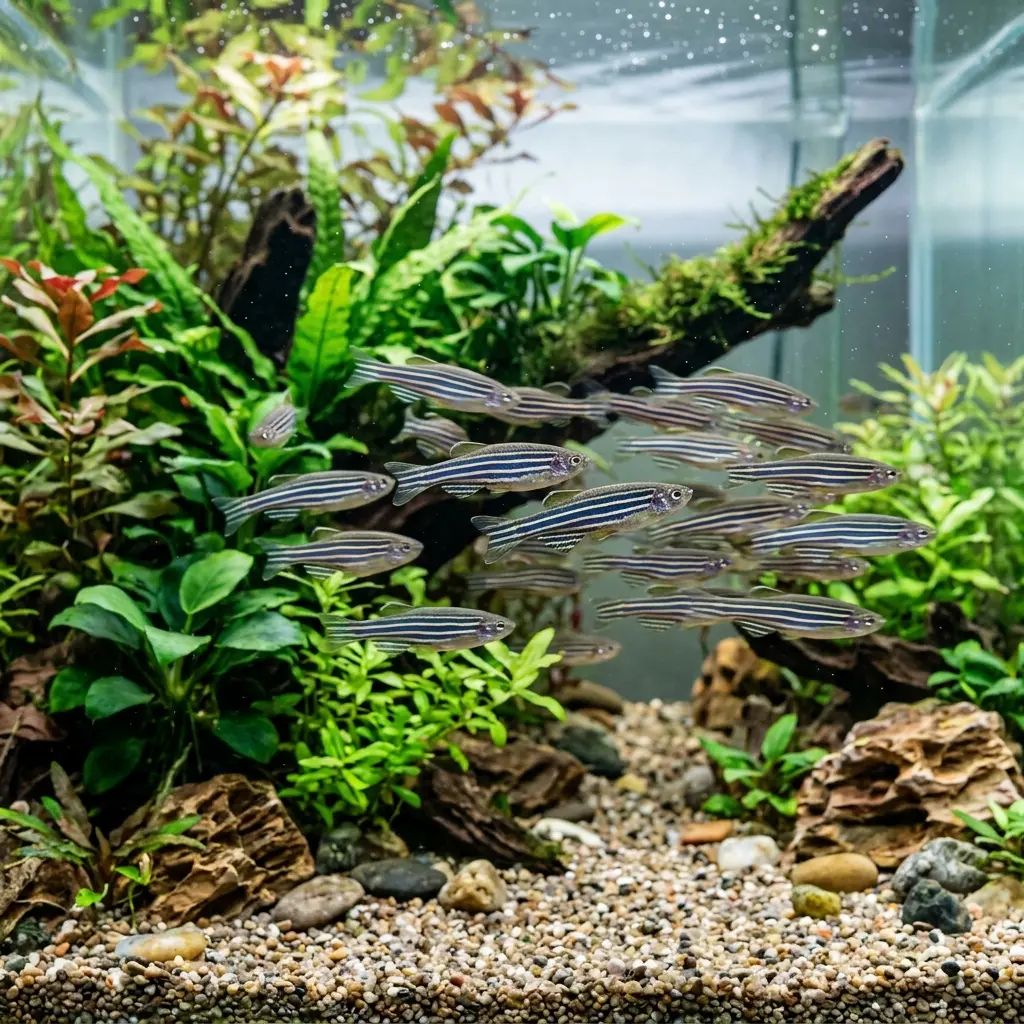
Zebra Danio (Danio rerio) is an exceptionally hardy, active freshwater schooling fish ideal for beginners. It requires a minimum 20-gallon (76 liter) long aquarium with a school of 6 to 8 individuals, pH 6.5 to 8.0, temperature 64°F to 75°F (18°C to 24°C), and moderate water flow. This omnivore occupies the top water column and thrives in community setups with other active, peaceful species.
Quick Facts
| Scientific Name | Danio rerio |
|---|---|
| Common Names | Zebra Danio |
| Family | Cyprinidae |
| Genus | Danio |
| Type | Freshwater |
| Temperament | peaceful |
| Care Difficulty | beginner |
| Lifespan | 5 years |
| Maximum Size | Up to 2 in (5 cm) |
| Diet | Omnivore |
| Temperature | 64–75°F (18–24°C) |
| pH | 6.5–8 |
| Hardness | 5–25 dGH |
| Minimum Size | 20 gallons |
Key Takeaways
- Requires a minimum school of 6 to 8 individuals; 10+ is optimal for natural behavior.
- Minimum tank size is 20 gallons (76 liters) long with 24 inches (60 cm) of horizontal swimming space.
- Prefers cooler water at 64°F to 75°F (18°C to 24°C); does not require a heater in most climate-controlled rooms.
- Omnivore requiring 40% protein, 10% fat, 50% plant matter; never feed mammalian proteins.
- Can become fin nippers in insufficient group sizes; increase school size to eliminate this behavior.
- Breeds easily using dawn simulation with shallow 4-inch (10 cm) water and spawning mops.
- Tight-fitting lid is mandatory due to powerful jumping behavior.
Diet
Nutritional Requirements
Zebra danios are opportunistic omnivores with a digestive tract adapted for varied intake. In the wild, they consume insect larvae, zooplankton, algae, and detritus. In captivity, their diet must replicate this diversity to maintain coloration, immune function, and reproductive health.
Macronutrient Profile
Target a dietary composition of approximately 40% protein, 10% fat, and 50% plant matter and fiber. Juveniles and conditioning adults for breeding benefit from elevated protein at 45% to 50%. Excess fat above 12% causes hepatic lipidosis and reduced lifespan.
Recommended Foods
- Staple: High-quality tropical flake food or 1mm slow-sinking micro-pellets. Choose formulations containing spirulina, krill meal, and fish meal as primary ingredients.
- Protein supplement (3 to 4 times weekly): Frozen or live bloodworms, brine shrimp, daphnia, and mosquito larvae. These provide essential amino acids and carotenoids for stripe coloration.
- Plant matter (twice weekly): Spirulina flakes, blanched zucchini, cucumber, or spinach. Plant fiber supports intestinal motility and prevents constipation.
- Breeding conditioning: Live baby brine shrimp, blackworms, and grindal worms. These high-protein live foods trigger gonadal development.
Feeding Schedule
Feed twice daily in portions consumed within 2 to 3 minutes. Fast the tank for 24 hours once weekly to clear the digestive tract. Overfeeding is the primary cause of water quality degradation in danio tanks; these fish will beg continuously but do not require more than they can consume rapidly.
Critical Dietary Restrictions
Never feed beef heart, chicken, pork, or any mammalian protein. Danios and all cyprinids lack the specific proteases required to digest mammalian muscle tissue. These foods cause intestinal blockages, bloat, and premature organ failure. Avoid tubifex worms sourced from polluted waters, as they are vectors for internal parasites including Camallanus and Capillaria.
Breeding
Breeding Zebra Danios in Captivity
Zebra danios are egg-scattering spawners with no parental care. They are among the easiest aquarium fish to breed, making them ideal for first-time breeders and the cornerstone of laboratory genetics research. Success depends on conditioning, the correct spawning environment, and the dawn simulation trigger.
Broodstock Selection
Select 10 to 12 mature fish aged 4 to 6 months showing bright, saturated stripes and well-rounded bodies. Use a ratio of 2 males per female (for example, 4 males and 2 females, or 6 males and 3 females). Males are slimmer with more golden coloration; females are rounder with silvery bellies. Separate males and females into different conditioning tanks for 7 to 14 days prior to spawning.
Conditioning Diet
Feed live baby brine shrimp, blackworms, grindal worms, and high-protein flake food 3 times daily during the conditioning period. This high-calorie diet triggers gonadal maturation and increases egg production. Maintain water temperature at 72°F to 74°F (22°C to 23°C) during conditioning.
Spawning Tank Setup
Use a bare-bottom or marble-substrate 10-gallon (38 liter) tank filled to a depth of only 4 to 6 inches (10 to 15 cm) of water. Shallow water concentrates the fish and ensures eggs fall quickly out of reach. Add a spawning mop made of acrylic yarn, a dense clump of java moss, or cover the bottom with glass marbles. Set water parameters to pH 7.0, dGH 6 to 10, and temperature 70°F to 74°F (21°C to 23°C). Install a gentle air stone for circulation but avoid strong filtration that will suck up eggs.
The Dawn Simulation Trigger
Zebra danios spawn almost exclusively at dawn in response to increasing light intensity. The evening before spawning, cover the tank in complete darkness or turn off all lights. The next morning, gradually increase light intensity over 30 to 60 minutes to simulate sunrise. Spawning commences within the first 1 to 2 hours of light exposure. The female releases 200 to 400 adhesive, non-sticky eggs scattered across the substrate and plants while males fertilize them externally in pursuit.
Post-Spawning Care
Remove all adult fish within 4 hours of spawning commencement to prevent egg predation. Adults will consume every egg they locate. Eggs are translucent, approximately 0.7 mm in diameter, and develop visible embryos within 12 hours.
Egg Development and Hatching
At 70°F to 74°F (21°C to 23°C), eggs hatch in 48 to 72 hours. Lower temperatures extend development; higher temperatures increase deformity rates. Do not disturb the tank during incubation. Infertile eggs turn white and fungus within 24 hours; these are consumed by harmless microorganisms and do not threaten viable eggs if fungal levels are low.
Fry Rearing
Newly hatched fry absorb their yolk sacs for 36 to 48 hours and remain attached to surfaces. Once free-swimming, they require infusoria for the first 3 days, followed by microworms, vinegar eels, and newly hatched brine shrimp from day 4 onward. By week 3, they accept crushed flake food. Perform 10% daily water changes with matched-temperature water to prevent growth stunting. Maintain temperature at 74°F to 76°F (23°C to 24°C) for maximum growth rate. Sexual maturity is reached at 10 to 12 weeks under optimal conditions.
GloFish and Long-Finned Variant Breeding
GloFish danios breed identically to wild types, with fluorescent coloration inherited as a dominant trait. Long-finned variants may have reduced swimming stamina during spawning chases; ensure gentle water flow and remove exhausted individuals promptly.
Compatible Tank Mates






Species Comparison
| Feature | Zebra Danio | Leopard Danio | Giant Danio | Neon Tetra | White Cloud Minnow |
|---|---|---|---|---|---|
| Scientific Name | Danio rerio | Danio rerio (color morph) | Devario aequipinnatus | Paracheirodon innesi | Tanichthys albonubes |
| Adult Size | 2 inches (5.1 cm) | 2 inches (5.1 cm) | 4 to 5 inches (10 to 13 cm) | 1 to 1.5 inches (2.5 to 3.8 cm) | 1.5 inches (3.8 cm) |
| Temperament | Peaceful; may nip fins in small groups | Peaceful; may nip fins in small groups | Peaceful; very active | Peaceful; shy | Peaceful; active |
| Minimum Tank Size | 20 gallons (76 L) long | 20 gallons (76 L) long | 55 gallons (208 L) | 10 gallons (38 L) | 10 gallons (38 L) |
| Temperature Range | 64°F to 75°F (18°C to 24°C) | 64°F to 75°F (18°C to 24°C) | 72°F to 77°F (22°C to 25°C) | 72°F to 82°F (22°C to 28°C) | 57°F to 72°F (14°C to 22°C) |
| Diet | Omnivore; flakes, pellets, live and frozen foods | Omnivore; flakes, pellets, live and frozen foods | Omnivore; larger pellets, live foods | Omnivore; micro-pellets, flakes, small live foods | Omnivore; flakes, small pellets, live foods |
| Schooling Requirement | 6 to 8 minimum; 10+ recommended | 6 to 8 minimum; 10+ recommended | 6 minimum; 8+ recommended | 6 minimum; 10+ recommended | 6 minimum; 10+ recommended |