
Forktail Rainbowfish (Pseudomugil furcatus)
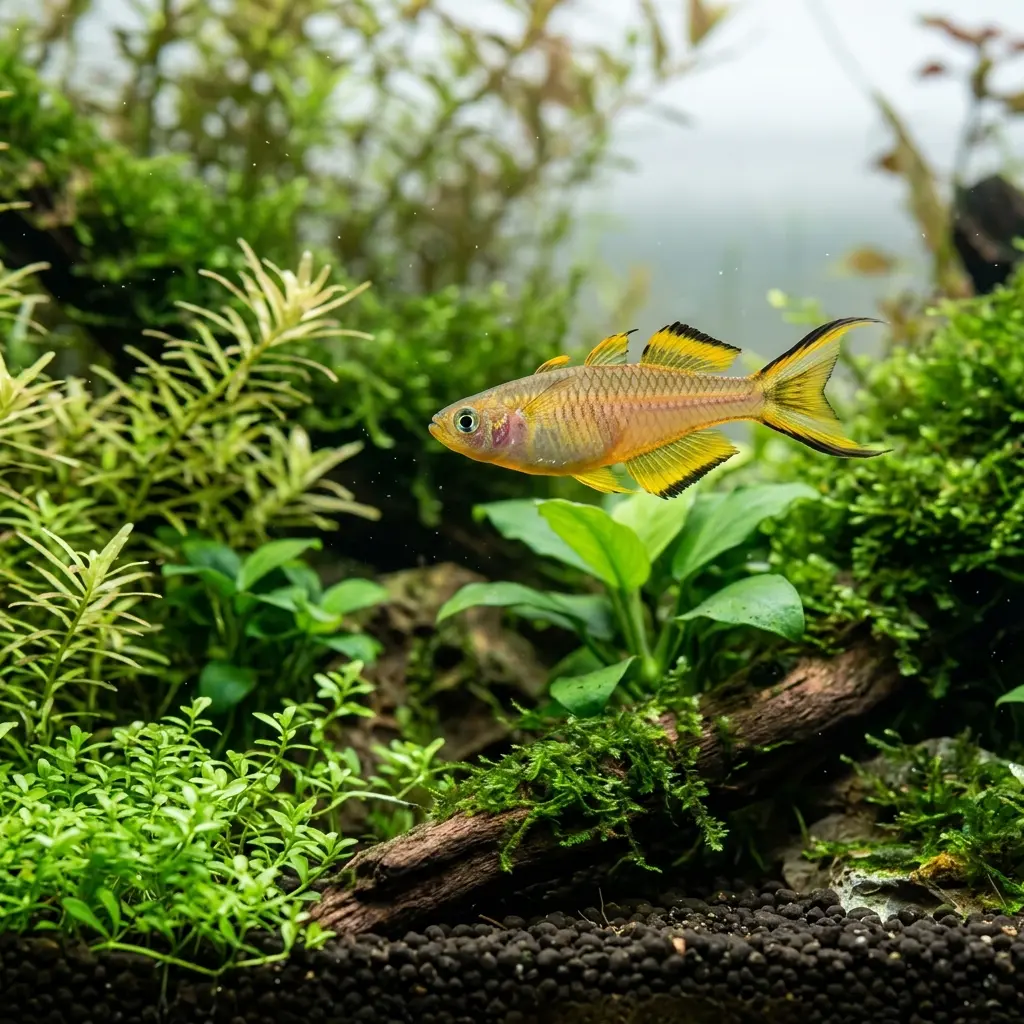
Quick Answer
Forktail Rainbowfish (Pseudomugil furcatus), also known as Forktail Blue-eye or Furcata Rainbowfish, are small, dazzling rainbowfish native to the clearwater streams of Papua New Guinea. They require a minimum 20 gallon (75 liter) aquarium with a pH of 6.5 to 7.5, moderately hard water (5 to 12 dGH), and temperature range of 72 to 79 degrees Fahrenheit (22 to 26 degrees Celsius). As peaceful, surface-dwelling omnivores with a short 2 to 3 year lifespan, they demand slow-sinking foods, daily spawning mop checks if breeding, and groups of 8 or more for natural behavior.
Quick Facts
| Scientific Name | Pseudomugil furcatus |
|---|---|
| Common Names | Forktail Rainbowfish |
| Family | Melanotaeniidae |
| Genus | Pseudomugil |
| Type | Freshwater |
| Temperament | peaceful |
| Care Difficulty | intermediate |
| Lifespan | 3 years |
| Maximum Size | Up to 2.2 in (6 cm) |
| Diet | Omnivore |
| Temperature | 72–79°F (22–26°C) |
| pH | 6.5–7.5 |
| Hardness | 5–12 dGH |
| Minimum Size | 20 gallons |
Key Takeaways
- Requires a minimum 20 gallon (75 liter) aquarium with a footprint of 30 by 12 inches (75 by 30 cm)
- Short lifespan of 2 to 3 years necessitates active breeding to maintain stock
- Males display bright yellow pom-pom pectoral fins and perform circular spawning dances
- Surface-dwelling; requires slow-sinking or floating foods; rarely feeds from substrate
- Daily egg production on spawning mops; parents will consume eggs if not collected
- Peaceful but may outcompete slow-moving tank mates during feeding
- Prefers moderately hard, slightly alkaline water with clean, well-oxygenated conditions
Overview
Species Overview
Natural History and Origin
The Forktail Rainbowfish (Pseudomugil furcatus), also known as the Forktail Blue-eye or Furcata Rainbowfish, is a small, dazzling species endemic to the clearwater streams and tranquil pools of Collingwood Bay and Dyke Ackland Bay in Papua New Guinea. These fish inhabit slow-moving, lowland waterways surrounded by dense rainforest vegetation, where dappled sunlight filters through the canopy and creates the shimmering light patterns that accentuate their brilliant coloration. The genus Pseudomugil belongs to the family Melanotaeniidae, which includes all rainbowfish and blue-eyes, a group of small, colorful atheriniform fish native to Australia, New Guinea, and nearby islands.
Physical Description
Adult Forktail Rainbowfish reach a maximum length of 2.2 inches (5.5 cm), with males typically growing slightly larger and more vividly colored than females. The body is slender and laterally compressed with a distinctly forked caudal fin that gives the species its common name. The most striking features are the brilliant blue eyes and the yellow pom-pom pectoral fins that males display during courtship and territorial sparring. These yellow fin edges, particularly prominent on the pectoral fins, create the appearance of tiny waving pom-poms as the fish swim. Males also develop elongated dorsal and anal fins with black margins on the rear edges, and during spawning, display a striking red hue on the chest area. Females are drab silver-gray with rounded fins and minimal yellow coloration. Juveniles of both sexes are dull and colorless, with full adult coloration developing at 3 to 4 months of age.
Short Lifespan and Breeding Urgency
A critical factor that competitors consistently underemphasize is the remarkably short lifespan of Forktail Rainbowfish. In the aquarium, they typically live only 2 to 3 years, with some individuals declining as early as 18 months. This short life expectancy makes active breeding management essential for maintaining a stable population. Unlike long-lived species such as discus or angelfish that may produce offspring over a decade, forktails require continuous breeding cycles to replace aging stock. Aquarists must begin breeding efforts within the first 6 months of acquiring young fish to ensure generational overlap. This biological reality transforms them from a simple display fish into an active breeding project.
Conservation and Trade
Wild populations are listed as Not Evaluated by the IUCN. The aquarium trade relies on a mix of wild-caught specimens and captive-bred stock from fish farms in Southeast Asia and Australia. Wild-caught fish often display more intense coloration and robust health compared to heavily inbred farm stock. When purchasing, select fish with bright blue eyes, clear yellow fin edges, and active swimming behavior. Avoid fish with clamped fins, faded coloration, or visible spinal deformities, which indicate poor breeding practices or transport stress.
Care
Aquarium Care Requirements
Tank Size and Dimensions
The absolute minimum tank size for a school of Forktail Rainbowfish is 20 gallons (75 liters) with a footprint of at least 30 by 12 inches (75 by 30 cm). A 29-gallon (110 liter) or 40-gallon breeder (151 liters, 36 by 18 inches or 91 by 46 cm) is strongly recommended for schools of 12 or more. These are active, speedy swimmers that require horizontal swimming space to exhibit natural schooling behavior. Tank height is secondary; a standard 12 to 16 inch (30 to 41 cm) water column is sufficient, though they appreciate some vertical space for their spawning chases. In tanks smaller than 20 gallons, water parameters fluctuate too rapidly, and adequate school sizes cannot be maintained.
Filtration and Water Flow
Use a sponge filter, hang-on-back filter with a flow baffle, or a canister filter with adjustable output. The filter should turn over the tank volume 6 to 8 times per hour. Strong currents exhaust these small fish, so flow must be gentle to moderate. Add an air stone in one corner to enhance oxygenation without creating surface turbulence. Always cover filter intakes with fine foam pre-filters; at 2 inches (5 cm) in length, Forktail Rainbowfish can easily be drawn into unprotected intakes, and multiple hobbyists report losses to powerheads and strong filter suction.
Substrate and Hardscape
Use dark fine gravel or sand substrate to enhance their blue eyes and yellow fin coloration. Bright white substrates cause washed-out coloration and stress. Add driftwood, smooth rocks, and leaf litter to create a natural rainforest stream aesthetic. Smooth, rounded hardscape is preferred; sharp edges can damage their delicate fins during active spawning chases. Provide dense planting in the rear and sides, leaving the front and center open for schooling.
Plant Recommendations
Plant densely with Cryptocoryne, Anubias, Java fern, Java moss, and Cryptocoryne balansae. Stem plants such as Cabomba, Rotala, Ludwigia, and Bacopa provide mid-level cover and improve water quality. Floating plants are essential: Amazon frogbit, water sprite, red root floaters, and duckweed diffuse overhead light, provide security, and create the dappled light patterns of their natural habitat. Java moss is particularly valuable as it serves as both a visual barrier and a natural spawning medium for eggs that evade the spawning mop.
Lighting
Maintain moderate to bright lighting for 8 to 10 hours daily. Bright light enhances male coloration and stimulates spawning. However, unfiltered overhead light causes stress; use floating plants to create dappled patterns. A photoperiod with gradual dawn and dusk simulation reduces stress and encourages natural behavior. LED fixtures with dimmable controllers are ideal.
Lid Requirements
A tight-fitting lid is strongly recommended. While not habitual jumpers, Forktail Rainbowfish will leap when startled by sudden light changes, aggressive chasing during spawning, or when pursuing food at the surface. Ensure the lid has no gaps larger than 0.25 inches (6 mm). After 3 to 4 weeks of stable acclimation, jump risk decreases, but the lid should remain in place.
Common Care Mistakes
- Using rapidly sinking pellets: These surface feeders will starve while food decays on the substrate.
- Insufficient school size: Groups under 8 cause chronic stress, faded colors, and fin-nipping.
- Strong filter intakes without pre-filters: Small fish are easily drawn into unprotected intakes.
- Soft water below 4 dGH: Causes clamped fins, faded coloration, and reduced immune function.
- Ignoring the short lifespan: Failure to breed replacements results in population collapse within 2 years.
- Skipping daily egg collection: Parents consume eggs within hours, eliminating natural reproduction in community tanks.
Diet
Diet and Feeding Protocol
Nutritional Requirements
Forktail Rainbowfish are omnivores with very small mouths adapted for capturing plankton and small invertebrates from the water column. Their dietary composition should target 40 percent protein, 12 percent fat, and 48 percent plant matter and fiber. In the wild, they feed on zooplankton, insect larvae, small crustaceans, and algae. In captivity, their tiny mouth size restricts them to food particles under 1 mm in diameter, and their surface-dwelling behavior means they rarely, if ever, feed from the substrate.
Recommended Foods
- Staple: High-quality crushed tropical flakes or micro-pellets of 0.3 mm or smaller. Look for products containing fish meal, krill meal, spirulina, and wheat germ. Brands such as Hikari Micro Pellets, Xtreme Nano pellets, and New Life Spectrum small fish formula are ideal.
- Protein supplement (3 to 4 times weekly): Frozen daphnia, cyclops, baby brine shrimp, and Mysis shrimp. Live baby brine shrimp and blackworms are excellent conditioning foods for breeding pairs.
- Plant matter (weekly): Spirulina powder, vegetable-based micro-pellets, or blanched zucchini pieces. Plant fiber supports digestive health and prevents constipation.
- Live prey (occasional): Wingless fruit flies, pinhead crickets, and live daphnia stimulate natural hunting behavior and provide enrichment.
Feeding Schedule
Feed small portions 2 to 3 times daily, offering only what the school can consume within 2 minutes. Their high metabolism and active swimming behavior demand frequent small feedings rather than one large meal. Fast the tank one day per week to clear digestive tracts and reduce waste accumulation. Spread food across the surface to allow subordinate fish access; dominant males will monopolize a single feeding zone.
Critical Feeding Note: Slow-Sinking Food Only
This is the single most important feeding consideration for Forktail Rainbowfish. They are obligate surface and mid-water feeders with upward-oriented mouths. Rapidly sinking pellets, wafers, or granules will pass through their feeding zone in seconds and settle on the substrate, where they will be completely ignored. This leads to two problems: malnutrition in the fish and dangerous ammonia spikes from decomposing uneaten food. You must use exclusively slow-sinking micro-pellets, floating crushed flakes, or live and frozen foods that remain suspended in the water column. Target feed by dropping food directly above the school. If you observe food accumulating on the substrate, reduce portion size and switch to slower-sinking formulations immediately. This practical detail is rarely emphasized by competitors but is critical for health and water quality.
Foods to Avoid
- Large pellets exceeding 1 mm: Cannot be consumed by these small-mouthed fish and will foul the water.
- Rapidly sinking granules or wafers: Will be ignored and decompose on the substrate.
- Beef heart and mammalian proteins: They cannot metabolize mammalian lipids effectively, leading to fatty liver disease.
- Low-quality generic flakes: Products containing excessive fillers (wheat, soy) provide poor nutrition and cloud water.
Expert Tip: Color Enhancement
To maximize blue eye brilliance and yellow pom-pom fin intensity, provide foods rich in carotenoids and astaxanthin, such as krill-based flakes, color-enhancing micro-pellets, and cyclops. Maintain stable water parameters and bright lighting with floating plant diffusion; stress causes rapid color fading regardless of diet quality.
Health
Health, Disease, and Treatment Protocols
General Health Considerations
Forktail Rainbowfish are moderately hardy but their small size, active metabolism, and short lifespan make them susceptible to rapid health declines when conditions are suboptimal. Their primary vulnerabilities are temperature shock, velvet disease, and internal parasites from live foods. Preventive care through stable water parameters, high-quality diet, and strict quarantine is far more effective than treatment once disease manifests. Their tiny size also means they metabolize medications quickly, requiring precise dosing.
Medication Sensitivity
Forktail Rainbowfish tolerate copper-based medications up to 0.15 mg per liter, which is lower than larger hardy fish but sufficient for most treatments. They are sensitive to formalin and malachite green; these should be dosed at quarter strength (0.025 mg per liter) if used at all. Praziquantel is safe for internal parasites. Salt baths up to 3 ppt effectively treat ich and external parasites but should not exceed 10 days. Methylene blue is safe for quarantine, egg fungicide, and mild bacterial infections at half-strength. Always prefer medicated foods over water-borne treatments for freshwater fish, as they do not drink and absorb dissolved medications poorly through the skin and gills.
Preventive Health Measures
- Quarantine all new fish for 14 to 21 days.
- Maintain nitrates below 15 ppm through weekly 20 percent water changes.
- Use a UV sterilizer to reduce free-floating pathogens.
- Source fish from reputable breeders to avoid inbred or diseased stock.
- Never introduce wild-caught live foods without freezing or quarantine.
- Monitor for early velvet symptoms daily; this disease progresses rapidly in small fish.
- Maintain stable temperature; sudden drops exceeding 3 degrees Fahrenheit (1.5 degrees Celsius) trigger immunosuppression.
Velvet Disease (Piscinoodinium pillulare)
A dinoflagellate parasite causing a fine yellow-gold dusting on the skin, particularly dangerous in small, active fish due to rapid progression.
- Fine yellow or gold dust covering the body, giving a velvety appearance; scratching against objects (flashing); rapid gill movement; clamped fins; lethargy; loss of appetite. Often harder to see than ich on brightly colored fish but visible as a dull, dusty sheen under bright light.
Introduction via new fish or plants. Thrives in temperatures below 75 degrees Fahrenheit (24 degrees Celsius) and poor water quality. The parasite contains photosynthetic pigments and is more active in well-lit tanks.
Quarantine all additions. Raise temperature to 82 degrees Fahrenheit (28 degrees Celsius) and treat with acriflavine at manufacturer-recommended dose. Increase aeration during treatment. Dim lights for 3 to 4 days, as the parasite uses photosynthesis. Perform daily 15 percent water changes during treatment.
Ichthyophthirius multifiliis (Ich or White Spot Disease)
A common protozoan parasite causing white salt-grain-like spots on the body and fins.
- Small white cysts covering body, fins, and gills; rubbing against decor (flashing); rapid breathing; clamped fins; lethargy in advanced stages.
Introduction via new fish, plants, or equipment. Triggered by temperature fluctuations and stress-induced immunosuppression.
Quarantine all additions. Maintain stable temperature between 75 and 78 degrees Fahrenheit (24 to 26 degrees Celsius). Treat with gradual temperature increase to 82 degrees Fahrenheit (28 degrees Celsius) combined with a salt bath at 2 to 3 ppt for 7 to 10 days. Avoid malachite green at full strength; use quarter dose if necessary.
Fin Rot (Aeromonas, Pseudomonas species)
Bacterial degradation of fin tissue, typically beginning at the edges and progressing toward the body.
- Frayed, ragged, or receding fin edges with white, red, or black discoloration. In severe cases, fin tissue erodes to the fin base and may progress to body rot.
Poor water quality, especially elevated nitrates and organic waste. Often triggered by fighting during spawning chases, rough decor, or strong filter suction damaging fins.
Perform weekly 20 percent water changes. Remove rough or jagged decor. Cover filter intakes with foam guards. Treat with antibiotic food (kanamycin or erythromycin) for 10 days. Ensure all hardscape has smooth, rounded edges.
Internal Parasites (Hexamita, Nematodes)
Parasitic infections of the intestinal tract, common in fish fed live foods from questionable sources.
- White, stringy feces; loss of appetite; weight loss despite normal feeding; lethargy; darkening coloration; visible worms in feces in severe cases.
Introduction via contaminated live foods, particularly tubifex worms, blackworms, or daphnia from outdoor sources. Poor water quality and stress weaken immune response.
Quarantine all live foods by freezing for 48 hours before feeding. Source live foods from reputable breeders. Treat with praziquantel in food for 5 days or metronidazole at 5 mg per liter for 10 days. Maintain nitrates below 15 ppm.
Columnaris (Flavobacterium columnare)
A bacterial infection often mistaken for fungal infection, presenting as white or grayish patches on the mouth, fins, or body.
- White or grayish patches on mouth, fins, or body resembling cotton wool; frayed or eroded fin edges; ulcerations; lethargy; loss of appetite.
Bacterial infection entering through wounds or gill damage. Often triggered by poor water quality, fighting, or rough decor causing physical injury.
Temperature Shock
Physiological stress caused by rapid temperature changes, particularly dangerous for small, metabolically active fish.
- Clamped fins; rapid breathing; lethargy; loss of appetite; color fading; fish may float motionless near the surface or hide in corners. Symptoms appear within 1 to 2 hours of temperature change.
Sudden temperature drops during water changes, heater failure, tank relocation, or introduction to a tank with significantly different temperature. Drops exceeding 3 degrees Fahrenheit (1.5 degrees Celsius) within 1 hour are particularly dangerous.
Always match new water temperature to tank temperature within 1 degree Fahrenheit (0.5 degrees Celsius) during water changes. Use a reliable heater with a thermostat guard. Float new fish in their bag for 20 to 30 minutes before drip acclimation. Never add ice or cold water directly to the tank. If temperature shock occurs, gradually raise temperature by 1 degree Fahrenheit (0.5 degrees Celsius) per hour until normal range is reached.
Breeding
Breeding Forktail Rainbowfish
Breeding Overview
Forktail Rainbowfish are prolific, continuous breeders that spawn daily under favorable conditions. Their breeding behavior is fascinating and relatively easy to observe, making them an excellent species for aquarists interested in daily reproductive behavior. However, their lack of parental care and voracious egg-eating habits mean that successful fry rearing requires active daily management. This is not a species where you can simply provide a spawning mop and expect fry to survive in the community tank.
Parent Selection and Conditioning
Select sexually mature fish at least 3 to 4 months old, measuring 1.5 inches (3.8 cm) or larger. Males display bright blue eyes, yellow pom-pom pectoral fins, elongated dorsal and anal fins with black margins, and a red chest patch during spawning. Females are drab silver-gray with rounded fins and a fuller body. Maintain a ratio of 1 male to 2 females; this reduces male harassment of any single female and ensures multiple females are depositing eggs daily. Condition the group for 2 to 3 weeks with live baby brine shrimp, blackworms, high-quality micro-pellets, and frozen cyclops. Feed 3 times daily. Maintain water temperature at 78 to 80 degrees Fahrenheit (25.5 to 26.5 degrees Celsius) during conditioning to accelerate gamete development.
Spawning Tank Setup
Set up a dedicated 10-gallon (38 liter) breeding tank with the following specifications:
- Water depth: 6 to 8 inches (15 to 20 cm). Shallow water makes egg collection easier and reduces the distance eggs fall.
- Water parameters: pH 7.0, 8 dGH, 75 to 80 degrees Fahrenheit (24 to 27 degrees Celsius). Slightly warmer water accelerates egg development.
- Filtration: Sponge filter with gentle air-driven flow. No hang-on-back or canister filters that could suck up eggs or fry.
- Spawning medium: A DIY spawning mop made of acrylic yarn (avoid natural fibers that rot) or dense java moss. Place the mop floating near the surface or weighted to stand vertically in the water column.
- Plant cover: Dense java moss and floating plants with long roots (water sprite) provide alternative spawning surfaces and refuge for fry.
- Lighting: Moderate. Bright light stimulates spawning but also encourages algae on eggs.
Spawning Behavior and Daily Egg Collection
Spawning occurs every morning at dawn when the lights first come on. Males intensify their coloration, display their red chest patches, and perform circular dances around females. The male wraps his body around the female in a brief embrace, and she deposits 5 to 15 adhesive eggs on the spawning mop or plant leaves. Multiple spawnings may occur over 30 to 60 minutes. After spawning concludes, you must remove the spawning mop and collect the eggs within 2 to 3 hours. Parents will consume eggs within hours if left in the tank. This daily collection routine is the single most labor-intensive aspect of forktail breeding but is absolutely necessary for fry survival.
Egg Incubation
Place collected eggs in a small hatching container with aquarium water from the breeding tank, a gentle air stone for water circulation, and 2 to 3 drops of methylene blue to prevent fungal infection. Perform daily 25 percent water changes with aged, temperature-matched water. Eggs hatch in 10 to 14 days at 72 degrees Fahrenheit (22 degrees Celsius) or 7 to 10 days at 80 degrees Fahrenheit (27 degrees Celsius). Fungal eggs turn white and opaque; remove these immediately with a pipette to prevent spread. Healthy eggs remain translucent with visible embryo development after day 5.
Fry Care
Newly hatched fry are approximately 0.15 inches (4 mm) and immediately free-swimming. They are extremely active and will jump from open containers; keep the hatching tank tightly covered. Feed infusoria for the first 3 days, then transition to microworms, vinegar eels, and baby brine shrimp. Feed 4 to 5 times daily in tiny portions. Perform daily 10 percent water changes with aged, temperature-matched water. Maintain temperature at 78 to 80 degrees Fahrenheit (25.5 to 26.5 degrees Celsius). Growth is rapid but uneven; this is normal. By day 14, fry will accept powdered high-quality flake food. By 4 to 6 weeks, they will be large enough (0.5 to 0.75 inches or 1.3 to 1.9 cm) to move to a grow-out tank or the main aquarium if adequate plant cover exists.
Alternative: Community Tank Natural Rearing
If daily egg collection is not feasible, you can attempt natural rearing in a heavily planted community tank with dense java moss and floating plants with long roots. Some fry will evade predation and survive on natural microfauna. However, survival rates are extremely low (typically 1 to 5 percent) compared to dedicated breeding (60 to 80 percent). This method is suitable for casual aquarists but not for those seeking to maintain a stable breeding population.
Stock Rotation Strategy
Given their 2 to 3 year lifespan, you must maintain overlapping generations. Keep detailed records of birth dates and maintain at least 3 age cohorts (0 to 6 months, 6 to 12 months, and 12 to 18 months) simultaneously. Begin breeding new stock when your current generation reaches 12 months of age. This ensures continuous population stability and genetic diversity. Without this active management, your colony will collapse as the founding generation ages out.
Tips
Expert Tips and Advanced Care
The Daily Spawning Mop Routine
The most critical management practice for Forktail Rainbowfish is the daily spawning mop check. Unlike many fish that spawn weekly or monthly, forktails deposit eggs every single morning. You must inspect the spawning mop within 2 to 3 hours of lights-on, remove it gently, and collect eggs into a hatching container. Miss a day, and the parents will consume every egg. This routine takes only 5 minutes once established but must be performed 7 days a week without exception. Use a white or light-colored spawning mop to make eggs easier to spot; they are small, clear, and adhesive.
Slow-Sinking Food: The Make-or-Break Detail
Competitors consistently fail to emphasize that Forktail Rainbowfish are obligate surface and mid-water feeders. They will starve in tanks where the only food is large, rapidly sinking pellets intended for bottom-feeding corydoras or loaches. Their upward-oriented mouths and natural plankton-feeding behavior mean they literally cannot recognize food on the substrate. If you observe your forktails ignoring food that sinks past them, or if you find uneaten pellets decaying on the gravel, you are using the wrong food. Switch to slow-sinking micro-pellets, floating crushed flakes, or live foods immediately. This single adjustment solves more forktail health problems than any medication.
Filter Intake Hazard
At 2 inches (5 cm) in length, Forktail Rainbowfish are small enough to be drawn into unprotected filter intakes, powerheads, and circulation pumps. Multiple hobbyists report losses to strong filter suction. Always install fine-pore foam pre-filters on every intake tube. Check pre-filters weekly for clogging. Position powerheads and circulation pumps so their intakes are not in the primary swimming zone. If a fish goes missing, check the filter housing and plumbing before assuming escape or predation.
Peacock Goby Biotope Pairing
For aquarists seeking an authentic Papua New Guinea biotope, the peacock goby (Tateurndina ocellicauda) is the ideal tank mate. Both species were originally collected together in the same waters, share identical water parameter requirements, and occupy different niches (forktails at the surface, peacock gobies on the substrate). This pairing creates a stunning, behaviorally complementary display that no other tank mate combination can replicate. Ensure the tank is at least 20 gallons (75 liters) with dense planting and smooth, dark substrate.
Acclimation Precision
Forktail Rainbowfish are highly sensitive to temperature shock. Never use the float-and-dump method. Drip acclimation at 1 to 2 drops per second for 45 to 60 minutes is mandatory. Match pH within 0.3 units and temperature within 1 degree Fahrenheit (0.5 degrees Celsius). Sudden temperature drops exceeding 3 degrees Fahrenheit (1.5 degrees Celsius) trigger immunosuppression and can cause death within 24 hours. This is particularly important when receiving shipped fish, as transport bags may have cooled significantly.
Lighting and Color Display
Male coloration is directly linked to lighting intensity and quality. Dim tanks produce washed-out, grayish males that appear sickly. Bright, full-spectrum lighting with floating plant diffusion triggers maximum blue eye brilliance and yellow pom-pom fin extension. LED fixtures with adjustable color temperature (6500K to 8000K) are ideal. A 30-minute dawn and dusk simulation period using dimmable controllers significantly reduces stress and encourages natural spawning behavior.
Stock Rotation and Record Keeping
Given their 2 to 3 year lifespan, detailed record keeping is essential. Maintain a simple log of acquisition dates, birth dates for home-bred fish, and spawning records. Replace founding stock with home-bred juveniles when the original generation reaches 15 to 18 months of age. This prevents population collapse and maintains genetic diversity. Without active stock rotation, you will face a sudden colony extinction event with no replacement fish ready.
Quarantine for Small Rainbowfish
Quarantine tanks for Forktail Rainbowfish must maintain stable parameters matching their display tank. Use a sponge filter, heater, and dim lighting. Provide a spawning mop even in quarantine, as stressed fish may spawn as a survival response. Quarantine for 14 to 21 days, feeding high-quality foods and observing for velvet, ich, fin rot, and internal parasites. Treat prophylactically with half-strength methylene blue if fish appear stressed or show stringy feces.
Common Expert Mistakes to Avoid
- Using rapidly sinking pellets: These surface feeders will starve while food decays below them.
- Ignoring the daily spawning mop check: One missed day means an entire day's egg production is lost to predation.
- Keeping only males: Males will not display full coloration or perform circular dances without female observers.
- Strong filter intakes without pre-filters: Small fish are easily drawn into unprotected intakes and killed.
- Soft water below 4 dGH: Causes clamped fins, faded coloration, and chronic stress.
- Skipping stock rotation: The 2 to 3 year lifespan means colonies collapse without active breeding management.
- Overfeeding: Their small stomachs and high metabolism mean excess food fouls water rapidly.
Compatible Tank Mates






Forktail Rainbowfish vs Similar Small Rainbowfish Species Comparison
| Feature | Forktail Rainbowfish | Gertrude's Blue-eye | Red Neon Blue-eye | Celestial Pearl Danio |
|---|---|---|---|---|
| Scientific Name | Pseudomugil furcatus | Pseudomugil gertrudae | Pseudomugil luminatus | Danio margaritatus |
| Adult Size | 2.2 in (5.5 cm) | 1.5 in (3.8 cm) | 1.5 in (3.8 cm) | 1.0 in (2.5 cm) |
| Temperament | Peaceful, active, schooling | Peaceful, active, schooling | Peaceful, active, schooling | Peaceful, shy, schooling |
| Minimum Tank Size | 20 gal (75 L) | 10 gal (38 L) | 10 gal (38 L) | 10 gal (38 L) |
| Temperature Range | 72-79 F (22-26 C) | 70-82 F (21-28 C) | 72-79 F (22-26 C) | 73-79 F (23-26 C) |
| pH Range | 6.5-7.5 | 6.0-8.0 | 6.5-7.5 | 6.5-7.5 |
| Diet | Omnivore; micro-pellets, flakes, live, frozen | Omnivore; tiny foods, micro-pellets, live | Omnivore; tiny foods, micro-pellets, live | Omnivore; micro-pellets, powdered flakes, live |
| Hardiness | Moderate; sensitive to temperature swings | Hardy; very adaptable | Moderate; needs stable parameters | Moderate; sensitive to parameter fluctuations |
| Color Highlights | Blue eyes, yellow pom-pom fins, forked tail | Blue eyes, spotted body, red fins | Blue eyes, red-orange body, neon stripe | Blue body with pearl spots, orange fins |
| Special Notes | Daily spawner; needs slow-sinking food; short lifespan | Smallest Pseudomugil; very prolific breeder | Stunning red color; more delicate than furcatus | Not a true rainbowfish but similar niche; very shy |