
Yellow Clown Goby (Gobiodon okinawae)
Quick Answer
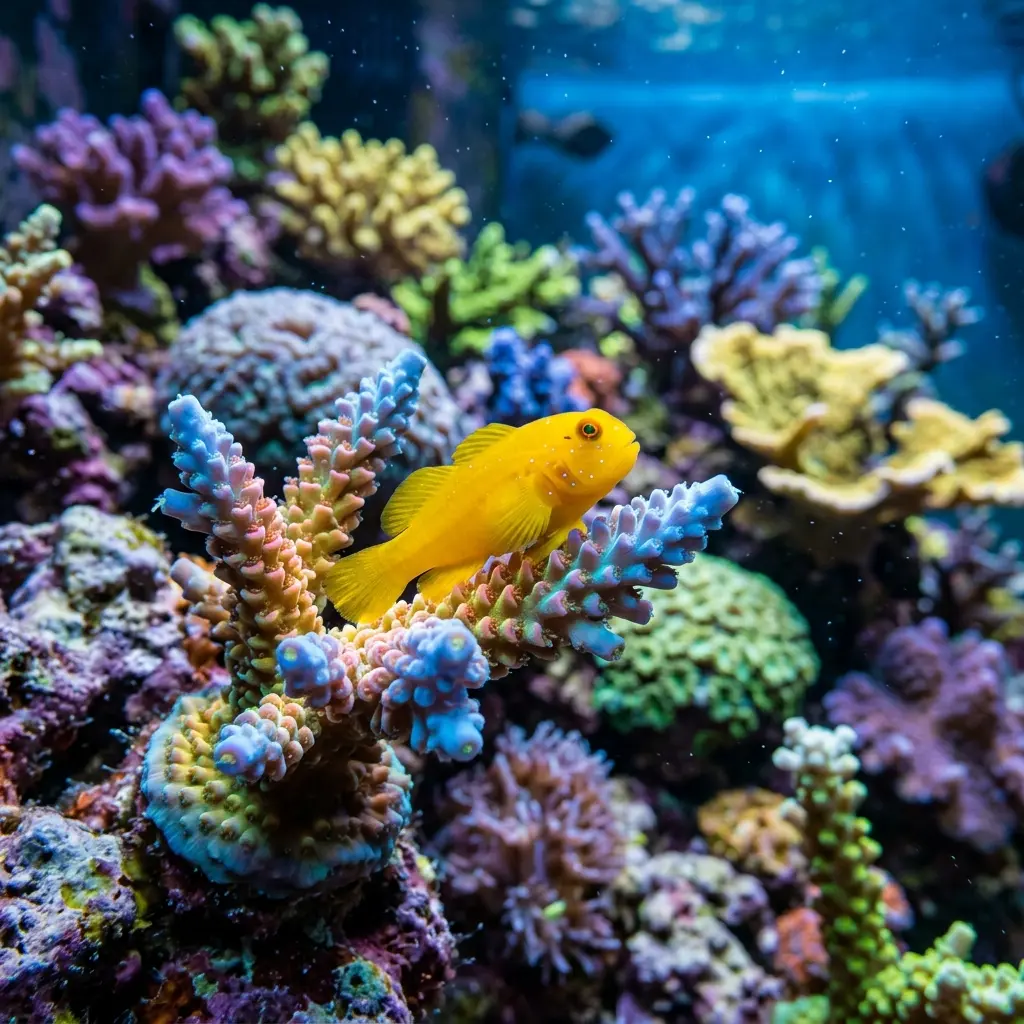
Yellow Clown Goby (Gobiodon okinawae) is a tiny, bright yellow coral-dwelling goby native to the western Pacific. It reaches 1.5 inches (3.8 cm) and requires a minimum 10 gallon (38 liter) nano reef aquarium with a pH of 8.1 to 8.4, specific gravity of 1.023 to 1.025, and temperature range of 72 to 82 degrees Fahrenheit (22 to 28 degrees Celsius). This micro-carnivore perches on SPS coral branches, produces a toxic skin mucus for defense, and is a bi-directional hermaphrodite that forms bonded pairs in captivity.
Quick Facts
| Scientific Name | Gobiodon okinawae |
|---|---|
| Common Names | Yellow Clown Goby |
| Family | Gobiidae |
| Genus | Gobiodon |
| Type | Saltwater |
| Temperament | peaceful |
| Care Difficulty | beginner |
| Lifespan | 5 years |
| Maximum Size | Up to 1.5 in (4 cm) |
| Diet | Carnivore |
| Temperature | 72–82°F (22–28°C) |
| pH | 8.1–8.4 |
| Hardness | 7–12 dGH |
| Minimum Size | 10 gallons |
Key Takeaways
- Known for its bright canary-yellow coloration and habit of perching on coral branches.
- Requires at least a 10 gallon (38 liter) nano reef aquarium with branching structures.
- Micro-carnivore requiring food particles under 0.5 mm due to an extremely small mouth.
- Produces a toxic skin mucus that deters predators; bright color is aposematic warning.
- Bi-directional hermaphrodite; any two individuals form a bonded breeding pair.
- Extremely susceptible to marine ich; 14 to 21 day quarantine is mandatory.
- Wild-caught specimens often arrive emaciated; buy captive-bred when possible.
- Reef safe with caveat; may nip SPS coral polyps and lay eggs on coral branches.
Diet
Diet and Feeding Protocol
Natural Diet
In the wild, Yellow Clown Gobies are micro-carnivores that feed on small invertebrates, crustaceans, worms, and the mucus of coral tissue. They rarely venture more than an inch or two from their host coral, making them among the least mobile fish on the reef. Instead of actively hunting, they sit quietly on their coral perches and wait for prey to drift by.
Captive Diet Composition
You must provide a diet consisting of approximately 55% protein, 15% fat, and 30% algae and plankton matter. They have extremely tiny mouths; food particle size must be under 0.5 mm. Feed at least twice daily with tiny portions consumed within 1 to 2 minutes.
- Staple Foods: High-quality marine micro-pellets sized 0.5 mm or smaller, and marine flake food crushed to a fine powder.
- Frozen Foods: Frozen cyclops, finely minced mysis shrimp, enriched brine shrimp, and frozen copepods offered daily.
- Live Foods: Live baby brine shrimp and copepods as an occasional treat to stimulate natural hunting behavior.
Feeding Behavior
Yellow Clown Gobies can be fussy about feeding in the aquarium, at least initially. Wild-caught specimens may refuse prepared foods for several days after introduction. Target feed near their coral perch using a turkey baster or pipette. They are quick eaters that swim into open water to grab food when they recognize the feeding routine. Because they are bold at feeding time, they usually get adequate nutrition in community tanks.
Common Dietary Mistakes
Feeding food that is too large is the primary error. Pellets or flakes larger than 0.5 mm will be ignored. Do not rely solely on one food type; nutritional diversity prevents deficiency diseases and brings out the best coloration. Underfeeding causes a pinched belly, which is a medical emergency in a fish this small.
Health
Health and Disease Management
Yellow Clown Gobies are relatively hardy once settled, but their tiny body mass means small problems escalate quickly. The two primary issues are marine ich and rapid weight loss from feeding refusal or internal parasites. Their toxic skin mucus provides some protection against bacterial skin infections, but shipping stress and poor acclimation override this defense. Quarantine all new arrivals for a minimum of 14 days, though 2 to 4 weeks is strongly recommended. Maintain pristine water quality with zero ammonia and nitrite.
Preventive Care
Perform weekly 15 to 20% water changes, maintain nitrates below 10 ppm, and run a protein skimmer continuously. Use a UV sterilizer to reduce free-floating pathogens. Test water parameters weekly. Because they are small and lack a heavy protective mucus coat, they are highly susceptible to marine ich. Never skip quarantine.
Marine Ich (Cryptocaryon irritans)
A ciliated protozoan parasite that encysts on fish skin and gills, causing white salt-like spots. Yellow Clown Gobies are among the most susceptible marine fish to this parasite due to their small size and lack of a heavy mucus coat.
- Small white cysts on body and fins; increased perching on a single spot; rapid opercular movement over 80 per minute; lethargy; loss of appetite.
Introduced via unquarantined fish, invertebrates, or live rock; triggered by shipping stress, temperature drops, or poor water quality.
Quarantine all new livestock for 14 to 21 days; maintain stable temperature at 75 to 78 degrees Fahrenheit (24 to 26 degrees Celsius); use UV sterilization; avoid temperature fluctuations.
Marine Velvet (Amyloodinium ocellatum)
A dinoflagellate parasite that causes a fine yellowish-brown or rusty dusting on the skin and rapid respiratory distress. Often fatal within days in small fish.
- Fine velvety film on body; rapid breathing; scratching against substrate; lethargy; clamped fins; loss of appetite.
Introduced via contaminated water, fish, or invertebrates; thrives in temperatures above 80 degrees Fahrenheit (27 degrees Celsius).
Strict quarantine protocol; avoid temperature spikes; maintain excellent water quality; use a UV sterilizer.
Internal Parasites (Capillaria and Nematodes)
Intestinal worms commonly introduced via wild-caught specimens. Cause persistent wasting despite eating and pinched belly appearance.
- Pinched or concave belly with spine visible through body wall; stringy white feces; persistent wasting despite normal feeding; lethargy; faded coloration.
Wild-caught specimens carrying intestinal worms; contaminated live foods; poor quarantine practices.
Buy captive-bred specimens when possible; quarantine for 2 to 4 weeks; observe for pinched belly before purchase; treat with praziquantel prophylactically.
Brooklynella (Brooklynella hostilis)
A ciliated protozoan that attacks skin and gills, commonly called clownfish disease but affects many small marine species.
- Sloughed skin and mucus; cloudy appearance; rapid breathing; loss of appetite; lethargy; death within days in severe cases.
Direct transmission from infected fish; stress from shipping or poor water quality; overcrowding in quarantine.
Quarantine all new fish for 14 to 21 days; avoid overcrowding; maintain stable salinity and temperature during acclimation.
Bacterial Infections (Post-Shipping Stress)
Secondary bacterial infections following shipping stress, poor acclimation, or harassment by tank mates.
- Pale or blotchy coloration; frayed fins; red lesions on body; lethargy; refusal to eat after the first three days.
Shipping stress; poor water quality; harassment by aggressive tank mates; failure to establish a secure coral perch.
Acclimate slowly over 45 to 60 minutes; provide immediate coral perch upon introduction; maintain pristine water quality; choose peaceful tank mates.
Breeding
Breeding Yellow Clown Gobies
Breeding Difficulty
Getting Yellow Clown Gobies to spawn is relatively easy; raising the fry to settlement is the hard part. Pairs will often lay eggs in a well-fed reef tank without human intervention. Captive breeding has been achieved by aquaculture facilities, and captive-bred specimens are increasingly available.
Bi-Directional Hermaphroditism
Any two individuals placed together will almost always form a bonded breeding pair within a few weeks. The fish sort out sex roles themselves, with one changing sex as needed. There is no need to sex specimens at the store.
Conditioning Breeders
Condition a bonded pair with enriched cyclops, baby brine shrimp, and finely minced mysis for 3 weeks. Maintain temperature at 75 degrees Fahrenheit (24 degrees Celsius) and feed 3 times daily.
Spawning Behavior
The pair selects a coral branch, usually on the underside of an Acropora colony. The female lays 200 to 1,000 adhesive eggs. If no coral is present, eggs are sometimes deposited on smooth rockwork or even the tank wall. The male guards and fans the eggs continuously for 4 to 7 days until they hatch. Happy pairs may spawn every 4 to 5 days.
Egg and Fry Care
Eggs hatch into pelagic larvae approximately 2 mm in length. You must catch the larvae immediately and move them to a pre-prepared 5 to 10 gallon raising tank with a sponge filter and water from the main tank. Larvae require rotifers enriched with phytoplankton for the first 7 to 10 days, then copepod nauplii, then newly hatched brine shrimp after 14 to 25 days. Metamorphosis begins at approximately 30 days when larvae start perching like adults. Switch to commercial microfoods at this point. Survival rates in home setups are low without dedicated larval-rearing equipment and continuous live food cultures.
Captive-Bred vs. Wild-Caught
Captive-bred Yellow Clown Gobies offer significant advantages: they are not exposed to wild pathogens, they settle into aquariums more readily, they accept prepared foods from a young age, and they support sustainable aquarium practices. Wild-caught adults can be challenging to acclimate and are more likely to carry internal parasites.
Compatible Tank Mates






Species Comparison
| Feature | Yellow Clown Goby | Green Clown Goby | Citron Clown Goby | Firefish Goby |
|---|---|---|---|---|
| Scientific Name | Gobiodon okinawae | Gobiodon atrangulatus | Gobiodon citrinus | Nemateleotris magnifica |
| Max Size | 1.5 in (3.8 cm) | 1.5 in (3.8 cm) | 1.5 in (3.8 cm) | 3 in (7.6 cm) |
| Temperament | Peaceful | Peaceful | Peaceful | Peaceful |
| Minimum Tank Size | 10 gal (38 L) | 10 gal (38 L) | 10 gal (38 L) | 20 gal (75 L) |
| Diet | Carnivore (micro-predator) | Carnivore | Carnivore | Carnivore |
| Reef Safe | Yes (SPS caveat) | Yes (SPS caveat) | Yes (SPS caveat) | Yes |
| Special Trait | Bi-directional hermaphrodite | Mottled olive-green | Orange facial lines | Dorsal fin extension |