
Melon Barb Care Guide (Haludaria fasciata)
Quick Answer
Melon Barb (Haludaria fasciata) is a peaceful, colorful schooling cyprinid from the Western Ghats of India requiring a minimum school of 6 to 8 individuals in a 20-gallon (75-liter) aquarium with a pH of 6.0 to 7.0 and temperature of 72 to 79 degrees Fahrenheit (22 to 26 degrees Celsius). As an omnivore with gentle temperament, it thrives in soft, slightly acidic, well-planted community aquariums with subdued lighting and dark substrates.
Quick Facts
| Scientific Name | Haludaria fasciata |
|---|---|
| Common Names | Melon Barb |
| Family | Cyprinidae |
| Genus | Haludaria |
| Type | Freshwater |
| Temperament | peaceful |
| Care Difficulty | intermediate |
| Lifespan | 5 years |
| Maximum Size | Up to 3 in (8 cm) |
| Diet | Omnivore |
| Temperature | 72–79°F (22–26°C) |
| pH | 6–7 |
| Hardness | 3–10 dGH |
| Minimum Size | 20 gallons |
Key Takeaways
- Minimum school of 6 to 8 individuals; 10 to 12 is optimal for confidence and color
- Minimum 20-gallon (75 L) tank with 24-inch (60 cm) length for a school of 6 to 8
- Peaceful temperament; safe with long-finned fish such as Guppies and Angelfish
- Soft water essential: 3 to 10 dGH; color fades above 12 dGH
- pH 6.0 to 7.0; slightly acidic conditions replicate native Western Ghats habitat
- Temperature 72 to 79 degrees Fahrenheit (22 to 26 degrees Celsius)
- Dark substrate and subdued lighting are mandatory for color development
- Botanical tannins from driftwood or Indian almond leaves enhance color and health
- Shy for 1 to 2 weeks after introduction; do not force interaction
- Live 4 to 5 years with proper care; reach 2.5 to 3 inches (6.4 to 7.6 cm) in adulthood
Overview
Species Overview
The Melon Barb (Haludaria fasciata), also known as the Banded Barb or Red Panda Barb, is a small, peaceful cyprinid endemic to the seasonal, rain-fed rivers and streams of the Western Ghats in southwestern India. First described by Jerdon in 1849 as Barbus fasciatus, this species has undergone repeated taxonomic revision, having been placed in Puntius and now the resurrected genus Haludaria. The Melon Barb remains one of the most visually rewarding small barbs available to aquarists, particularly when males develop their spectacular deep red and gold spawning coloration.
Unlike the semi-aggressive Tiger Barb, the Melon Barb is entirely peaceful, making it suitable for community aquariums with long-finned and slow-moving species. However, it is not a beginner fish in the strictest sense. Success requires attention to water chemistry, specifically soft, slightly acidic conditions, and adequate school size to overcome their naturally shy disposition. In properly maintained groups of 8 or more with subdued lighting and botanical tannins, Melon Barbs transform from timid, washed-out fish into confident, vividly colored centerpieces.
Physical Characteristics and Sexual Dimorphism
Adult Melon Barbs reach 2.5 to 3 inches (6.4 to 7.6 cm) in standard aquarium conditions, though specimens in spacious, well-maintained tanks occasionally exceed 4 inches (10 cm). They possess a moderately deep, laterally compressed body with a small, terminal mouth typical of micro-predatory cyprinids. The dorsal fin is short-based with a slightly pointed tip; the caudal fin is moderately forked.
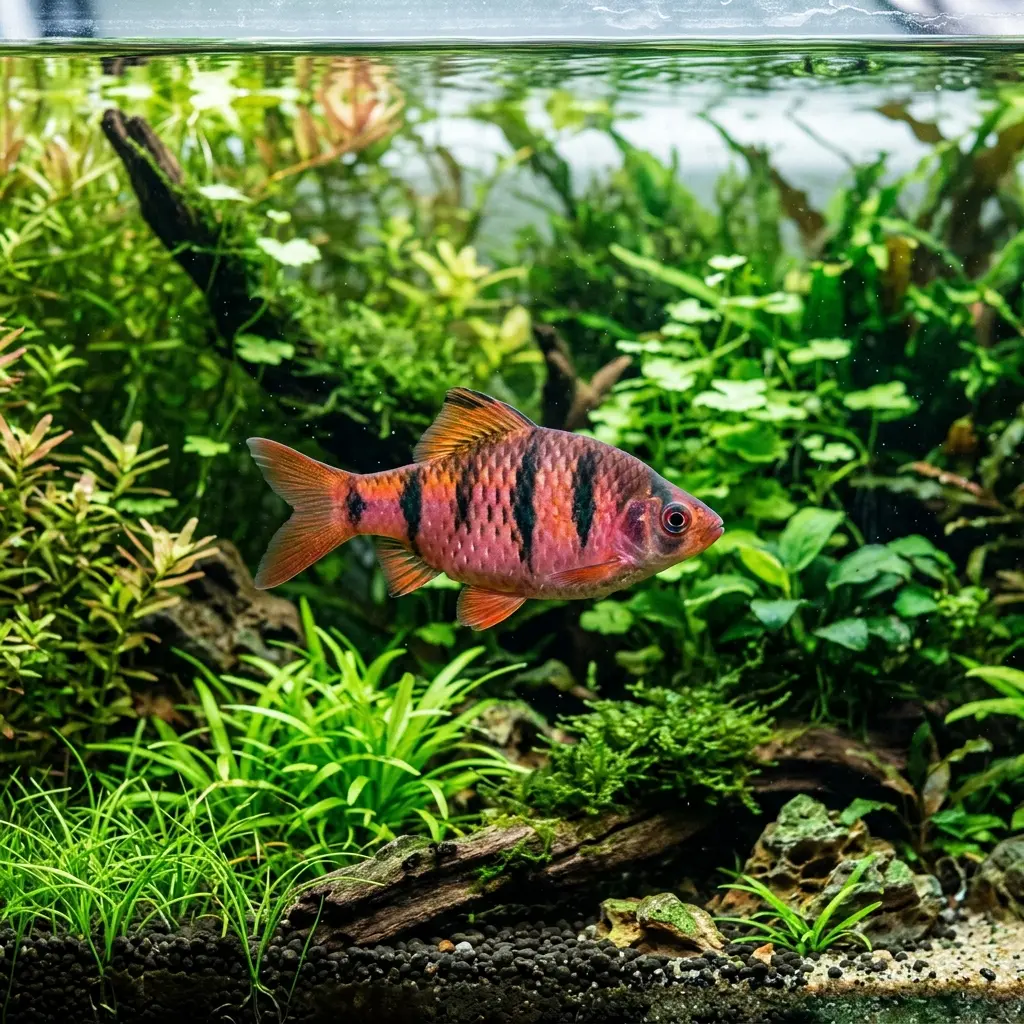
The most striking feature is the color pattern. The body ground color ranges from golden-yellow to orange-bronze, overlaid with 3 to 5 vertical black bars depending on geographic origin. Males in spawning condition develop an intense, almost fluorescent red to deep pink coloration across the entire body, with black margins on the dorsal and caudal fins. Females remain larger, deeper-bodied, and display more subdued brown-gold tones with less intense barring. Juveniles of both sexes appear silvery-brown with faint bars that intensify with age and optimal conditions.
Natural Habitat and Ecology
Melon Barbs inhabit clear to moderately turbid streams, rivers, and forest pools in the Western Ghats mountain range of Kerala, Karnataka, Goa, and Tamil Nadu. Their habitats are characterized by soft, acidic water stained with tannins from decaying leaf litter, submerged driftwood, and overhanging riparian vegetation. Water flow is generally gentle to moderate, with seasonal fluctuations driven by the monsoon cycle. During the dry season, they congregate in deeper pools with dense plant cover. During monsoons, they disperse into flooded marginal zones to spawn.
The substrate in their native range consists of sand, fine gravel, and leaf litter. Marginal vegetation includes emergent grasses, submerged Cryptocoryne, and aquatic mosses. The combination of tannin-stained water, dappled shade, and soft substrates creates the conditions you must replicate for optimal health and coloration in captivity.
Geographic Variation
Wild populations from different river drainages exhibit clinal variation in bar count, body depth, and color intensity. Northern Kerala and southern Karnataka populations typically show 3 to 4 broad bars with the most intense red male coloration. Southern Tamil Nadu populations may display 5 narrower bars and slightly more golden body tones. Goa populations tend toward deeper bodies and thicker bar width. These are intraspecific variations within H. fasciata, not distinct species, and all share identical aquarium care requirements.
Care
Housing and Aquarium Requirements
Tank Size and Dimensions
The absolute minimum aquarium for a school of Melon Barbs is 20 gallons (75 liters) with a length of at least 24 inches (60 cm) and a width of 12 inches (30 cm). A school of 6 to 8 individuals functions at this baseline. For every additional 3 to 4 barbs, add 10 gallons (38 liters) of water volume. A 30-gallon (113-liter) aquarium measuring 36 by 12 by 16 inches (90 by 30 by 40 cm) provides superior conditions for a school of 10 to 12 adults and significantly reduces shyness.
Tank height is secondary to length and width. Melon Barbs are mid-water column swimmers that cruise horizontally through the aquarium. Tall, narrow tanks restrict their natural movement and increase stress. You must provide open swimming lanes at least 12 inches (30 cm) wide with unobstructed horizontal travel paths of 24 inches (60 cm) or more. Avoid cluttered aquascapes that force constant direction changes or create dead zones where fish feel trapped.
School Size Requirements
The single most critical factor in Melon Barb husbandry is school size. You must never keep fewer than 6 individuals. Groups of 4 or fewer produce chronic stress, persistent hiding, and complete color suppression. A school of 6 to 8 is the functional minimum. A school of 10 to 12 individuals is optimal, allowing natural social confidence and the full expression of male spawning coloration. In larger tanks of 40 gallons (150 liters) or more, schools of 15 or more create a spectacular, cohesive display of synchronized movement.
Maintain a sex ratio of 1 male to 2 or 3 females. All-male groups escalate courtship chasing to the point of female exhaustion even without females present. Mixed-sex groups distribute male attention and produce the most natural, balanced behavior.
Filtration and Water Flow
Melon Barbs prefer gentle to moderate water flow. Size filtration at 4 to 5 times the tank volume per hour. A 20-gallon (75-liter) aquarium requires a filter rated for 80 to 100 gallons per hour (300 to 380 liters per hour). Sponge filters, hang-on-back units with flow diffusers, or small canister filters with adjustable outflow are ideal. High-velocity currents exhaust these fish and suppress natural exploratory behavior. Position filter outflows to create gentle circulation rather than turbulent streams.
Sponge filters are particularly beneficial for Melon Barb tanks because they provide gentle filtration, surface agitation for gas exchange, and a feeding surface for microorganisms that fry may consume. In breeding setups, sponge filters are mandatory to prevent fry from being drawn into filter intakes.
Substrate and Hardscape
Use dark, smooth gravel 2 to 4 mm in diameter or dark pool-filter sand. Dark substrates are non-negotiable for this species; light-colored gravel causes stress-induced color fading and inhibits the development of male spawning reds. A substrate depth of 1 to 2 inches (2.5 to 5 cm) is sufficient. Melon Barbs do not dig extensively but will sift fine gravel for edible microorganisms.
Hardscape should include smooth driftwood, water-worn rocks, and terracotta caves. Driftwood serves a dual purpose: it provides visual barriers that reduce shyness and releases tannins that soften water and replicate native conditions. Indian almond leaves, oak leaves, or alder cones can be added to the tank or filter to maintain a light tea-colored tint. Avoid sharp lava rock or rough slate that can abrade scales.
Plant Selection and Layout
Plant the rear and sides of the tank densely while leaving the front and center open for swimming. Use Cryptocoryne, Java Fern, Anubias, and Vallisneria as background and midground plants. Floating plants such as Water Sprite, Salvinia, Frogbit, or Amazon Frogbit are essential; they diffuse overhead light, provide security, and create the dappled shade these fish require. For authenticity, consider Indian native aquatic plants such as Lagenandra ovata or Blyxa aubertii if available.
Melon Barbs may nibble tender-leaved plants such as Cabomba or Elodea but generally ignore tougher species. They do not uproot plants significantly. The plant layout should create a gradient from dense cover at the back to open water at the front, allowing fish to retreat when startled while maintaining a visible schooling area.
Lighting and Photoperiod
Provide subdued lighting between 4,000 and 6,000 Kelvin for 8 to 10 hours daily. Bright, unshaded lighting causes acute stress and washed-out coloration. Use floating plants to create dappled light patterns that mimic forest canopy cover. If using LED fixtures, dim them to 50 to 60 percent intensity. A gradual dawn-dusk lighting schedule reduces startle responses. Moonlight LEDs or dim blue lighting can be used for evening observation without disrupting the fish.
Diet
Diet and Nutritional Requirements
Feeding Biology
Melon Barbs possess a true stomach and short to moderate intestinal tract, making them efficient digesters. In the wild, they consume insect larvae, small crustaceans, zooplankton, algae, and detritus sifted from leaf litter. In captivity, they accept virtually any appropriately sized food but develop washed-out coloration and reduced immune function on monotonous diets. Their small terminal mouth limits them to food particles under 2 mm in diameter.
Macronutrient Requirements
Adult Melon Barbs require a diet containing 30 to 35 percent protein, 8 to 12 percent fat, and significant plant-derived fiber. Juveniles under 3 months benefit from 38 to 42 percent protein for rapid growth. Fat content exceeding 15 percent causes hepatic lipidosis in this active species. Fiber below 3 percent leads to constipation. Carotenoid intake is critical: males cannot develop spawning reds without dietary astaxanthin, beta-carotene, and spirulina.
Recommended Foods
- Staple Dry Foods: High-quality tropical micro-pellets or small granules with spirulina, krill meal, and fish meal as primary ingredients. Select color-enhancing formulations containing astaxanthin.
- Live and Frozen Foods: Daphnia, brine shrimp, bloodworms, mosquito larvae, and small blackworms. These provide essential amino acids and stimulate hunting behavior. Feed live or frozen foods 2 to 3 times weekly.
- Vegetable Matter: Spirulina flakes, blanched peas with skins removed, zucchini slices, cucumber, and lettuce. Vegetable fiber maintains gastrointestinal motility and provides B-vitamins. Offer vegetable matter at least twice weekly.
Foods to Avoid
You must never feed beef heart, mammalian meats, or bread to Melon Barbs. Mammalian proteins contain lipids and structural proteins that cyprinids cannot metabolize. Bread expands in the gut and provides zero nutritional value. Avoid large pellets designed for cichlids; Melon Barbs have small throats and can choke on food exceeding 2 mm in diameter. Soak freeze-dried foods in tank water for 60 seconds before feeding to prevent expansion in the stomach.
Feeding Schedule and Strategy
Feed adult Melon Barbs 2 to 3 percent of their body weight daily, divided into two feedings. Morning and evening feedings 12 hours apart optimize digestion. Observe the 2-minute rule: offer only what the school consumes completely within 2 minutes. Remove all uneaten food immediately. In community tanks with slower or more timid tank mates, feed at one end of the tank to distract the active barbs, then add food at the opposite end for slower fish.
Breeding
Breeding Melon Barbs
Sexual Dimorphism and Selection
Melon Barbs are sexually dimorphic, with differences becoming pronounced during spawning condition. Males are smaller, more slender, and develop intense red to deep pink body coloration with black margins on the dorsal and caudal fins. The red coloration can cover the entire body, giving males a spectacular appearance. Females are larger, deeper-bodied, and display more subdued golden-brown tones with less defined barring. Select breeders at least 8 months old and 1.5 inches (4 cm) in body length. Choose the most vividly colored males and the plumpest females.
Conditioning and Triggering
Condition breeders separately for 2 weeks on a diet of live blackworms, bloodworms, and brine shrimp supplemented with spirulina flakes. The critical spawning trigger is a simulated monsoon. Lower the water level in the breeding tank by 1 inch (2.5 cm) and maintain temperature at 78 degrees Fahrenheit (25.5 degrees Celsius) for 3 days. Then sprinkle slightly cooler water, 2 to 3 degrees Fahrenheit (1 to 1.5 degrees Celsius) below tank temperature, into the aquarium to mimic rainfall. The vibrations and temperature drop trigger hormonal spawning cascades. Increase photoperiod to 14 hours during conditioning.
Spawning Setup
Use a dedicated breeding tank of 20 gallons (75 liters) with 5 inches (12 cm) of water depth. Install spawning mops made of acrylic yarn, fine-leaf plants such as Java Moss or Cabomba, or cover the bare bottom with glass marbles or a plastic spawning grid. The shallow water concentrates hormones and facilitates egg fertilization.
Introduce 1 male and 2 females to the breeding tank in the evening. Spawning occurs at dawn, typically within 12 to 24 hours. The female scatters 150 to 250 adhesive eggs over plants and substrate while males fertilize them externally. Once spawning is complete, remove all adults immediately. Melon Barbs exhibit no parental care and will consume eggs.
Egg and Fry Development
Eggs hatch in 24 to 36 hours at 75 to 78 degrees Fahrenheit (24 to 25.5 degrees Celsius). Newly hatched fry attach to surfaces for 2 to 3 days while absorbing their yolk sacs. Do not feed during this period. Once free-swimming, offer infusoria, vinegar eels, or liquid fry food for the first 4 days. Transition to microworms and newly hatched brine shrimp nauplii from day 5 to day 14. By week 3, introduce finely crushed high-quality flake or micro-pellets.
Fry require pristine water conditions with daily 15 to 20 percent water changes using matched temperature and pH. Maintain temperature at 76 to 78 degrees Fahrenheit (24.5 to 25.5 degrees Celsius) for optimal growth. Melon Barb fry grow rapidly, reaching 1 inch (2.5 cm) within 8 to 10 weeks under optimal conditions. Color bands develop gradually and become distinct by 10 to 12 weeks of age. Males begin showing red coloration by 4 to 5 months.
Tips
Expert Tips and Common Mistakes
Critical Success Factors
- School Size Overcomes Shyness: A group of 4 Melon Barbs will hide indefinitely. A group of 10 or more becomes confident and interactive within 2 weeks. School size is the single most important factor for success.
- Dark Substrate is Mandatory: Light gravel causes stress and color suppression. Use black sand, dark brown gravel, or pool-filter sand dyed dark. The difference in male color intensity is dramatic.
- Subdued Lighting with Floating Plants: Bright overhead lighting mimics predator exposure. Floating plants such as Salvinia or Frogbit create essential dappled shade and security.
- Botanical Tannins Enhance Color: Indian almond leaves, oak leaves, or alder cones release tannins that soften water, reduce pathogen loads, and intensify red coloration in males.
Common Mistakes to Avoid
- Keeping 2 to 4 Individuals: Small groups produce chronic shyness, hiding, and complete color suppression. This species requires group confidence.
- Bright, Bare Tanks: Tanks with white gravel, no plants, and intense lighting guarantee washed-out, stressed fish that never display properly.
- Hard Water Above 12 dGH: While they survive in harder water, color intensity and spawning behavior are severely suppressed. Soft water is non-negotiable for optimal display.
- Overfeeding Dry Foods: Excessive flake food causes obesity and bloat. Feed measured portions and include substantial live and vegetable matter.
- Adding to Established Aggressive Tanks: While peaceful themselves, Melon Barbs cannot defend against truly aggressive cichlids or large barbs. House them with equally peaceful community species.
- Ignoring Acclimation Period: New Melon Barbs hide for days. This is normal. Do not increase lighting, rearrange decor, or add more fish during the first 2 weeks.
Behavioral Observation Guide
Healthy Behavior: Loose schooling in the middle water column, vivid male coloration, immediate response to feeding, gentle parallel swimming between individuals.
Stress Indicators: Faded or washed-out color, hiding in corners or behind plants, separated from the school, clamped fins, refusal to eat.
Spawning Readiness: Males intensify to deep red with black fin margins, chase females in short bursts, and display lateral fin-spreading to rivals.





