
Turquoise Rainbowfish (Melanotaenia lacustris)
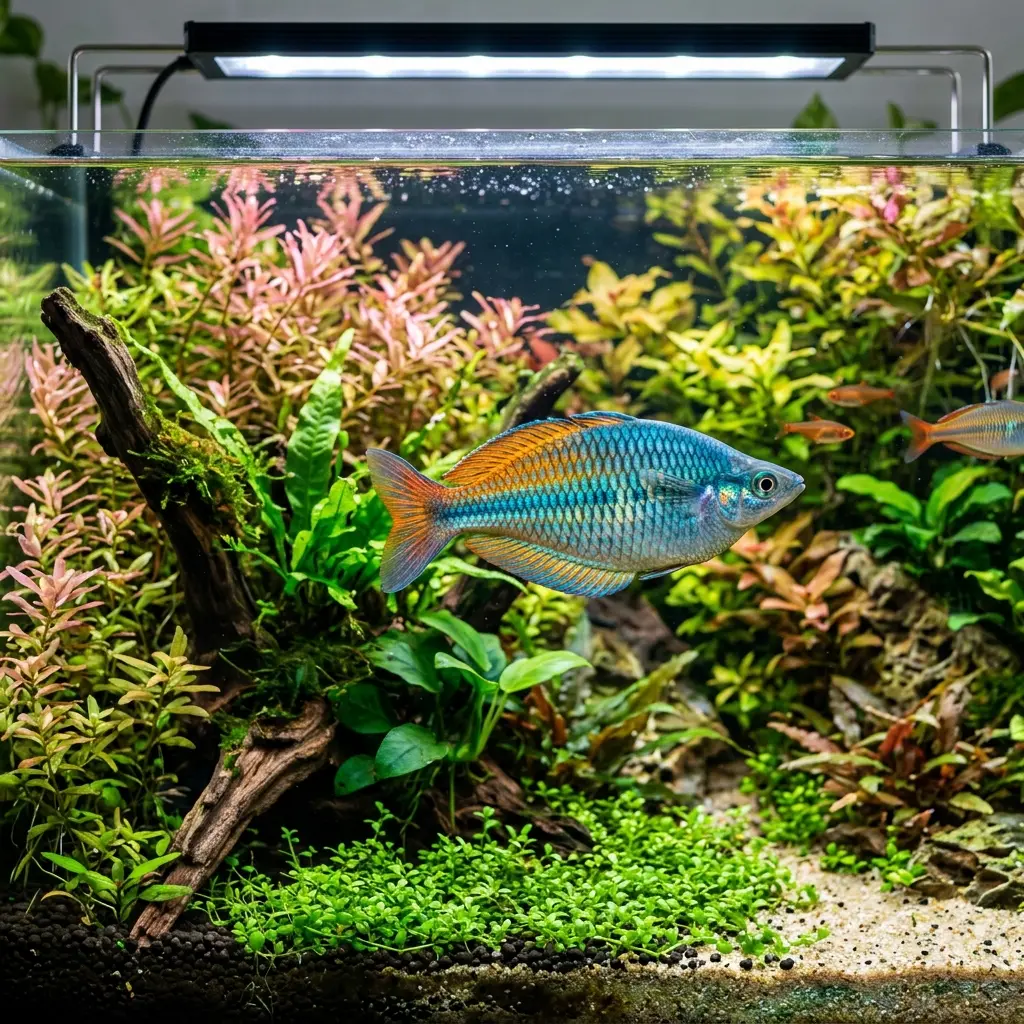
Quick Answer
Turquoise Rainbowfish (Melanotaenia lacustris) is a brilliant blue endemic species from Lake Kutubu, Papua New Guinea. It requires a minimum 55-gallon aquarium with hard, alkaline water (pH 7.0 to 8.5, GH 8 to 20 dGH) and temperature 72°F to 78°F (22°C to 26°C). This peaceful omnivore must be kept in schools of 6 to 8 minimum and thrives in well-planted tanks with open swimming lanes.
Quick Facts
| Scientific Name | Melanotaenia lacustris |
|---|---|
| Common Names | Turquoise Rainbowfish |
| Family | Melanotaeniidae |
| Genus | Melanotaenia |
| Type | Freshwater |
| Temperament | peaceful |
| Care Difficulty | intermediate |
| Lifespan | 7 years |
| Maximum Size | Up to 4.5 in (11 cm) |
| Diet | Omnivore |
| Temperature | 72–78°F (22–26°C) |
| pH | 7–8.5 |
| Hardness | 8–20 dGH |
| Minimum Size | 55 gallons |
Key Takeaways
- Endemic to Lake Kutubu, Papua New Guinea; classified as Endangered in the wild.
- Requires hard, alkaline water (GH 8 to 20 dGH, pH 7.0 to 8.5) for health and coloration.
- Must be kept in schools of 6 to 8 minimum; smaller groups cause stress and color fading.
- Reaches 4.5 inches (11.4 cm) and lives 5 to 8 years with proper care.
- Brilliant turquoise coloration requires bright lighting, carotenoid-rich diet, and social stimulation.
- Skilled jumpers requiring a tight-fitting lid at all times.
- Peaceful community fish compatible with tetras, rasboras, danios, Corydoras, and peaceful cichlids.
Overview
Species Overview
The Turquoise Rainbowfish (Melanotaenia lacustris), also known as the Lake Kutubu Rainbowfish or Blue Rainbowfish, is widely regarded as one of the most spectacularly colored freshwater fish in the aquarium hobby. Endemic to a single lake in Papua New Guinea, this species displays an intense electric-turquoise to deep sapphire-blue body that shifts to greenish-gold along the back, with mature males developing a brilliant yellow to orange finnage that creates a stunning contrast.
Natural History and Endemism
Turquoise Rainbowfish are found exclusively in Lake Kutubu, an ancient oligotrophic lake in the Southern Highlands Province of Papua New Guinea, part of the Kikori River drainage system. The lake sits at 2,600 feet (800 meters) elevation and is surrounded by limestone geology, which produces the characteristically hard, alkaline water these fish require. This single-lake endemism makes them both biologically significant and conservation-sensitive.
Physical Characteristics
Adult Turquoise Rainbowfish reach 4 to 4.5 inches (10 to 11.4 cm) in standard length, with a deep, laterally compressed body typical of the Melanotaeniidae family. The body coloration ranges from electric turquoise in dominant males to forest blue in females and subordinate males, with a paler silvery-white underside. The fins, particularly the dorsal and anal fins, develop bright yellow to orange margins in mature males. Juveniles appear drab gray-green and only develop their full coloration at 6 to 8 months of age when kept in proper conditions.
Conservation Status
The species is classified as Endangered by the IUCN. Lake Kutubu experiences periodic catastrophic oxygen depletion events approximately every 2 years, caused by upwelling of anoxic water from the lake's depths. These events cause mass mortality of the rainbowfish population. Combined with habitat degradation from deforestation, agricultural runoff, and introduction of non-native tilapia, the wild population faces severe pressure. The aquarium trade now relies primarily on captive-bred specimens, and responsible sourcing is critical for species survival.
Diet
Feeding and Nutrition
Turquoise Rainbowfish are opportunistic omnivores with a high metabolic rate that demands frequent, varied feeding. In their native Lake Kutubu, they consume algae, insect larvae, small crustaceans, zooplankton, and detritus. In captivity, replicating this varied diet is essential for health, coloration, and breeding condition.
Nutritional Requirements
Their dietary composition should approximate 45% protein, 12% fat, and 43% plant matter and fiber. Rainbowfish have relatively short digestive tracts and benefit from multiple small meals rather than one large feeding.
Feeding Schedule
Feed 2 to 3 times daily, offering only what the fish consume within 2 to 3 minutes. Overfeeding causes obesity, bloat, and water quality degradation. Fast the tank one day weekly to allow digestive rest.
Staple Foods
- High-quality flake or micro-pellet: Formulated for rainbowfish or tropical omnivores. Select products with spirulina, krill, and fish meal as primary ingredients.
- Color-enhancing pellets: Foods containing astaxanthin, canthaxanthin, and beta-carotene directly intensify blue and turquoise iridescence.
- Frozen foods: Bloodworms, daphnia, brine shrimp, and mysis shrimp. Thaw completely and rinse before feeding. Offer 3 to 4 times weekly.
- Live foods: Blackworms, daphnia, and mosquito larvae stimulate natural foraging and condition fish for breeding. Offer weekly.
Vegetable Supplementation
Offer spirulina flakes 2 to 3 times weekly and blanched vegetables (spinach, zucchini, peas, cucumber) once weekly. The plant fiber aids digestion and prevents constipation, a common issue in rainbowfish fed exclusively protein-rich diets.
Color Enhancement Protocol
The brilliant turquoise coloration is structurally produced by guanine crystals in the scales and enhanced by dietary carotenoids. To maximize color intensity:
- Feed astaxanthin-enriched foods daily for 2 weeks, then reduce to 3 times weekly for maintenance.
- Include krill and mysis shrimp as 25% to 30% of the diet; these are rich in carotenoids that deposit in skin and scales.
- Maintain hard water above 10 dGH; mineral content directly affects scale iridescence and structural color production.
- Provide bright, full-spectrum lighting for 8 to 10 hours daily; photoperiod triggers hormonal color intensification pathways.
Foods to Avoid
- Beef heart and mammalian meat: Indigestible lipids cause fatty liver disease.
- Exclusively flake diets: Lack sufficient carotenoids and fiber for long-term health.
- Overfeeding dry pellets: Expands in the gut and causes bloat. Soak pellets briefly before feeding.
Health
Health and Disease Management
Turquoise Rainbowfish are generally hardy fish when maintained in appropriate water conditions. However, their sensitivity to soft water, nitrate accumulation, and certain pathogens requires proactive health management. Preventive care is far more effective than treatment.
Preventive Health Protocol
- Quarantine all new fish for 14 days minimum. Rainbowfish are susceptible to ich and external parasites introduced by new tank mates.
- Maintain nitrates below 15 ppm through weekly 25% to 30% water changes. Elevated nitrates suppress immune function and cause color fading.
- Keep GH above 8 dGH at all times. Soft water causes osmotic stress, reduced immunity, and poor coloration.
- Avoid sudden parameter changes. Rainbowfish are sensitive to pH swings greater than 0.3 units in 24 hours.
- Provide a varied, vitamin-rich diet. Malnutrition is a leading cause of secondary infections in rainbowfish.
Ichthyophthirius multifiliis (Ich / White Spot Disease)
A protozoan parasite causing white cysts on skin, fins, and gills. Highly contagious and common in rainbowfish due to their sensitivity to temperature fluctuations.
- White salt-like spots 0.5 to 1 mm in diameter on body and fins, flashing against decor, rapid gill movement, clamped fins.
Introduced via infected fish, plants, or equipment. Stress from temperature drops below 72°F (22°C) or pH swings reduces resistance.
Quarantine all new additions for 14 days. Maintain stable temperature between 72°F and 78°F (22°C to 26°C). Avoid cross-contamination between tanks using separate nets and siphons.
Fin Rot (Bacterial / Aeromonas, Pseudomonas, Flexibacter)
Bacterial infection of fin tissue, often secondary to poor water quality, fin-nipping tank mates, or physical damage during transport.
- Frayed or receding fin edges with white, red, or black margins, tissue necrosis advancing toward the body, lethargy, loss of appetite.
Elevated nitrates above 15 ppm, ammonia or nitrite above 0 ppm, fin-nipping by tiger barbs or serpae tetras, rough handling during netting.
Perform weekly 25% to 30% water changes. Remove aggressive fin-nippers. Use soft nets for handling. Maintain nitrates below 15 ppm.
Columnaris (Flexibacter columnaris)
A highly contagious bacterial infection presenting as white cottony patches on the mouth, fins, or body. Can progress rapidly and become fatal within 48 hours.
- White or grayish cottony patches on mouth, fins, or body, frayed fins, lethargy, loss of appetite, rapid breathing, ulcerations in advanced cases.
Poor water quality, overcrowding, stress from incompatible tank mates, high temperatures above 80°F (27°C) that accelerate bacterial growth.
Maintain excellent water quality with weekly changes. Avoid overcrowding. Keep temperature at 72°F to 78°F (22°C to 26°C). Quarantine new fish for 14 days.
Internal Parasites (Tapeworms, Nematodes, Hexamita)
Helminth worms or protozoan flagellates infecting the digestive tract. Common in wild-caught specimens or those fed contaminated live foods.
- Emaciation despite normal feeding, stringy white or translucent feces, abdominal bloating, lethargy, refusal to eat, visible worms in feces.
Feeding live foods from contaminated sources, introducing infected tank mates, wild-caught specimens carrying native parasites.
Quarantine new fish for 14 days. Use commercially bred live foods or frozen alternatives. Treat prophylactically with Praziquantel during quarantine.
Constipation and Bloat
Digestive impaction caused by overfeeding, low-fiber diet, or ingestion of dry pellets that expand in the gut.
- Swollen abdomen, reduced or absent feces, buoyancy problems, loss of appetite, lethargy, stringy feces.
Overfeeding dry pellets without soaking, lack of dietary fiber, excessive protein without vegetable matter, feeding too-large food items.
Feed appropriately sized foods. Include spirulina flakes and blanched vegetables weekly. Soak dry pellets for 30 seconds before feeding. Fast one day weekly.
Color Fading Syndrome
Not a disease per se, but a collection of stress responses causing loss of the characteristic turquoise coloration. Often the first sign of underlying problems.
- Drab gray-green body color instead of turquoise-blue, pale fins, reduced activity, hiding behavior, reduced appetite.
School size below 6 individuals, soft water below 5 dGH, dim lighting, poor diet lacking carotenoids, high nitrates above 20 ppm, stress from aggressive tank mates.
Maintain a school of 8 or more. Keep GH at 10 to 15 dGH. Provide bright full-spectrum lighting. Feed astaxanthin-enriched foods. Maintain nitrates below 15 ppm.
Breeding
Breeding Turquoise Rainbowfish
Breeding Turquoise Rainbowfish is an intermediate-level project that rewards patience with daily spawning behavior and the challenge of raising tiny fry. These fish are prolific daily egg scatterers that spawn at dawn in vegetation, making them one of the more predictable rainbowfish species to breed.
Sexual Dimorphism
Mature males are slightly larger than females, with a more arched back, broader body, and markedly more intense coloration. The dorsal, anal, and caudal fins develop bright yellow to orange margins. Females are smaller, deeper-bodied when gravid, and exhibit a subdued blue-green coloration without the vivid fin margins. Sexing is unreliable in juveniles under 3 inches (7.5 cm).
Pre-Spawn Conditioning
Select 8 to 10 mature adults with a ratio of 1 male to 2 females. Condition them for 3 weeks in a spacious aquarium on a diet of live blackworms, brine shrimp, bloodworms, and high-quality flakes. Maintain water at pH 7.5, dGH 10 to 12, and 75°F (24°C). Males will begin displaying to females within days of introducing quality live foods.
Breeding Tank Setup
Prepare a 30-gallon (113-liter) breeding aquarium with 10 inches (25 cm) of water depth. Install a gentle sponge filter to prevent eggs and fry from being drawn into the filtration. Provide dense spawning substrate using acrylic yarn spawning mops suspended throughout the water column and fine-leaved plants such as Java moss, hornwort, or guppy grass. Slightly reduce water hardness to dGH 8 to 10 and pH 7.2 to 7.5.
Spawning Behavior
Spawning occurs daily at dawn, typically within the first hour of the photoperiod. The male performs an elaborate courtship display, intensifying his blue coloration to maximum brilliance and quivering his body alongside the female. He guides her to the spawning mop or vegetation, where she releases 50 to 150 small, adhesive eggs per day. The eggs are pale yellow to amber, approximately 1.2 mm in diameter, and stick to plant leaves and mop strands. The male fertilizes the eggs externally. Neither parent provides care.
Egg Collection and Incubation
Because adults will consume eggs readily, you must remove the spawning mop daily and transfer it to a separate hatching tank with identical water parameters. Alternatively, remove the parents every 2 days and replace them with fresh conditioned breeders. This rotation allows continuous spawning while protecting developing eggs.
Fry Rearing
Eggs hatch in 7 to 10 days at 72°F (22°C). Warmer temperatures of 76°F (24°C) reduce hatching time to 6 to 7 days but increase the risk of fungal infection. Newly hatched fry are extremely small and require infusoria or commercial liquid fry food for the first 3 days. By day 4, transition to microworms and vinegar eels. By day 10, introduce newly hatched brine shrimp (Artemia nauplii). Perform 10% daily water changes with extreme care using an airline tube siphon to avoid sucking up fry.
Growth is moderate; fry reach 1 inch (2.5 cm) at 6 weeks and sexual maturity at 8 to 10 months. Color development begins at 3 to 4 months, with full turquoise expression by 6 to 8 months in males. Separate size-disparate fry to prevent cannibalism of the smallest individuals.
Common Breeding Challenges
- Egg fungus (Saprolegnia): Treat hatching tank with methylene blue at 1 drop per gallon (3.8 liters) immediately after egg transfer.
- Poor fertility: Caused by soft water or insufficient conditioning. Ensure dGH is at least 8 and conditioning lasts a full 3 weeks.
- Fry mortality: Almost always due to inadequate first foods. Never skip the infusoria stage; fry mouths are too small for baby brine shrimp at hatching.
- Parental egg predation: Remove parents daily. Even well-fed adults will consume eggs within hours of spawning.
Compatible Tank Mates






Species Comparison
| Feature | Turquoise Rainbowfish | Boesemani Rainbowfish | Neon Dwarf Rainbowfish | Congo Tetra |
|---|---|---|---|---|
| Max Size | 4.5 inches (11.4 cm) | 4 inches (10 cm) | 2.5 inches (6.4 cm) | 3 inches (7.6 cm) |
| Temperament | Peaceful / Active | Peaceful / Active | Peaceful / Active | Peaceful / Active |
| Minimum Tank Size | 55 gallons (208 L) for 6-8 | 55 gallons (208 L) for 6-8 | 20 gallons (76 L) for 6-8 | 30 gallons (113 L) for 6-8 |
| Diet | Omnivore: flakes, pellets, frozen, veggies | Omnivore: flakes, pellets, frozen, veggies | Omnivore: flakes, pellets, frozen | Omnivore: flakes, pellets, frozen |
| pH Range | 7.0 - 8.5 (alkaline) | 7.0 - 8.0 (alkaline) | 6.5 - 7.5 (neutral) | 6.0 - 7.5 (slightly acidic) |
| Hardness Requirement | 8 - 20 dGH (hard water mandatory) | 10 - 20 dGH (hard water preferred) | 5 - 15 dGH (moderate) | 4 - 12 dGH (soft to moderate) |
| Special Notes | Endangered in wild; needs 4ft tank | Bicolor body; males most colorful | Smaller species; bright blue males | Long fins; needs soft acidic water |