
Red Crystal Shrimp (Caridina cantonensis)
Quick Answer
Red Crystal Shrimp (Caridina cantonensis) is a selectively bred dwarf shrimp prized for its striking red and white banding. It requires a minimum 10-gallon (38-liter) species-only tank with soft, acidic water (pH 6.0 to 6.8, GH 4 to 6 dGH, KH 0 to 2 dKH, TDS 100 to 180 ppm), RO water remineralized with shrimp-specific products, and stable parameters. This peaceful omnivore occupies the bottom zone and is best suited to dedicated shrimp keepers.
Quick Facts
| Scientific Name | Caridina cantonensis |
|---|---|
| Common Names | Red Crystal Shrimp |
| Family | Atyidae |
| Genus | Caridina |
| Type | Freshwater |
| Temperament | peaceful |
| Care Difficulty | intermediate |
| Lifespan | 2 years |
| Maximum Size | Up to 1.2 in (3 cm) |
| Diet | Omnivore |
| Temperature | 68–76°F (20–24°C) |
| pH | 6–6.8 |
| Hardness | 4–6 dGH |
| Minimum Size | 10 gallons |
Key Takeaways
- Requires soft, acidic water with pH 6.0 to 6.8 and GH 4 to 6 dGH.
- RO water with shrimp-specific remineralizer is absolutely mandatory.
- Grading system from C to SSS determines color quality and price.
- Failed molts are the leading cause of death; maintain strict GH control.
- Copper at 0.01 mg/L is lethal; never use tap water or copper medications.
- Species-only tanks strongly recommended for breeding success.
Overview
Species Overview
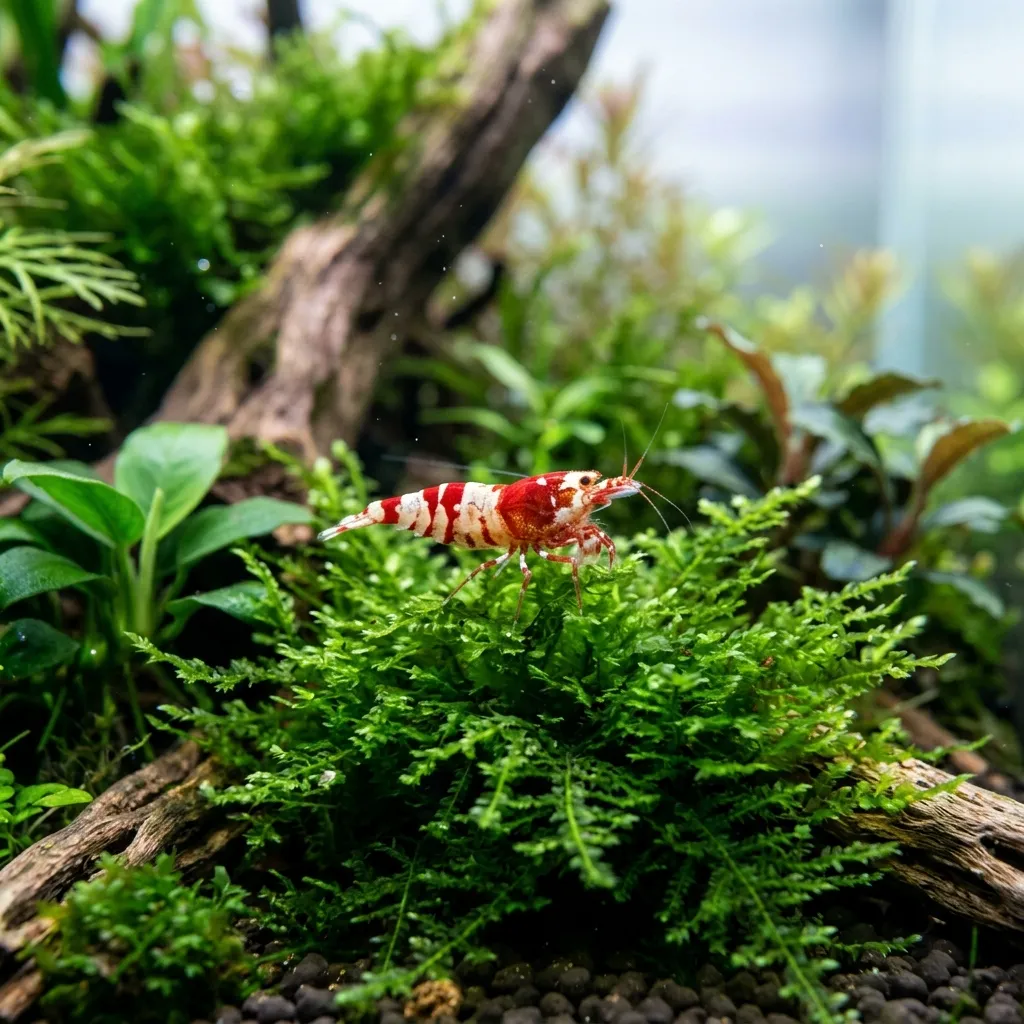
The Red Crystal Shrimp (Caridina cantonensis var. Crystal Red), often abbreviated as CRS, is one of the most iconic and sought-after dwarf shrimp in the aquarium hobby. Selectively bred from the wild Bee Shrimp by Japanese breeder Hisayasu Suzuki in the 1990s, this species displays a breathtaking red and white candy cane pattern that has captivated aquarists worldwide. The striking coloration is the result of decades of intensive selective breeding, which has also made the species more sensitive to water parameters than its wild ancestor.
Physical Characteristics
Adult Red Crystal Shrimp reach approximately 1 to 1.2 inches (2.5 to 3.0 cm) in length. The body exhibits a vivid red base color beautifully contrasted with white stripes or patches. The intensity and pattern of the red and white determine the shrimp's grade, which ranges from C Grade (least desirable) to SSS Grade (show quality). Females are generally larger and rounder than males, particularly when berried (carrying eggs). Males are slimmer with more intense coloration in some lines.
Grading System
The Crystal Red Shrimp grading system is standardized across the hobby:
- C Grade: Patchy red coloration with large clear areas
- B Grade: More red coverage with some white definition
- A Grade: Good red and white contrast with defined pattern
- S Grade: Excellent pattern definition with thick white bands
- SS Grade: Near-perfect pattern with minimal clear areas
- SSS Grade: Show quality with perfect candy cane patterning
Higher grades command premium prices, with SSS specimens fetching $50 or more each. Culling low-grade offspring is standard practice to maintain colony quality.
Lifespan
With optimal care in a stable, mature tank, Red Crystal Shrimp live 1.5 to 2 years, with exceptional individuals reaching 3 years. Their relatively short lifespan is offset by prolific breeding once a colony is established. Poor water quality, incorrect parameters, or copper exposure can reduce lifespan to mere weeks.
Conservation Status
The Red Crystal Shrimp is currently listed as Not Evaluated by the IUCN. The species does not exist in the wild in its red-and-white form; it is entirely a product of captive selective breeding. Wild Caridina cantonensis populations in southern China, Hong Kong, and Taiwan remain stable.
Care
Housing & Pond Requirements
Minimum Tank Specifications
The absolute minimum tank size for a starter colony is 10 gallons (38 liters) with a footprint of at least 20x10 inches (50x25 cm). A 20-gallon (76-liter) tank is strongly recommended for beginners as larger water volumes provide superior parameter stability. The tank must be fully cycled and mature (minimum 6 to 8 weeks old) with established biofilm before adding shrimp. Shrimp added to new tanks almost always die within the first month.
Filtration Requirements
Use a sponge filter or a hang-on-back filter with a sponge pre-filter over the intake. Canister filters are acceptable but must have all intake openings covered with fine mesh or sponge to prevent shrimplet loss. Water flow must be very gentle; strong currents stress shrimp and prevent proper grazing. The sponge filter serves dual purpose: mechanical filtration and biofilm growth surface for grazing.
Substrate
Use an active buffering substrate designed for Caridina shrimp (ADA Amazonia, Fluval Stratum, Brightwell RioEscuro). These substrates lower pH and maintain soft water conditions. Inert substrates (gravel, sand) require constant chemical adjustment and are not recommended for beginners. Substrate depth of 2 to 3 inches (5 to 7.6 cm) provides rooting space for plants and detritus accumulation for biofilm.
Hardscape & Decor
Provide dense moss coverage (Java moss, Christmas moss, peacock moss, weeping moss), cholla wood, alder cones, and Indian almond leaves. These serve as grazing surfaces, hiding spots for molting shrimp, and tannin sources that stabilize pH. Smooth stones and driftwood create additional microhabitats. Avoid copper-containing rocks or decorations.
Plants
Red Crystal Shrimp are completely plant-safe and benefit from dense planting. Recommended plants include Java fern, Anubias, Cryptocoryne, Bucephalandra, and mosses. Floating plants (Duckweed, Salvinia, Frogbit) diffuse light and create shaded retreats. Fast-growing stem plants help absorb excess nitrates.
Lid
A lid is recommended to reduce evaporation (which concentrates minerals) and prevent shrimp from climbing out during water changes or maintenance.
Diet
Diet & Nutrition
Red Crystal Shrimp are omnivorous scavengers that spend most of their time grazing on biofilm, algae, and detritus. In a healthy, mature aquarium, natural biofilm constitutes the majority of their diet. However, supplemental feeding is essential in clean, heavily maintained tanks where biofilm is insufficient.
Health
Health & Disease Management
Red Crystal Shrimp are generally healthy when kept in stable, appropriate conditions. However, their extreme sensitivity to copper, parameter fluctuations, and specific mineral requirements makes them vulnerable to several preventable health issues. Preventive care through water quality management and copper avoidance is far more effective than treatment.
Failed Molt (Ecdysis Failure)
The leading cause of death in Crystal Red Shrimp, caused by incorrect mineral balance or sudden parameter changes during the molting process.
- Shrimp stuck partially in old shell, white line of death (crack along the back), lethargy, loss of appetite, shrimp lying on side, inability to right itself.
GH below 4 dGH (insufficient calcium/magnesium), GH above 8 dGH (shell too hard), sudden pH shift greater than 0.2, temperature mismatch during water changes, iodine deficiency, tank immaturity.
Maintain GH strictly at 4 to 6 dGH. Perform small water changes (10% weekly) with parameter-matched RO water. Add iodine supplement monthly. Provide mineral stones or cuttlebone for supplemental calcium. Ensure tank is 6+ months mature before adding shrimp.
Copper Toxicity
Acute poisoning from copper concentrations as low as 0.01 mg/L, lethal within hours. Copper is absorbed through gills and disrupts hemocyanin.
- Rapid death within hours, shrimp turning pale or white, erratic swimming, convulsions, lying on back, all shrimp dying simultaneously.
Tap water containing copper pipes, copper-based medications, copper-containing plant fertilizers, new decorations with copper content, contaminated foods.
Use only RO or DI water. Test all new decorations with copper test kit. Never use copper-based medications in shrimp tanks. Use shrimp-safe fertilizers only. Quarantine all new hardscape and plants.
Bacterial Infection (Chitinolytic Bacteria)
Secondary bacterial infection that degrades the exoskeleton, often following injury, poor water quality, or failed molt.
- White or cloudy patches on exoskeleton, soft or discolored shell, lethargy, loss of appetite, shrimp hiding excessively, death within days.
Poor water quality (nitrates above 10 ppm), injury during molting, overcrowding, overfeeding causing bacterial blooms, introduction via contaminated plants or food.
Maintain pristine water quality with weekly 10% changes. Avoid overcrowding (max 10 shrimp per gallon). Remove uneaten food promptly. Quarantine new plants. Treat with shrimp-safe antibiotics (Maracyn, Furan-2) in a hospital tank.
Vorticella & Epistylis (Protozoan Infections)
External protozoan parasites that attach to the shrimp’s rostrum, antennae, and legs, appearing as white fuzzy growths.
- White cotton-like tufts on rostrum, antennae, or legs, reduced feeding, lethargy, difficulty molting if infestation is heavy.
Introduction via contaminated plants, poor water quality, stress from parameter fluctuations, introduction of infected shrimp.
Quarantine all new plants in hydrogen peroxide dip (1% for 3 minutes). Maintain stable parameters. Treat with shrimp-safe herbal parasite treatments or salt baths (1 ppt for 30 minutes) in a hospital container.
Sudden Colony Collapse
Mass die-off of the entire colony within days, caused by catastrophic parameter failure, copper contamination, or ammonia spike.
- Multiple shrimp dying within 24 to 72 hours, shrimp gasping at surface, erratic behavior, color fading, simultaneous death across all age groups.
Use only RO water with shrimp remineralizer. Test parameters before and after every water change. Never add medications without verifying shrimp safety. Keep a spare cycled tank ready for emergency relocation. Perform 10% water changes weekly, never more than 15% at once.
Breeding
Breeding Red Crystal Shrimp
Breeding Red Crystal Shrimp is one of the most rewarding aspects of shrimp keeping. Once parameters are stable and the colony is established, breeding occurs naturally without intervention. However, successful breeding requires precise water chemistry, mature biofilm for shrimplets, and culling to maintain color quality.
Compatible Tank Mates






Species Comparison
| Feature | Red Crystal Shrimp | Cherry Shrimp | Amano Shrimp | Blue Bolt Shrimp |
|---|---|---|---|---|
| Scientific Name | Caridina cantonensis | Neocaridina davidi | Caridina multidentata | Caridina cantonensis |
| Max Size | 1.2 inches (3.0 cm) | 1.5 inches (3.8 cm) | 2 inches (5.1 cm) | 1.2 inches (3.0 cm) |
| Temperament | Peaceful, shy | Peaceful, active | Peaceful, bold | Peaceful, shy |
| Minimum Tank Size | 10 gallons (38 L) | 5 gallons (19 L) | 10 gallons (38 L) | 10 gallons (38 L) |
| Water Type | Soft, acidic (RO required) | Hard, neutral (tap water OK) | Neutral to slightly acidic | Soft, acidic (RO required) |
| pH Range | 6.0 - 6.8 | 6.5 - 8.0 | 6.5 - 7.5 | 6.0 - 6.8 |
| GH Range | 4 - 6 dGH | 6 - 12 dGH | 6 - 12 dGH | 4 - 6 dGH |
| Difficulty Level | Intermediate | Beginner | Beginner | Advanced |
| Breeding Difficulty | Moderate (requires stable params) | Easy (breeds prolifically) | Very hard (larvae need brackish) | Moderate (requires stable params) |
| Price per Shrimp | $8 - $50+ (by grade) | $2 - $8 | $3 - $6 | $15 - $100+ |