
Splashing Tetra (Copella arnoldi)
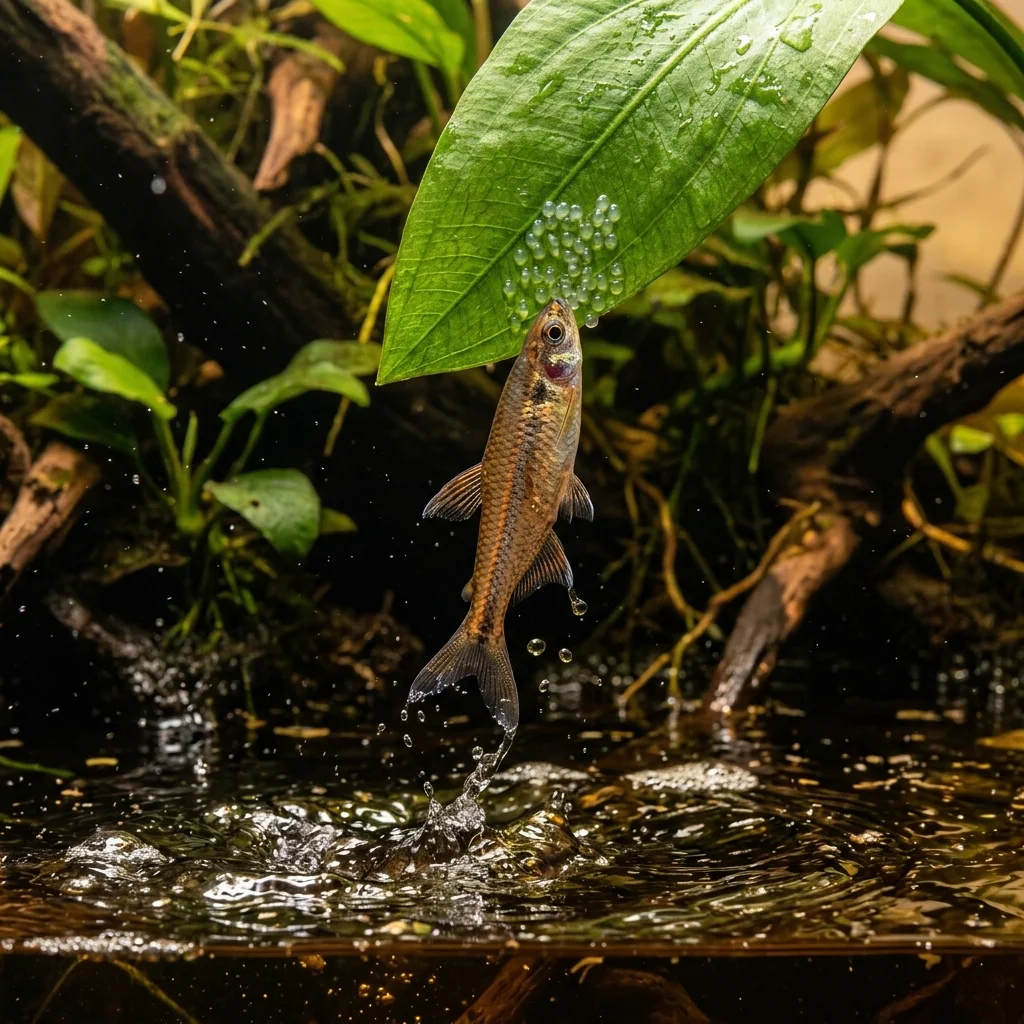
Quick Answer
Splashing Tetra (Copella arnoldi) is a peaceful, surface-dwelling pencilfish from South American blackwater creeks. Famous for leaping out of water to deposit eggs on overhanging leaves, it requires a minimum 20 gallon (75 liter) aquarium with a tight-fitting lid, soft acidic water, dim lighting, and groups of 6 or more.
Quick Facts
| Scientific Name | Copella arnoldi |
|---|---|
| Common Names | Splashing Tetra |
| Family | Lebiasinidae |
| Genus | Copella |
| Type | Freshwater |
| Temperament | peaceful |
| Care Difficulty | intermediate |
| Lifespan | 4 years |
| Maximum Size | Up to 2.2 in (6 cm) |
| Diet | Omnivore |
| Temperature | 75–82°F (24–28°C) |
| pH | 5.5–7 |
| Hardness | 2–8 dGH |
| Minimum Size | 20 gallons |
Key Takeaways
- Not a true tetra; belongs to the pencilfish family Lebiasinidae.
- Famous for unique breeding: leaps onto leaves and splashes eggs with water.
- Tight-fitting lid is absolutely mandatory; expert jumpers.
- Requires soft, acidic blackwater with dim lighting and gentle flow.
- Obligate surface feeder; rarely consumes sinking foods.
- Best kept in groups of 6 to 10 with other small, peaceful species.
Overview
Taxonomy and Classification
Splashing Tetra, scientifically known as Copella arnoldi, is not a true tetra. It belongs to the family Lebiasinidae, the pencilfish family, within the order Characiformes. This distinction is critical for aquarists because Lebiasinidae species possess different jaw morphology, dentition, and reproductive strategies than true tetras of the family Characidae. The genus Copella is distinguished from the closely related Pyrrhulina by head morphology and the possession of only one row of conical teeth in the premaxillary.
The species was described by Regan in 1912 and named in honor of J. Paul Arnold, a German aquarist from Hamburg who collected the type specimens and donated them to the British Museum. The generic name Copella is a diminutive of Copeina, which itself honors the American naturalist Edward Drinker Cope. Synonyms include Copeina arnoldi.
Natural Distribution and Habitat
The species is widely distributed in the lower Amazon basin in Brazil and the coastal drainages of Guyana, Suriname, and French Guiana, including the Demerara, Essequibo, Suriname, and Nickerie river systems. Some populations also occur in the Orinoco basin of Venezuela. However, taxonomic research by Zarske (2011) suggests that specimens from the Guianas may represent a separate species, Copella carsevennensis, implying that true C. arnoldi sensu stricto may be restricted to the lower Amazon near Belém, Brazil.
Their natural habitat consists of shallow forest creeks, streams, swamps, and wetlands in both clearwater and blackwater systems. During periods of high water, they inhabit flooded forests. Their preferred environments feature extensive overhanging riparian vegetation, and the water is often stained the color of weak tea by tannins released from decomposing organic matter. These are slow-moving or stagnant waters with dim light and abundant leaf litter.
Physical Characteristics
Adult Splashing Tetras reach a maximum standard length of 2.2 inches (5.5 cm), though total length including fins may reach 2.75 inches (7 cm). Males are larger than females and possess longer, more vividly colored fins accented with red and black outlines. The body is slender and olive-brown with a whitish belly. A distinctive dark spot on the dorsal fin is bordered by a whitish-pink hue, accompanied by a dark band running from the snout through the eye to the operculum.
The caudal fin is deeply forked, with the upper lobe more extensive than the lower, often exhibiting a scarlet flash in males. There is no adipose fin and no lateral line. The mouth is relatively large and upturned, with acutely pointed teeth adapted for surface feeding. Under optimal conditions, the upper half of the iris develops an iridescent orange hue. During spawning, nuptial males may manifest a conspicuous dark band extending posteriorly along the body from behind the opercle.
Care
Aquarium Requirements
Splashing Tetras demand an aquarium that replicates their dimly-lit, tannin-stained forest creek habitat. The absolute minimum tank size for a group of 6 is 20 gallons (75 liters) with surface dimensions of 30 inches by 12 inches (75 cm by 30 cm). For long-term success, provide a tank of at least 30 gallons (113 liters) measuring 36 inches by 12 inches (90 cm by 30 cm) or larger. These fish inhabit the upper water column exclusively and require substantial surface area.
The Non-Negotiable Lid
A tight-fitting lid with absolutely no gaps is mandatory. Splashing Tetras are expert jumpers that will exploit any opening larger than 0.5 inches (1.25 cm). Use a glass canopy with a rear strip sealed with foam, mesh, or acrylic to prevent escape. Standard hoods with feeding flaps are insufficient. In nature, they leap onto overhanging leaves to spawn and to capture terrestrial insects. This behavior is instinctive and cannot be suppressed. If a fish escapes, rehydrate it immediately by placing it back in the tank and directing gentle water flow over its gills. Survival depends on reimmersion within 2 to 3 minutes.
Filtration and Water Flow
Gentle water movement is essential. Use sponge filters or hang-on-back filters with adjustable flow rates providing 4 to 5 times the tank volume per hour. Strong current exhausts these fish and suppresses their natural surface-patrolling behavior. Position filter outflows to create minimal surface disruption while maintaining adequate oxygen exchange.
Substrate and Hardscape
Use dark sand or fine gravel to replicate leaf-litter forest floors. Dark substrates enhance the fish's subtle coloration and reduce skittishness. Add driftwood, Indian almond leaves, and alder cones to create tannins and humic acids. These not only soften and acidify the water but also provide anti-microbial and anti-fungal benefits. Arrange smooth rocks and bogwood to create shaded areas and visual barriers.
Plant Decor
Provide dense floating vegetation using Amazon Frogbit, Salvinia, or Water Lettuce to diffuse overhead light and create dappled shade. Submerged plants should include Cryptocoryne and Java Moss, which tolerate low light. Broad-leaved plants such as Anubias and Amazon Sword should be positioned with leaves extending above the water surface to provide natural spawning sites. True aquatic plants are rare in their acid pool habitats, so do not overplant with stem species that require bright light and nutrients.
Water Parameter Stability
While Splashing Tetras tolerate a range of soft, acidic conditions, stability is paramount. Sudden pH swings or temperature shocks above 3 degrees Fahrenheit induce acute stress. Perform weekly water changes of 20 percent using RO water, rainwater, or aged tap water treated with peat. Maintain nitrates below 10 ppm; these fish are sensitive to nitrate accumulation despite their adaptability in the wild.
Diet
Dietary Requirements
Splashing Tetras are specialized surface omnivores with an upturned mouth and sharply pointed teeth adapted for capturing prey at the air-water interface. In the wild, their diet consists of worms, small crustaceans, and terrestrial invertebrates that fall onto the water surface, as well as tiny insects hatching from aquatic larvae and microscopic life skimmed from the surface film.
Staple Foods
Provide high-quality floating flakes and granules as the dietary foundation. Select products with at least 40 percent protein content and visible spirulina or vegetable matter. Feed once or twice daily, offering only what the fish can consume at the surface within 2 to 3 minutes. They rarely eat sinking foods, so avoid relying on bottom-dwelling pellets.
Supplemental Foods
Supplement with live or frozen foods twice weekly. Ideal options include Moina, baby brine shrimp, daphnia, grindal worms, and bloodworms. These protein sources are essential for maintaining the iridescent orange iris and reddish caudal flash. For advanced aquarists, offer small terrestrial insects such as aphids from the garden, first-instar crickets, fruit flies (Drosophila melanogaster), and springtails from reptile suppliers. These replicate their wild jungle diet and stimulate natural hunting behavior.
Feeding Behavior
These fish are enthusiastic surface feeders. In community tanks, ensure food remains at the surface long enough for them to consume it. Fast-moving mid-water feeders such as danios may intercept floating flakes before they reach the Splashing Tetras. Use targeted feeding rings or pipettes to deliver food directly to the surface zone. The fish will also hunt fruit flies introduced into the tank, providing exceptional behavioral enrichment.
Prohibited Foods
Never feed beef heart, pork, or other mammalian proteins. Characiformes lack the digestive enzymes to process mammalian fats, leading to fatty liver degeneration. Avoid large pellets or wafers that sink before the fish can locate them, as this causes food to decompose on the substrate and pollute the water.
Health
General Health and Immunity
Splashing Tetras are generally hardy when maintained in appropriate soft, acidic water with stable parameters. However, their specialized surface-dwelling lifestyle and sensitivity to water chemistry make them susceptible to certain stress-related conditions. They are particularly vulnerable to diseases triggered by poor water quality, bright lighting stress, and inadequate group sizes.
Quarantine Protocol
All new specimens must undergo a 14-day quarantine in a bare-bottom hospital tank with sponge filtration and gentle aeration. Perform a 7-day prophylactic treatment with methylene blue at half strength (1.5 mg per liter) to eliminate external protozoans and fungal spores. Observe for intestinal worms, which can be treated with praziquantel if white segments are visible in feces. Because these fish are sensitive to many standard medications, quarantine is essential before introducing them to established community tanks.
Ich (White Spot Disease)
A protozoan infection caused by Ichthyophthirius multifiliis, characterized by white cysts on fins and body.
- Small white salt-like granules on fins, body, and gills; rubbing against decor; rapid breathing; clamped fins; flashing against substrate.
Introduced via infected fish or plants; triggered by temperature fluctuations or stress from bright lighting, inadequate group size, or incompatible tank mates.
Quarantine all new arrivals for 14 days. Maintain stable temperature between 76 and 80 degrees Fahrenheit. Use gradual lighting transitions. Keep groups of 6 or more to reduce stress.
Velvet (Gold Dust Disease)
A parasitic infection caused by Piscinoodinium or related dinoflagellates, presenting as a fine yellow-gold dust on the body.
- Yellowish gold or rust-colored dusting on body and fins; scratching against substrate; lethargy; rapid gill movement; difficulty breathing; clamped fins.
Introduced via new fish or contaminated equipment; exacerbated by poor water quality, low oxygen, and stress from strong water flow or bright lighting.
Quarantine new fish. Maintain excellent water quality with nitrates below 10 ppm. Provide gentle surface agitation. Use dim lighting and tannin-stained water, which has natural anti-parasitic properties.
Fin Rot and Tail Rot
A bacterial infection typically caused by Aeromonas, Pseudomonas, or Flexibacter species, attacking the fin rays and tail tissue.
- Frayed or ragged fin edges; white or blackened fin margins; receding fin tissue; red streaks at fin base in advanced cases; lethargy; loss of appetite.
Poor water quality with elevated nitrates or ammonia; fin nipping from incompatible tank mates; injury during jumping; stress from inadequate group size or bright lighting.
Maintain weekly 20 percent water changes. Remove aggressive or nipping tank mates. Ensure a tight lid to prevent jumping injuries. Keep groups of 6 or more to disperse stress.
Columnaris (Mouth Fungus)
A bacterial infection caused by Flavobacterium columnare, often mistaken for fungal growth due to its cottony appearance.
- White or grayish cotton-like patches on mouth, fins, or body; frayed fins; ulcers on body; rapid breathing; loss of appetite; clamped fins.
High organic load from uneaten surface food sinking and decomposing; overcrowding; temperature spikes above 84 degrees Fahrenheit; stress from transport or poor acclimation.
Remove uneaten food promptly after 3 minutes. Avoid overcrowding. Maintain stable temperature between 75 and 82 degrees Fahrenheit. Perform regular water changes and gravel vacuuming.
Jump Injury and Desiccation
Physical trauma sustained when the fish leaps from the aquarium and lands on dry surfaces, causing scale loss, fin damage, and fatal desiccation.
- Missing scales; torn or frayed fins; dry, cracked skin; lethargy upon return to water; difficulty maintaining buoyancy; death if not reimmersed within 3 minutes.
Inadequate lid coverage; gaps around filter equipment; startle response to sudden light changes; spawning instinct driving jumps onto non-existent overhanging vegetation.
Install a tight-fitting glass canopy with all gaps sealed. Use gradual dawn-to-dusk lighting controllers. Provide overhanging leaves or floating plants to satisfy the jumping instinct. Position the tank away from high-traffic areas that cause vibrations.
Internal Parasites (Hexamita and Nematodes)
Intestinal parasitic infections common in wild-caught or poorly quarantined specimens, leading to malnutrition and wasting.
- Wasting despite normal appetite; stringy white feces; bloated or sunken abdomen; lethargy; faded coloration; flashing against substrate.
Introduction via infected live foods or new fish; poor quarantine protocols; overcrowded conditions facilitating parasite transmission; feeding untreated tubifex or bloodworms.
Quarantine all new specimens for 14 days minimum. Avoid feeding untreated live tubifex from questionable sources. Treat prophylactically with praziquantel during quarantine. Use frozen rather than live foods from unknown origins.
Breeding
Captive Breeding Overview
Breeding Splashing Tetras is one of the most rewarding experiences in aquarium keeping due to their unique reproductive strategy. Unlike most aquarium fish that deposit eggs underwater, Copella arnoldi lays eggs on surfaces above the waterline, with the male actively splashing water onto them to prevent desiccation.
Conditioning Phase
Select a group of 6 to 8 mature fish and condition them for 3 weeks on a diet rich in live foods, particularly fruit flies (Drosophila) and baby brine shrimp. Maintain water temperature at 78 degrees Fahrenheit (25.5 degrees Celsius) during conditioning. Sex the fish by selecting the largest individuals with the longest fins as males, and smaller, fuller-bodied fish with shorter fins as females. Maintain a ratio of 1 male to 2 or 3 females.
Spawning Tank Setup
Use a dedicated breeding tank of 10 to 15 gallons (38 to 57 liters) with a sponge filter providing gentle flow. Lower the water level to 6 to 8 inches (15 to 20 cm) from the substrate, leaving 4 to 6 inches (10 to 15 cm) of airspace above. Raise temperature to 80 to 82 degrees Fahrenheit (27 to 28 degrees Celsius). Provide an overhanging broad leaf, plastic plant, or smooth glass slide positioned 1 to 2 inches (2.5 to 5 cm) above the water surface. Alternatively, use a paludarium setup with emergent vegetation.
Spawning Behavior
The male selects a spawning site and performs courtship displays to attract a female. When ready, the pair leaps simultaneously from the water and clings to the chosen overhanging surface using their enlarged pelvic fins for up to 10 seconds. The female deposits 6 to 10 eggs per jump, which the male fertilizes immediately. This sequence is repeated 10 to 20 times over the course of an hour, yielding 50 to 200 eggs total depending on the size and maturity of the female.
Parental Care and Egg Development
After spawning, remove the female immediately. The male remains below the eggs and assumes sole parental care. He splashes water onto the eggs using his tail at a rate of approximately 38 splashes per hour to keep them moist. This behavior continues for 36 to 48 hours until the eggs hatch. If multiple nests are present, the male remembers each location and attends to them in rotation. Remove the male immediately after hatching, as he will consume the fry once they enter the water.
Fry Rearing
The fry are extremely small and fall into the water upon hatching. They require infusoria, paramecium, or commercially available liquid fry food for the first 3 to 5 days. After 7 to 10 days, transition to vinegar eels and then newly hatched brine shrimp nauplii. The fry grow slowly initially and require pristine water quality with gentle aeration. Perform small daily water changes of 10 percent to maintain water quality without shocking the delicate fry.
Tips
Expert Tips for Long-Term Success
The Lid is Everything
The single most common cause of Splashing Tetra mortality is escape. These fish are Olympic-caliber jumpers that will find any gap in your aquarium cover. A standard hood with feeding flaps is inadequate. You must use a glass canopy with all equipment gaps sealed using acrylic, foam, or fine mesh. Check the seal weekly, as filter vibrations can gradually shift covers and create escape routes.
Paludarium Perfection
Splashing Tetras are ideal candidates for paludariums, where a water area is combined with a terrestrial section featuring emergent plants. In this setup, the fish can utilize real overhanging leaves for spawning, and the male's splashing behavior is fully expressed. Philodendron and Pothos plants with leaves draping into the water provide natural spawning sites and improve water quality through root absorption.
Surface Feeding Mastery
These fish are obligate surface feeders. If your community tank contains mid-water or bottom-dwelling species that consume floating food, the Splashing Tetras will starve. Use feeding rings or target feeding with a pipette to ensure they receive adequate nutrition. Introducing live fruit flies into the tank provides both nutrition and extraordinary behavioral observation opportunities.
Blackwater Benefits
Do not fear tannins. The dark, tea-colored water created by Indian almond leaves, alder cones, and peat is not merely aesthetic, it is medicinal. Tannins and humic acids have documented anti-bacterial, anti-fungal, and anti-parasitic properties. They also reduce light penetration, which makes these dimly-adapted fish feel secure and display their best coloration.
Shallow Tank Advantage
Contrary to conventional aquarium wisdom, Splashing Tetras thrive in shallow tanks. In nature, they inhabit the upper 6 inches (15 cm) of water and rarely venture deeper. A 20 gallon long (30 inches by 12 inches by 12 inches) provides more usable habitat than a 20 gallon high. Shallow tanks also make it easier to provide overhanging spawning surfaces and reduce the distance fry must fall after hatching.
Lighting Discipline
Bright overhead lighting is the enemy of this species. It causes chronic stress, washed-out coloration, and hiding behavior. Use dimmable LED fixtures set to 30 to 40 percent intensity, or rely on ambient room light filtered through dense floating plants. A photoperiod of 10 hours on and 14 hours off mimics their forest floor habitat.
Compatible Tank Mates






Species Comparison
| Feature | Splashing Tetra | Hatchetfish | Pencilfish (Nannostomus) | Cardinal Tetra |
|---|---|---|---|---|
| Maximum Size | 2.2 inches (5.5 cm) standard length | 2.5 inches (6.5 cm) | 2 inches (5 cm) | 2 inches (5 cm) |
| Temperament | Peaceful; timid with boisterous tank mates | Peaceful; extremely timid | Peaceful; very shy | Peaceful; moderately confident |
| Minimum Tank Size | 20 gallons (75 L); 30 gal (113 L) recommended | 20 gallons (75 L) | 10 gallons (38 L) | 20 gallons (75 L) |
| Diet | Surface omnivore; insects, flakes, live foods | Surface carnivore; insects, crustaceans | Omnivore; microfoods, flakes, small live foods | Omnivore; flakes, pellets, frozen foods |
| pH Range | 5.5 to 7.0 (soft, acidic blackwater) | 5.5 to 7.0 (soft, acidic) | 5.0 to 7.0 (very soft, acidic) | 5.5 to 7.5 (soft, acidic to neutral) |
| Special Requirements | Tight lid mandatory; overhanging leaves for spawning | Tight lid mandatory; surface cover essential | Dim lighting; dense planting; very peaceful community | Stable parameters; sensitive to ammonia spikes |