
Quick Answer
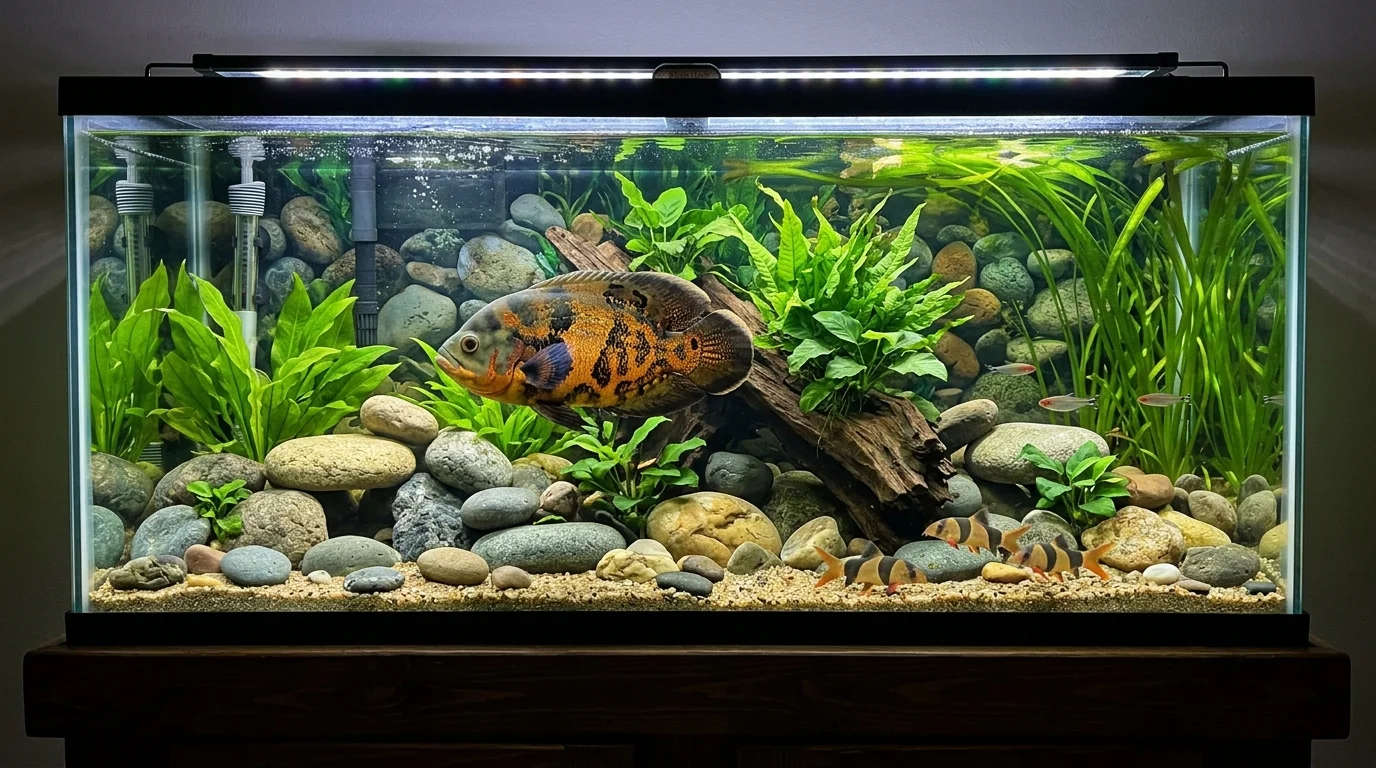
A standard 75-gallon aquarium (48.5″ L × 18.5″ W × 21.25″ H) represents the gold standard footprint for serious freshwater hobbyists. Its critical advantage is the 18.5-inch width (front-to-back depth), providing 897 square inches of floor space—nearly 46% more usable area than a standard 55-gallon. This depth allows adult heavy-bodied fish like Oscars (Astronotus ocellatus) or Severums (Heros severus) to turn 180 degrees without physical strain. Support this biological volume with high-capacity canister filtration turning over 600–750 GPH (8× to 10× turnover rate) and structured vertical hardscape.
The standard 75-gallon aquarium (48.5″ L × 18.5″ W × 21.25″ H) is widely regarded by experienced aquarists as the most versatile freshwater platform. While sharing the identical four-foot run of a traditional 55-gallon, its expansive 18.5-inch depth provides 897 square inches of base area. This footprint eliminates the narrow corridor bottleneck, unlocking stocking viability for deep-bodied cichlids, complex aquascaping layouts, and stable multi-tiered communities.
The 18.5-Inch Width Advantage: 75-Gallon vs. 55-Gallon
The fundamental constraint of the 55-gallon tank is its 12.75-inch width, which traps large fish in restrictive linear tracks. The 75-gallon's additional 5.75 inches of front-to-back space expands total benthic territory by nearly 46%. This horizontal clearance allows an adult 12-inch cichlid to execute full 180-degree turning maneuvers without scraping lateral lines against glass walls or hardscape decor. For aquascapers, 18.5 inches provides the physical depth needed to construct true foreground, midground, and background plant elevations with extensive hardscape slopes that do not collapse toward the front pane.
Bioload Realities: Why the 'Inch Per Gallon' Rule Fails at 75 Gallons
Stocking a 75-gallon requires calculating mass displacement and organic waste output rather than fish length. A single adult 12-inch Oscar (Astronotus ocellatus) possesses a metabolic biomass and ammonia production rate roughly equivalent to 80–100 Neon Tetras (Paracheirodon innesi). Furthermore, adding 80 pounds of substrate, heavy slate formations, and large bogwood branches displaces 8 to 12 gallons of water, reducing true liquid volume to roughly 63–67 gallons. Safe stocking must be modeled using metabolic waste indices and oxygen saturation capacities through our Stocking Calculator rather than linear fish counts.
Layering Swimming Tiers Across 897 Square Inches
With an expansive floor plan and 21 inches of vertical depth, livestock can be partitioned into distinct ecological strata:
- Surface & Upper Strata: Inhabited by open-water dithers and surface skimmers such as Silver Dollars (Metynnis argenteus) or Marbled Hatchetfish. Maintaining active water displacement here prevents territorial monopolies.
- Mid-Water Strata: The focal display corridor for deep-bodied schoolers, Angelfish pairs, or large centerpiece cichlids that require broad swimming avenues.
- Benthic & Substrate Strata: Sifting cichlids (Geophagus), large Loricariids, and robust Corydoradinae colonies. The 18.5-inch depth allows multiple benthic caves and foraging tracks to exist simultaneously without territorial overlap.
4 Proven Stocking Archetypes for a 75-Gallon Aquarium
1. The Neotropical Wet-Pet / Predator Setup
Engineered for individual personality and predatory display, highlighting heavy-bodied South American cichlids (pH 6.5–7.4, Temperature 76–80°F):
- Solitary Centerpiece: 1× Tiger or Albino Oscar (Astronotus ocellatus) OR a Bonded Pair of Severums (Heros severus)
- Target / Dither School: 6× Silver Dollars (Metynnis argenteus) or 8× Columbian Tetras (Hyphessobrycon columbianus)
- Substrate Armored Catfish: 1× Green Phantom Pleco (Hemiancistrus subviridis, L-200) or 1× Blue Phantom Pleco (Hemiancistrus sp., L-128)
- Filtration Demands: Dual canister filtration or heavy-duty canister yielding 8× to 10× hourly turnover with weekly 40–50% water changes.
2. The Mega Planted Amazonian Showcase
A tranquil, high-density biotope capitalizing on deep lateral aquascaping and schooling dynamics (pH 6.2–6.8, Temperature 77–82°F):
- Vertical Centerpiece: 4–6× Manacapuru Red Back Angelfish (Pterophyllum scalare) or a settled group of 5–6× Discus (Symphysodon aequifasciatus — advanced care required)
- Primary Schooling Shoal: 30–40× Cardinal Tetras (Paracheirodon axelrodi) or Rummy-Nose Tetras (Hemigrammus rhodostomus)
- Substrate Flocking Crew: 12–15× Sterbai Corydoras (Corydoras sterbai)
- Algae Control Team: 8–10× Otocinclus Catfish (Otocinclus vestitus) and 3× Bristlenose Plecos (Ancistrus sp.)
3. The Lake Malawi Mbuna / Peacock Mixed Biotope
Capitalizes on rockwork caves and structured overstocking to disperse territorial dominance (pH 7.8–8.6, dGH 12–20, Temperature 76–82°F):
- Mbuna Colonies: 5× Yellow Labs (Labidochromis caeruleus), 5× Rusties (Iodotropheus sprengerae), and 5× Pseudotropheus Acei
- Haplochromine / Peacock Accent: 3–4× Dragon Blood or Strawberry Peacocks (Aulonocara sp. — all-male setup recommended if mixing)
- Bottom Scavengers: 4–5× Synodontis Lucipinnis (Dwarf Petricola Catfish)
- Hardscape Infrastructure: 100+ lbs of lace rock or holey limestone configured into dual vertical bommies extending toward the surface.
4. The South American Geophagine Eartheater Biotope
Focuses on substrate excavation and collective social foraging behavior across open sandbeds (pH 6.5–7.0, Temperature 78–82°F):
- Centerpiece Colony: 5× Red Head Tapajos (Geophagus sp. 'Tapajos Red Head')
- Upper Column Dithers: 12–15× Lemon Tetras (Hyphessobrycon pulchripinnis) or Diamond Tetras (Moenkhausia pittieri)
- Mid-Water Companion: 1× Festivum (Mesonauta festivus)
- Substrate Scavengers: 8× Brochis splendens (Emerald Catfish)
- Substrate Requirements: Fine pool filter sand (0.5–1.0 mm) is mandatory to prevent gill damage during sediment sifting.
Filtration Engineering: Hydrodynamics and Turnover Rates
Managing the metabolic load of a 75-gallon setup requires a minimum flow rate of 600 to 750 GPH (8× to 10× volume turnover hourly). Large cichlids produce dense solid waste that overwhelms standard Hang-On-Back filters. Install a commercial-grade canister filter (such as the Fluval FX4 or Sicce Whale 500) packed with high-porosity sintered glass media and dual mechanical foam pads. Complement this with an opposing circulating wavemaker (400–600 GPH) positioned near the substrate to keep detritus in suspension toward the filter intake grid.
Species to Avoid in a Standard 75-Gallon
- Common Plecostomus (Hypostomus plecostomus): Quickly attains 18–24 inches; produces massive solid waste loads and strips slime coats from deep-bodied sleeping fish.
- Redtail Catfish (Phractocephalus hemioliopterus): Grows beyond 3–4 feet; capable of consuming adult tank mates within months.
- Jaguar Cichlids & Dovii (Parachromis sp.): Hyper-aggressive Neotropical predators that outgrow 75-gallon footprints and systematically eliminate tank mates.
- Bala Sharks (Balantiocheilos melanopterus): Powerful open-water jumpers that require a 6-to-8-foot lateral run to prevent terminal collision trauma.
The Problem
Aquarists often step up to a 75-gallon expecting to house multiple large predatory cichlids together, underestimating adult territorial spans and heavy metabolic bioload, which results in violent aggression and nitrate spikes.
When to Use This Tool
Refer to this guide when moving from standard 12-inch wide tanks to your first wide-format setup, configuring aquascapes for large cichlids, or scaling schooling nano numbers to massive community shoals.
Who is this for?
- Intermediate to advanced freshwater aquarists, cichlid keepers, and high-tech planted aquascapers seeking verified livestock limits and hydrodynamic parameters for 75-gallon setups.
75-Gallon Tank Stocking Archetypes Compared
| Setup Archetype | Centerpiece Species | Schooling Species | Bottom Dwellers | Bioload Impact | Difficulty |
|---|---|---|---|---|---|
| Neotropical Predator | 1× Oscar or 2× Severums | 6× Silver Dollars | 1× Green Phantom Pleco | Very High | Intermediate |
| Mega Planted Amazon | 4–6× Angelfish / Discus | 35× Cardinal Tetras | 15× Sterbai Corydoras | Moderate | Advanced |
| Malawi Cichlid Biotope | 15× Mixed Mbuna / Peacocks | None (Target Aggression) | 4× Synodontis lucipinnis | High | Intermediate |
| Geophagine Eartheater | 5× Geophagus Tapajos | 15× Diamond Tetras | 8× Emerald Catfish | Moderate to High | Intermediate |
Troubleshooting Guide
1 Substrate is constantly excavated and plants are uprooted in a cichlid community.
Large cichlids and Geophagus naturally dig. Anchor live plants to hardscape (Anubias, Java Fern on driftwood) or protect root structures with heavy perimeter stones; substitute fragile stem plants with floating species.
2 Severe aggression and territorial bullying following a single fish introduction.
The established resident has mapped the entire 4-foot territory. Remove all fish temporarily, rearrange the hardscape to erase existing boundaries, lower the water temperature by 2°F, and reintroduce all inhabitants simultaneously with lights off.
3 Nitrate levels spike above 40 ppm within 4 days of a 30% water change in an Oscar setup.
Bioload exceeds current water exchange volume. Increase weekly water changes to 50%, reduce protein-heavy pellet feedings to once daily, and install an external secondary mechanical filter for frequent pad changes.
4 Micro-debris remains suspended in the water column despite running a large canister filter.
Dead flow zones are common across an 18-inch wide footprint. Install a low-voltage circulation pump (500–800 GPH) 4 inches above the substrate on the opposite wall to sweep detritus toward the canister intake.
Frequently Asked Questions
Can an Oscar live comfortably in a 75-gallon tank for its entire life?
Which is better: a 55-gallon or a 75-gallon tank?
How many fish can I put in a 75-gallon planted community tank?
What size filter do I need for a 75-gallon aquarium?
Can I keep African Cichlids in a 75-gallon tank?
Can you keep Discus in a 75-gallon tank?
Glossary of Terms
- Front-to-Back Depth
- The horizontal width dimension of an aquarium (18.5 inches in a 75-gallon) determining benthic floor space, turning radius for large species, and aquascaping perspective.
- Geophagic Sifting
- The specialized foraging behavior of substrate-sifting cichlids that ingest mouthfuls of sand to filter out micro-invertebrates before expelling sediment through the gill slits.
- Benthic Zone
- The lowest ecological stratum of a water body, encompassing the sediment surface and subsurface structures inhabited by bottom-dwelling organisms.
- Target / Dither Fish
- Active, fast-swimming open-water schooling fish whose movement dissipates social aggression and signals physical security to reclusive or territorial centerpiece species.
- Bioload Volumetric Scaling
- The biological principle that metabolic waste production increases geometrically with three-dimensional body mass rather than linearly with fish length.
Scientific References
- Design and Management of Recirculating Aquaculture Systems: Mass Balance and Oxygen Dynamics
- Space Use, Territoriality, and Agonistic Encounters in Captive Lake Malawi Cichlids (Pseudotropheus)
- Allometric Scaling of Metabolic Rate and Waste Excretion in Freshwater Teleosts