
Diamond Tetra (Moenkhausia pittieri)
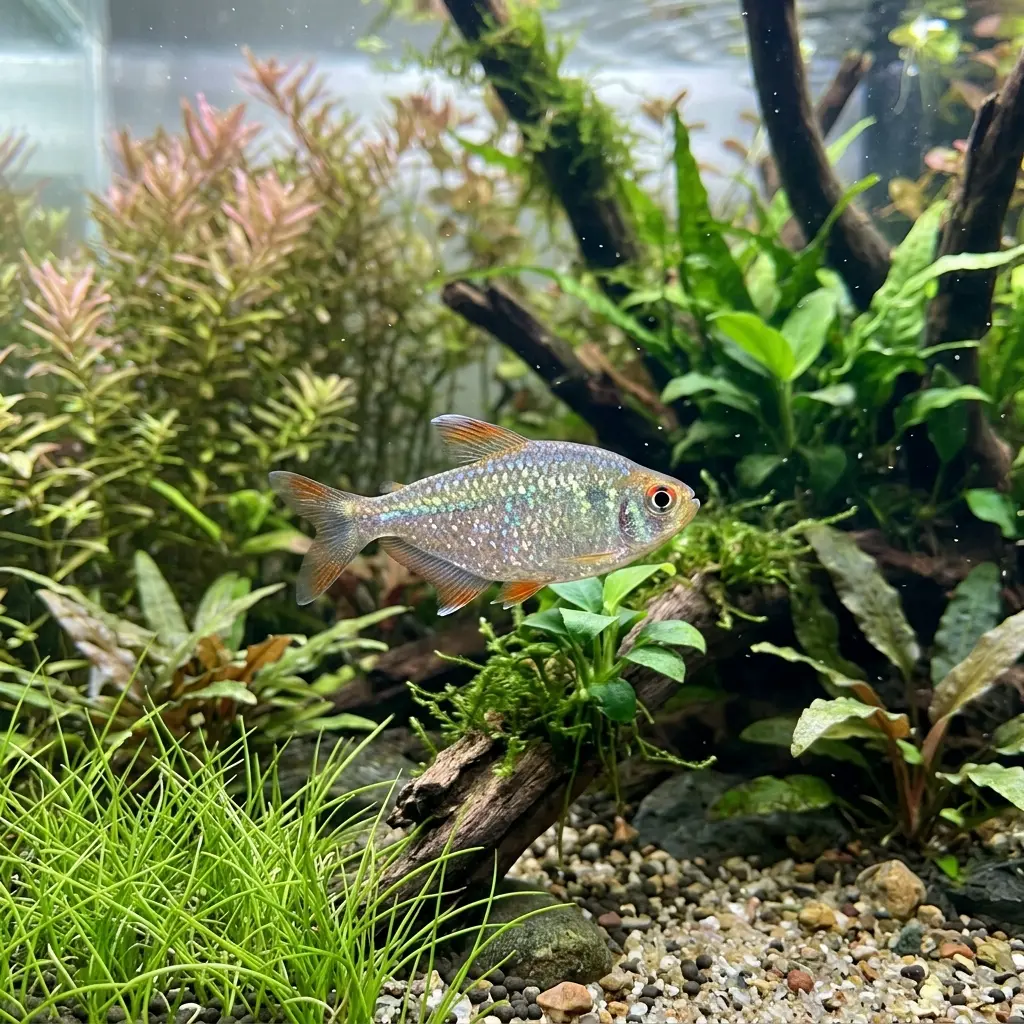
Quick Answer
Diamond Tetra (Moenkhausia pittieri) is a stunning tetra endemic to Lake Valencia in Venezuela. It requires a minimum 20-gallon (76-liter) aquarium with a pH of 5.5 to 7.5 and temperature range of 72°F to 82°F (22°C to 28°C). This peaceful omnivore occupies the middle water zone, requires a school of 8 or more, and makes an excellent addition to planted community setups with dim lighting.
Quick Facts
| Scientific Name | Moenkhausia pittieri |
|---|---|
| Common Names | Diamond Tetra |
| Family | Characidae |
| Genus | Moenkhausia |
| Type | Freshwater |
| Temperament | peaceful |
| Care Difficulty | beginner |
| Lifespan | 5 years |
| Maximum Size | Up to 2.4 in (6 cm) |
| Diet | Omnivore |
| Temperature | 72–82°F (22–28°C) |
| pH | 5.5–7.5 |
| Hardness | 2–12 dGH |
| Minimum Size | 20 gallons |
Key Takeaways
- Requires dim, angled lighting with floating plants; bright overhead lights wash out iridescence.
- School of 8+ is mandatory; groups under 6 experience chronic stress and faded color.
- Dark substrate is essential for color contrast; light gravel makes them appear grey.
- Soft water (GH 5-8) promotes breeding and maximum scale sparkle.
- Endemic to Lake Valencia, Venezuela; wild populations threatened by pollution.
- Captive-bred specimens preferred; wild-caught fish carry parasites and contribute to population decline.
Overview
Species Overview
The Diamond Tetra (Moenkhausia pittieri) is one of the most visually striking and underappreciated tetras in the aquarium hobby. Named for the extraordinary iridescent scales that shimmer like cut diamonds under proper lighting, this species is endemic to Lake Valencia and surrounding waters in Venezuela. First described by Eigenmann in 1920, the Diamond Tetra has captivated aquarists with its comet-like flashes of violet, green, and gold as it darts through the water column.
Physical Characteristics
Adult Diamond Tetras reach approximately 2.4 inches (6.0 cm) in standard length, with males growing slightly larger and more slender than females. The body is deep and laterally compressed with a silvery base color overlaid by a spectacular prismatic sheen. Males develop elongated, flowing dorsal, anal, and ventral fins suffused with a subtle violet sheen. Females are deeper-bodied, especially when gravid, with shorter, rounded fins and slightly paler coloration. The signature diamond sparkle is most pronounced on the flanks and becomes visible only under subdued, angled lighting. Juveniles under 6 months appear dull grey-silver and lack the adult iridescence.
Lifespan
With optimal care in stable, soft water, Diamond Tetras live 3 to 5 years in captivity, with exceptional individuals reaching 6 years. Their longevity is directly tied to water quality, school size, and lighting conditions. Fish kept in bright, stressful conditions or inadequate schools typically survive only 2 to 3 years.
Conservation Status
The Diamond Tetra is currently listed as Not Evaluated by the IUCN but is considered threatened in its native Lake Valencia habitat. Wild populations have declined significantly due to agricultural and industrial pollution, eutrophication, and algal blooms. Fish species diversity in Lake Valencia dropped by nearly 60% during the mid to late twentieth century. Fortunately, nearly all specimens in the aquarium trade are now captive-bred on commercial farms, reducing pressure on wild stocks.
Care
Housing & Pond Requirements
Minimum Tank Specifications
The absolute minimum tank size for a school of 8 to 10 Diamond Tetras is 20 gallons (76 liters) with a footprint of at least 30x12 inches (75x30 cm). A 29 to 40 gallon (110 to 151 liter) tank is strongly recommended for long-term health and natural behavioral expression. Tank length is critical; these fish are active mid-water swimmers that require at least 24 inches (60 cm) of horizontal space for their characteristic high-speed dashes. Height is less important. A 10-gallon tank is absolutely unacceptable for adult Diamond Tetras.
Filtration & Water Flow
Use a sponge filter, gentle hang-on-back filter, or canister filter with adjustable flow. Water turnover of 4x to 6x per hour is sufficient; strong currents stress Diamond Tetras and prevent proper mid-water swimming. The filter intake should be covered with fine sponge to protect eggs and fry during accidental spawning in community tanks. Weekly 20% water changes are mandatory to maintain nitrates below 15 ppm.
Substrate & Decor
Use dark-colored substrate (black sand, dark gravel, or specialty aquarium sand) to create contrast that enhances the diamond sparkle. Add driftwood, smooth stones, and dense planting along the back and sides of the tank. Leave the front third open for swimming. Indian almond leaves or alder cones add tannins that soften water, lower pH naturally, and create the tea-colored water that makes their iridescence pop. Avoid bright white or light-colored substrates that wash out their coloration.
Lighting
Dim to moderate lighting is critical. Bright, unshaded overhead lighting causes chronic stress, hiding behavior, and faded iridescence. Use floating plants (Duckweed, Salvinia, Frogbit, Water Lettuce) to diffuse overhead light. Install LED lights with dimmer functions or use side-angle lighting to create the prismatic effect. A photoperiod of 8 to 10 hours is sufficient. In a biotope setup, lighting should be very dim to replicate the dense canopy shade of their native streams.
Planting
Diamond Tetras thrive in densely planted tanks. Recommended plants include Amazon swords, Cryptocoryne, Java fern, Anubias, and stem plants (Cabomba, Elodea, Ludwigia). Floating plants are essential for light diffusion. Mosses (Java moss, Christmas moss) provide spawning surfaces and grazing areas for biofilm. The goal is to create a balance of open swimming lanes and shaded retreats.
Diet
Diet & Nutrition
Diamond Tetras are omnivorous micro-predators that feed on small insects, worms, crustaceans, and plant matter in the wild. In captivity, they are easy to feed but require a varied diet to maintain their spectacular coloration and health. A monotonous diet of dry flakes alone leads to faded color, reduced immunity, and shortened lifespan.
Health
Health & Disease Management
Diamond Tetras are generally hardy when kept in appropriate conditions with stable parameters and adequate schooling. However, their dependence on proper lighting and social structure makes them vulnerable to stress-related diseases that hardier, less specialized fish avoid.
Ich (Ichthyophthirius multifiliis)
The most common parasitic infection in Diamond Tetras, particularly after temperature fluctuations or stress from bright lighting and inadequate schooling.
- Small white salt-like spots on body and fins, rapid breathing, rubbing against decorations, flashing, clamped fins, loss of appetite.
Introduction via infected fish, temperature fluctuations during water changes, stress from bright lighting or small groups, poor water quality.
Quarantine all new fish for 14 days. Maintain stable temperature between 75°F and 78°F. Avoid adding cold water during changes. Use dim lighting. Treat with malachite green at half-dose (0.05 mg/L) combined with gradual temperature increase to 82°F (28°C) for 14 days.
Skin & Gill Flukes (Gyrodactylus / Dactylogyrus)
External monogenean parasites that attach to skin and gills, causing irritation and secondary infections.
- Excessive mucus production, rapid gill movement, flashing against substrate, reddened gills, labored breathing.
Introduction via live foods, new plants, or infected tank mates. Poor water quality exacerbates infestation.
Quarantine live foods. Treat new plants with hydrogen peroxide dip. Maintain pristine water conditions. Praziquantel is the treatment of choice at standard dose.
Bacterial Fin Rot & Columnaris
Secondary bacterial infections often following injury from fin nipping, rough handling, or parasite damage.
- Frayed or receding fins, white cotton-like patches on mouth or body, lethargy, loss of appetite, reddening at fin bases.
Poor water quality (nitrates above 15 ppm), injury from aggressive tank mates, stress from inadequate schooling, untreated parasitic infections.
Maintain nitrates below 15 ppm. Keep adequate school size to reduce stress. Treat with broad-spectrum antibiotics (Maracyn, Furan-2) and perform daily 20% water changes during treatment.
Neon Tetra Disease (Pleistophora hyphessobryconis)
A microsporidian parasite that affects many tetra species, causing muscle degeneration and spinal curvature.
- Difficulty swimming, loss of coloration, spinal curvature or deformity, emaciation despite eating, white cysts under skin, lethargy.
Introduction via infected fish or live foods. Stress from poor water quality or inadequate schooling weakens immunity.
Quarantine all new fish for 21 days. Purchase from reputable breeders. There is no cure; affected fish must be euthanized humanely. Maintain pristine water quality and stable parameters.
Color Loss & Chronic Stress
Not a disease per se, but a syndrome caused by inadequate lighting, small school size, hard water, or poor diet that leads to faded iridescence and suppressed immunity.
- Dull, grey coloration instead of diamond sparkle, hiding behavior, reduced activity, loss of appetite, increased susceptibility to other diseases.
Bright overhead lighting, groups under 6 individuals, GH above 12 dGH, lack of carotenoid-rich foods, aggressive tank mates, sudden parameter changes.
Maintain dim, angled lighting. Keep schools of 10 or more. Maintain GH at 5 to 8 dGH. Feed varied, carotenoid-rich diet. Remove aggressive tank mates. Match water parameters during changes.
Breeding
Breeding Diamond Tetras
Breeding Diamond Tetras is achievable in the home aquarium using the spawning mop technique, which mimics their natural egg-scattering behavior in Lake Valencia vegetation. Success requires precise water chemistry, proper conditioning, and careful handling of light-sensitive eggs.
Compatible Tank Mates






Species Comparison
| Feature | Diamond Tetra | Congo Tetra | Silver Dollar | Cardinal Tetra |
|---|---|---|---|---|
| Scientific Name | Moenkhausia pittieri | Phenacogrammus interruptus | Metynnis argenteus | Paracheirodon axelrodi |
| Max Size | 2.4 inches (6.0 cm) | 3.5 inches (8.9 cm) | 6 inches (15 cm) | 2 inches (5.1 cm) |
| Temperament | Peaceful, shoaling | Peaceful, active | Peaceful, skittish | Peaceful, schooling |
| Minimum Tank Size | 20 gallons (76 L) | 30 gallons (114 L) | 75 gallons (284 L) | 20 gallons (76 L) |
| Diet | Omnivore (35% protein) | Omnivore (40% protein) | Herbivore (80% plants) | Omnivore (35% protein) |
| pH Range | 5.5 - 7.5 | 6.0 - 7.5 | 5.5 - 7.5 | 5.5 - 7.5 |
| Lighting Preference | Dim, shaded | Moderate | Subdued | Dim, shaded |
| Scale Iridescence | Extreme (diamond-like) | High (rainbow sheen) | High (metallic silver) | Moderate (blue-red stripe) |
| Schooling Requirement | 8+ individuals | 6+ individuals | 6+ individuals | 6+ individuals |
| Origin | Lake Valencia, Venezuela | Congo River, Africa | Amazon Basin, S. America | Rio Negro, Brazil |