
Lemon Tetra (Hyphessobrycon pulchripinnis)
Quick Answer
Lemon Tetras (Hyphessobrycon pulchripinnis) are small, peaceful freshwater schooling fish endemic to the Tapajos River basin in Brazil. They require a minimum 15-gallon (57-liter) aquarium with soft to moderately hard water at pH 6.0 to 7.5, general hardness 3 to 10 dGH, and temperatures of 72 to 82 degrees Fahrenheit (22 to 28 degrees Celsius). These omnivorous egg scatterers display brilliant lemon-yellow bodies with red eyes when kept in schools of 8 or more with dark substrate and dim lighting.
Quick Facts
| Scientific Name | Hyphessobrycon pulchripinnis |
|---|---|
| Common Names | Lemon Tetra |
| Family | Characidae |
| Genus | Hyphessobrycon |
| Type | Freshwater |
| Temperament | peaceful |
| Care Difficulty | beginner |
| Lifespan | 6 years |
| Maximum Size | Up to 2 in (5 cm) |
| Diet | Omnivore |
| Temperature | 72–82°F (22–28°C) |
| pH | 6–7.5 |
| Hardness | 3–10 dGH |
| Minimum Size | 15 gallons |
Key Takeaways
- Known for their peaceful temperament and brilliant lemon-yellow coloration with red eyes.
- Requires at least a 15 gallon aquarium with a school of 8 to 12 individuals minimum.
- Prefers soft to moderately hard water with dim lighting and dark substrate for optimal color display.
- Egg-scattering species that requires dedicated breeding setups with egg traps to prevent parental predation.
- Sensitive to formalin and bright lighting; thrives in planted tanks with moderate current.
Overview
Species Overview
Natural History and Distribution
The Lemon Tetra (Hyphessobrycon pulchripinnis) is a small freshwater characin endemic to the Tapajos River basin in Brazil, South America. The Tapajos River flows through a hot and humid tropical region before emptying into the Amazon River approximately 500 miles above Para. This river system stretches roughly 1,200 miles and provides the clear, moderately flowing, heavily vegetated waters that Lemon Tetras call home. They inhabit narrow, overgrown streams and shallows near the shore, often in densely vegetated areas with leaf litter and submerged roots.
Physical Characteristics
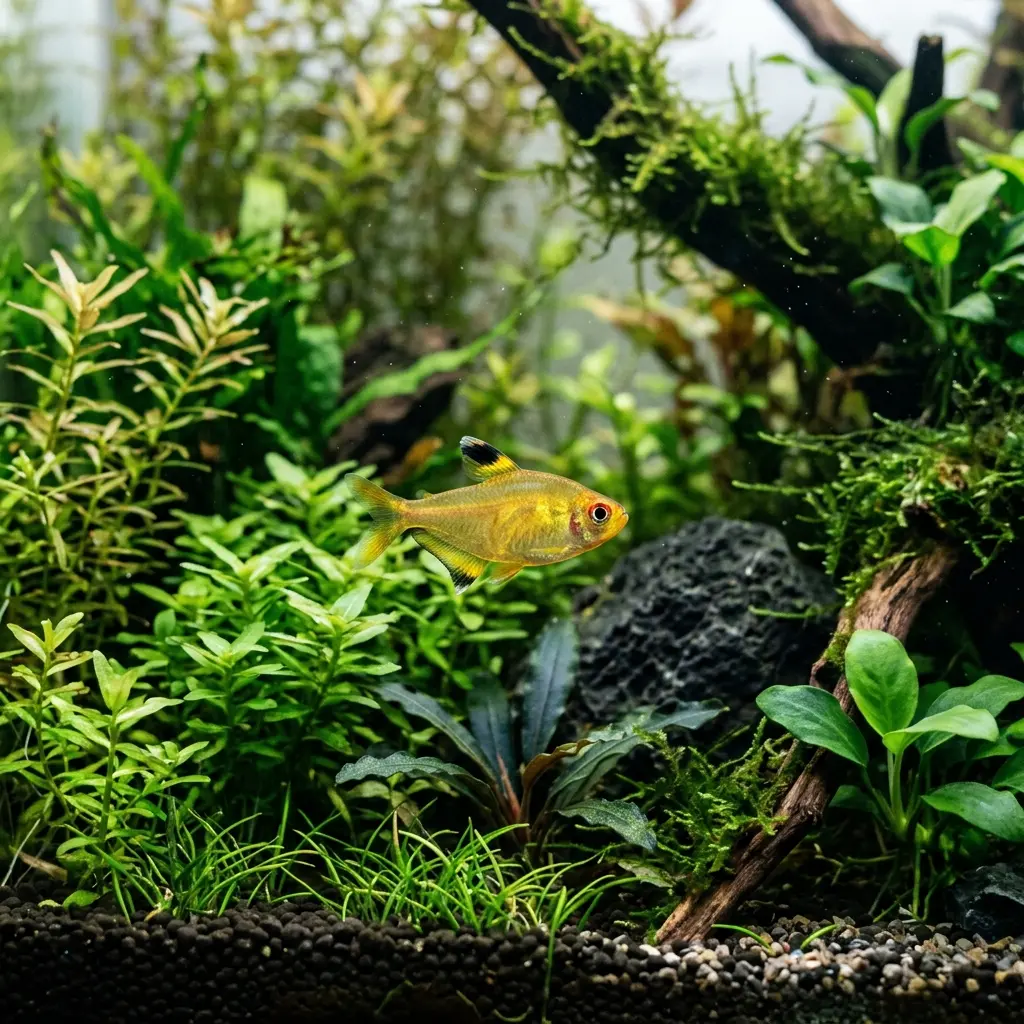
Adult Lemon Tetras reach approximately 2 inches (5.1 cm) in total length, though the largest scientifically measured male was 3.8 centimeters (1.5 inches) and the largest female 3.6 centimeters (1.4 inches). Many aquarists report specimens growing larger under optimal aquarium conditions. The body is translucent with a slight yellowish tinge and a shimmering lateral stripe running from the gill cover to the caudal fin. The front fins feature bright yellow coloration, while the edge of the dorsal fin and the back rays of the anal fin are black. The most distinctive feature is the strong red coloration on the upper part of the eyes. Males are more colorful with pointed dorsal fins and wide black borders on the anal fin; females are plumper with finer black lines on the anal fin edge.
Conservation Status
The IUCN lists Lemon Tetras as Not Evaluated. Wild populations remain stable within their restricted endemic range, and the species is now predominantly commercially farmed for the aquarium trade, reducing pressure on wild stocks. Their adaptability to a wide range of water parameters has made them a sustainable and readily available aquarium fish worldwide.
Why Lemon Tetras Stand Out
While often overshadowed by the more famous Neon Tetra and Cardinal Tetra, Lemon Tetras offer a unique aesthetic with their uniform lemon-yellow bodies and ruby-red eyes. They are more adaptable to varying water parameters than many other tetra species, making them excellent choices for beginners who want a colorful schooling fish without the demanding soft-water requirements of Cardinals. Their active, confident swimming behavior in large groups creates a stunning visual display in planted community tanks.
Diet
Feeding and Nutritional Requirements
Dietary Composition
Lemon Tetras are omnivores with a metabolism geared toward frequent, small meals. Their ideal dietary composition is approximately 35 percent protein, 10 percent fat, and 55 percent plant matter and fiber. In the wild, they consume plant matter, worms, crustaceans, and insect larvae. Captive diets must replicate this balance to prevent nutritional deficiencies, faded coloration, and reduced breeding success. Protein sources should be primarily aquatic in origin.
Recommended Foods
- High-quality tropical flakes or micro-pellets formulated for small community fish with spirulina and carotenoid inclusion
- Frozen or live foods: daphnia, baby brine shrimp (Artemia nauplii), bloodworms, black worms, and mosquito larvae
- Vegetable matter: spirulina flakes, blanched spinach, zucchini, and cucumber
- Supplemental grazing: allow controlled natural algae growth on rocks and plant leaves
- Conditioning foods for breeding: live blackworms and gut-loaded brine shrimp fed daily for 2 weeks prior to spawning
Feeding Schedule
Feed adult Lemon Tetras two to three times daily, offering only what they can consume in 2 to 3 minutes. Overfeeding is a primary cause of poor water quality and bloat in tetra tanks. Their colors are more intense and vivid when fed high-quality, varied foods; dull or faded mature specimens usually indicate a nutritional deficiency. Fast the tank one day per week to clear the digestive tract. Fry require feeding 4 to 6 times daily with infusoria, microworms, or baby brine shrimp.
Foods to Avoid
Never feed beef heart, pork, chicken, or other mammalian proteins. These fish cannot digest the high fat content and connective tissue, leading to intestinal blockages and fatty liver disease. Avoid generic low-quality flakes containing excessive fillers, ash, and artificial dyes. Tubifex worms should be avoided unless from a trusted parasite-free source. Bread, crackers, and human processed foods are toxic to fish and must never enter the aquarium.
Color Enhancement Through Diet
To intensify yellow pigmentation, feed foods rich in carotenoids and xanthophylls, such as spirulina, krill, and specialized color-enhancing flakes. The red eye coloration is enhanced by astaxanthin-rich marine proteins. Avoid color-enhancing foods that rely on artificial dyes, as these provide no biological benefit and may stress the liver over time.
Health
See sections.health for comprehensive disease profiles and treatment protocols.
Breeding
Breeding and Reproduction
Reproductive Biology
Lemon Tetras are egg scatterers that provide no parental care. In the wild, they are gang spawners; thousands of pairs may spawn simultaneously in a single stream, with each large female producing up to 400 eggs. This overwhelming egg production strategy ensures that predators cannot consume all offspring. However, this same instinct drives captive parents to eat their own eggs with ruthless efficiency, as they evolved to consume the eggs of competing pairs.
Sexing and Conditioning
Sexing adult Lemon Tetras is straightforward. Males have pointed dorsal fins, brighter overall coloration, and a wide black border on the anal fin that can occupy up to one-third of the fin when ready to spawn. Females have plumper bodies, rounded dorsal fins, and only a fine black line on the anal fin edge. To condition breeders, separate males and females for 2 weeks and feed live blackworms, gut-loaded brine shrimp, and daphnia daily. Females should become visibly plump with eggs.
Breeding Tank Setup
Set up a dedicated 10-gallon (38 liter) breeding tank with 4 inches (10 cm) of water depth. Target parameters of pH 6.5, dGH 4, and temperature 78 to 80 degrees Fahrenheit (25.5 to 27 degrees Celsius). Install a small air-powered sponge filter for gentle filtration and oxygenation. Use a spawning mop, Java moss, or fine-leaved Cabomba as egg deposition sites. Cover the bottom with marbles or a mesh grid to prevent parents from reaching fallen eggs. Dim lighting is essential; some aquarists report that morning sunshine helps trigger spawning.
Spawning Triggers and Behavior
Introduce one conditioned male and one or two plump females to the breeding tank. Simulate dawn over 30 minutes with gradually increasing light. Extend the photoperiod to 12 or more hours daily. The male will display with fins held out, swimming at rivals in ritualistic passes. Once females are ready, males chase them through vegetation. Both fish flash their yellow fins, with the male in a head-down position, then move toward fine-leaved vegetation to mate. The female releases 200 to 400 adhesive eggs over the leaves. Remove parents within 2 to 4 hours of spawning, or they will consume the entire clutch.
Egg and Fry Development
Eggs hatch in 24 to 30 hours at 75 to 78 degrees Fahrenheit (24 to 26 degrees Celsius). The fry absorb their yolk sacs for the first 2 to 3 days. Keep the tank completely dark during this period. Fry become free-swimming in approximately 5 days. Feed infusoria for the first 3 days, then microworms or commercially available liquid fry food. Introduce baby brine shrimp nauplii after day 7. Perform daily 10% water changes with aged, temperature-matched water. The fry are fragile during the first week but become hardy juveniles if they survive this critical period. Sexual differentiation becomes visible at 2 to 3 months of age.
Egg Trap Designs
Several egg trap designs work effectively for Lemon Tetras. The marble method involves covering the entire tank bottom with glass marbles; eggs fall between the gaps where parents cannot reach them. The mesh grid method uses a plastic mesh suspended 1 inch above the substrate, wide enough for eggs to pass through but small enough to block adults. The spawning mop method uses nylon or wool mops hung vertically in the tank; eggs adhere to the fibers and can be removed to a separate hatching container. All methods require prompt removal of parents after spawning.
Compatible Tank Mates






Species Comparison
| Feature | Lemon Tetra | Neon Tetra | Cardinal Tetra | Ember Tetra |
|---|---|---|---|---|
| Adult Size | 2 inches (5.1 cm) | 1.5 inches (3.8 cm) | 2 inches (5.1 cm) | 0.8 inches (2 cm) |
| Temperament | Peaceful | Peaceful | Peaceful | Peaceful |
| Minimum Tank Size | 15 gallons (57 L) | 10 gallons (38 L) | 20 gallons (75 L) | 10 gallons (38 L) |
| Diet | Omnivore | Omnivore | Omnivore | Omnivore |
| pH Range | 6.0 to 7.5 | 6.0 to 7.0 | 5.5 to 7.0 | 5.0 to 7.0 |
| Water Hardness | 3 to 10 dGH | 1 to 5 dGH | 1 to 5 dGH | 1 to 5 dGH |
| Breeding Difficulty | Moderate (egg scatterer) | Difficult (egg scatterer) | Difficult (egg scatterer) | Moderate (egg scatterer) |