
Glowlight Tetra (Hemigrammus erythrozonus)
Quick Answer
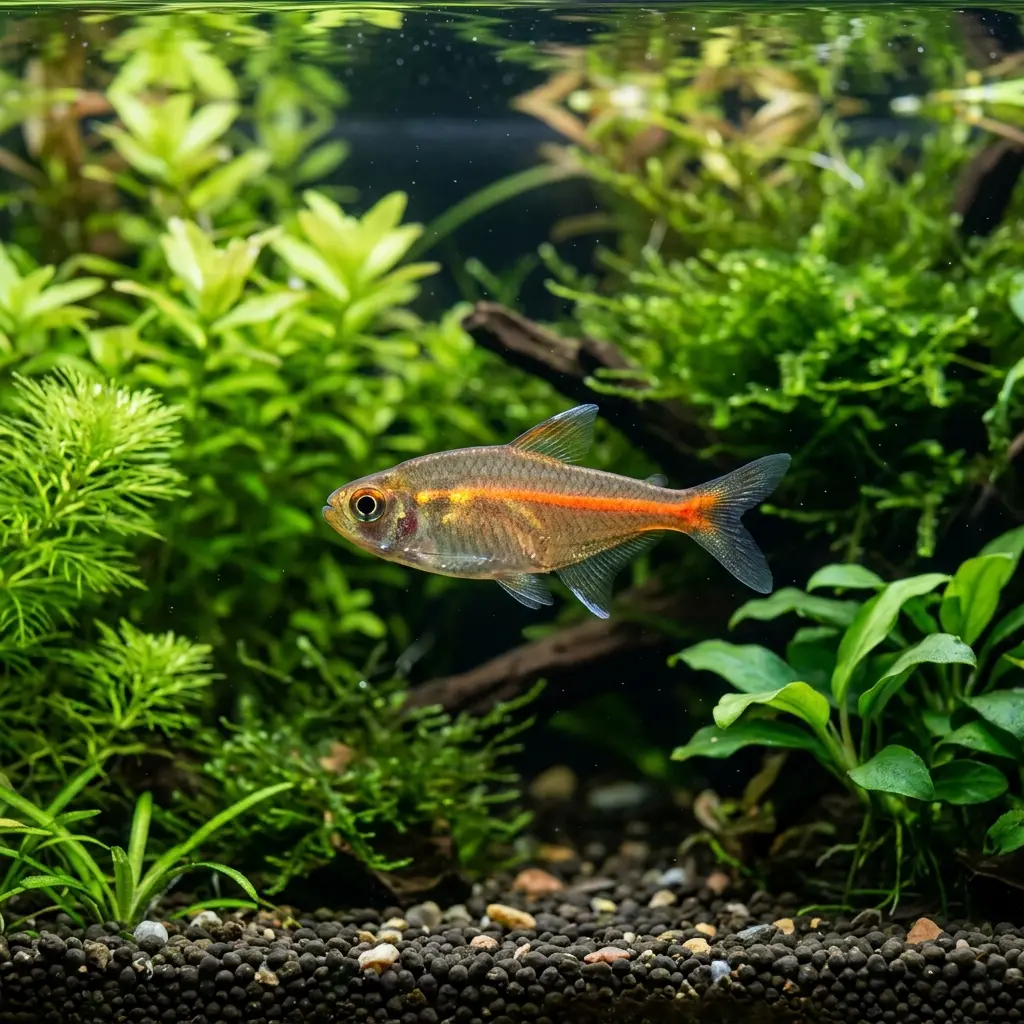
Glowlight Tetra (Hemigrammus erythrozonus) is a small, peaceful, schooling characin native to the blackwater tributaries of Guyana, South America. It requires a minimum 10-gallon (38-liter) aquarium for a school of 6-8 fish, with water parameters of pH 5.5-7.5 and temperature 72-82 degrees Fahrenheit (22-28 degrees Celsius). This omnivorous, beginner-friendly fish occupies the middle water column and is distinguished by a brilliant orange-gold stripe running the length of its semi-transparent body.
Quick Facts
| Scientific Name | Hemigrammus erythrozonus |
|---|---|
| Common Names | Glowlight Tetra |
| Family | Characidae |
| Genus | Hemigrammus |
| Type | Freshwater |
| Temperament | peaceful |
| Care Difficulty | beginner |
| Lifespan | 5 years |
| Maximum Size | Up to 2 in (5 cm) |
| Diet | Omnivore |
| Temperature | 72–82°F (22–28°C) |
| pH | 5.5–7.5 |
| Hardness | 1–10 dGH |
| Minimum Size | 10 gallons |
Key Takeaways
- Requires a school of at least 6-8 individuals; 10+ is optimal for natural behavior and color display.
- Displays a vivid neon-orange to red stripe that appears to glow against dark substrate.
- Thrives in soft, slightly acidic water but adapts well to standard community tank parameters.
- Sensitive to salt; avoid salt-based treatments and medications containing sodium chloride.
- Susceptible to Neon Tetra Disease; quarantine new fish and remove infected individuals immediately.
- Dark substrate and floating plants are essential for maximizing color display and reducing stress.
- Commercially captive-bred; widely available, inexpensive, and highly adaptable.
- Excellent first-time breeding project; produces 100-300 light-sensitive eggs per spawn.
Diet
Diet and Feeding Protocol
Glowlight Tetras are opportunistic omnivores. In the wild, they consume insect larvae, small crustaceans, zooplankton, and algae films. In captivity, a varied diet maintains immune function, coloration, and breeding condition.
Staple Foods
Feed high-quality micro-flakes, micro-pellets, or crumble foods as the dietary base. Because their mouths are extremely small, standard-sized flakes must be crushed into a fine powder. The staple food should contain approximately 35% protein, 10% fat, and supplemental plant matter.
Supplemental Foods
- Frozen: Daphnia, baby brine shrimp, bloodworms, and cyclops. Thaw before feeding.
- Live: Baby brine shrimp, daphnia, blackworms, and mosquito larvae. Live foods are excellent for conditioning breeders.
- Vegetable Matter: Offer spirulina flakes or finely chopped blanched spinach once weekly. They will graze algae from plant leaves and hardscape.
Feeding Schedule
Feed 2-3 times daily in portions consumed within 2-3 minutes. Overfeeding causes obesity and degrades water quality. Remove uneaten food after 5 minutes. During breeding conditioning, increase live food to 2-3 feedings daily for 10-14 days.
Prohibited Foods
Never feed beef heart, pork, mammalian fats, bread, or processed human foods. These cause fatal digestive blockages in small characins.
Health
Health and Disease Management
Glowlight Tetras are generally hardy when maintained in appropriate water conditions. However, their small size and characin physiology make them susceptible to specific diseases. Poor water quality, particularly elevated nitrates and ammonia, suppresses their immune system rapidly. Additionally, they share a family-wide vulnerability to Neon Tetra Disease, a fatal parasitic infection that affects many small tetras.
Critical Sensitivity: Glowlight Tetras are sensitive to salt. Treatments containing sodium chloride, including standard salt baths, should be avoided or used at drastically reduced concentrations. Always verify medication compatibility before treating these small fish.
Neon Tetra Disease (Pleistophora hyphessobryconis)
A fatal microsporidian parasite infection affecting many small characins including Glowlight Tetras, despite the common name suggesting otherwise.
- Faded coloration with the orange stripe turning pale gray, difficulty swimming, curved or crooked spine, emaciation despite eating, white or grayish patches under the skin, lethargy, separation from the school.
Consumption of infected tissue, contaminated food, contact with dead infected fish, or live foods collected from contaminated water sources. The parasite invades muscle tissue and progressively destroys the fish.
Quarantine all new fish for 14 days. Never feed live foods collected from natural water bodies. Remove and humanely euthanize infected fish immediately. Disinfect nets and equipment after contact with infected specimens.
Ichthyophthirius multifiliis (Ich / White Spot Disease)
A protozoan parasite that presents as white salt-like grains on the fins, body, and gills.
- White cysts visible on skin and fins, flashing against substrate, rapid breathing, clamped fins, rubbing against decor, loss of appetite.
Introduced via new fish or plants; triggered by temperature fluctuations or stress. In Glowlight Tetras, ich is often the first sign of compromised immunity from poor water quality or inadequate school sizes.
Quarantine all new additions for 14 days. Maintain stable temperatures between 75-78 degrees Fahrenheit (24-25.5 degrees Celsius). Avoid sudden temperature drops during water changes.
Fin Rot (Aeromonas / Pseudomonas)
Bacterial infection causing frayed, receding, or discolored fins with possible red streaking at the fin base.
- Fins appear torn or melted at the edges, redness or inflammation at the fin base, lethargy, loss of appetite.
Poor water quality (elevated nitrates above 40 ppm), fin-nipping tank mates, or physical damage from sharp decor. Bacteria colonize damaged tissue.
Perform weekly 20-25 percent water changes. Maintain nitrates below 15 ppm. Remove fin-nipping species such as Tiger Barbs. Use only smooth-edged hardscape.
Fungal Infections (Saprolegnia)
Cotton-like fungal growth on the skin, fins, or mouth, often secondary to physical injury or stress.
- White or gray cottony patches on skin, fins, or mouth, lethargy, loss of appetite, clamped fins.
Fungal spores present in all aquariums colonize damaged tissue, open wounds, or stressed fish. Poor water quality and low temperatures increase susceptibility.
Maintain pristine water quality with 0 ppm ammonia and nitrite. Avoid sharp decor that causes injuries. Treat minor wounds promptly with methylene blue.
Swim Bladder Disorder
A physical or infectious condition affecting buoyancy control, causing the fish to float uncontrollably or sink to the bottom.
- Inability to maintain neutral buoyancy, floating upside down or sideways, sinking to the substrate, difficulty reaching the surface for food.
Overfeeding, constipation, physical trauma, or bacterial infection of the swim bladder. Small-bodied fish are particularly vulnerable to constipation from dry foods.
Feed small portions 2-3 times daily rather than one large meal. Include vegetable matter to prevent constipation. Soak dry foods before feeding to reduce air ingestion.
Breeding
Breeding Glowlight Tetras
Glowlight Tetras are widely regarded as one of the best first-time breeding projects for aspiring aquarists. They are prolific egg scatterers that breed readily in captivity when provided with appropriate conditions. Their fry are hardy and grow quickly compared to many other tetra species.
Sexual Maturity and Sexing
Sexual maturity is reached at 8-12 months of age. Sexing is straightforward in mature, well-conditioned fish. Females are larger, deeper-bodied, and have a distinctly round, full abdomen when carrying eggs. Males are slimmer, more streamlined, and have a slightly sunken belly region. There are no significant color differences between the sexes, though males may display marginally more intense striping.
Conditioning Breeders
Select a robust, plump female and a slim, active male. Condition them in the community tank or a separate conditioning tank with live blackworms, daphnia, and baby brine shrimp 3-5 times daily for 2 weeks. Well-conditioned females will become visibly swollen with eggs, and males will display constant courtship behavior.
Breeding Tank Setup
Use a bare-bottom tank of 5-10 gallons (19-38 liters) with very soft water (dGH 3-6, ideally not exceeding 6.5), pH 6.0-7.0, and temperature 78-82 degrees Fahrenheit (25.5-27.8 degrees Celsius). A small air-driven sponge filter provides adequate gentle filtration. Place spawning mops made of nylon wool (cleaned in hot water) or a dense mass of java moss covering at least 75 percent of the tank. Some breeders place a spawning grate or marbles on the bottom to protect eggs from parents. Keep lighting dim; ambient room light is sufficient.
Spawning Process
Move the conditioned pair to the breeding tank in the evening. Cover the tank with newspaper or a dark towel to block all light. The eggs are highly light-sensitive. Spawning occurs at dawn as light levels increase. The male courts the female with fin flicking and shimmying displays. Both fish then roll onto their backs over the spawning medium, releasing and fertilizing eggs simultaneously. A typical spawning produces 100-300 slightly adhesive eggs, though large females may produce 200+ eggs.
Remove parents immediately after spawning. Glowlight Tetras will eat their own eggs within hours if left in the tank. Some breeders add a few drops of methylene blue to the breeding tank to prevent fungal growth on the eggs.
Egg and Fry Development
Eggs hatch in 24-30 hours at 78 degrees Fahrenheit (25.5 degrees Celsius). Newly hatched fry remain attached to the substrate or spawning mop for 3-5 days, absorbing their yolk sacs. Keep the tank completely dark during this period, as the fry and eggs are extremely sensitive to light. Once free-swimming, feed infusoria, green water, or vinegar eels for the first 5-7 days. Transition to microworms, then baby brine shrimp by day 10. At 2-3 weeks, fry display a silver coloration, and by 3 weeks the characteristic orange glow line begins to appear. Perform 25 percent water changes weekly with aged, matched-parameter water. A sponge pre-filter is mandatory once fry begin swimming to prevent them from being drawn into the filter.
Compatible Tank Mates






Species Comparison
| Feature | Glowlight Tetra | Neon Tetra | Cardinal Tetra | Ember Tetra |
|---|---|---|---|---|
| Adult Size | 1.5-2 in (4-5 cm) | 1.5 in (3.8 cm) | 2 in (5 cm) | 1 in (2.5 cm) |
| Temperament | Peaceful; shoaling | Peaceful; tight schooling | Peaceful; tight schooling | Peaceful; shoaling |
| Minimum Tank Size | 10 gal (38 L) for 6-8 fish | 10 gal (38 L) for 6 fish | 10 gal (38 L) for 6 fish | 10 gal (38 L) for 8-10 fish |
| Temperature Range | 72-82 degrees F (22-28 degrees C) | 72-78 degrees F (22-25.5 degrees C) | 73-81 degrees F (23-27 degrees C) | 68-82 degrees F (20-28 degrees C) |
| Diet | Omnivore; micro-flakes, frozen, live foods | Omnivore; prefers small foods | Omnivore; prefers small foods | Omnivore; accepts all standard foods |
| pH Range | 5.5 - 7.5 (soft, acidic preferred) | 6.0 - 7.0 (soft, acidic preferred) | 5.5 - 7.5 (soft, acidic preferred) | 5.0 - 7.0 (soft, acidic preferred) |
| Special Requirements | Dark substrate; dim lighting; sensitive to salt | Sensitive to temperature fluctuations; prone to NTD | Requires stable parameters; sensitive to fluctuations | Heavily planted; dim lighting; small groups acceptable |