
Penguin Tetra (Thayeria boehlkei)
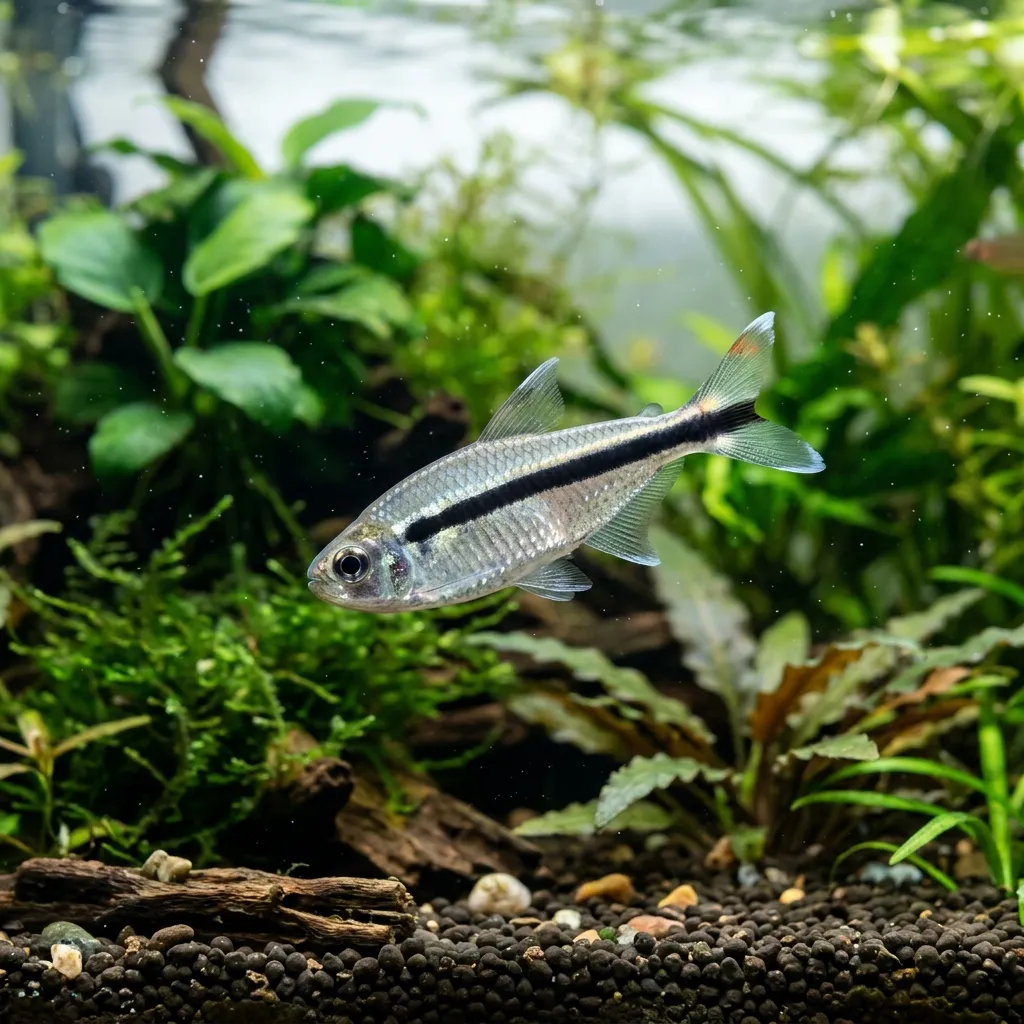
Quick Answer
Penguin Tetra (Thayeria boehlkei) is named for its unique swimming posture with the body tilted at a 45-degree angle. It requires a minimum 20 gallon (75 liter) aquarium with a pH of 5.5 to 8.0 and temperature range of 72 to 82 degrees Fahrenheit (22.2 to 27.8 degrees Celsius). This omnivorous, peaceful species occupies the middle water column and thrives in schools of 8 or more in well-planted community setups with a tight-fitting lid.
Quick Facts
| Scientific Name | Thayeria boehlkei |
|---|---|
| Common Names | Penguin Tetra |
| Family | Characidae |
| Genus | Thayeria |
| Type | Freshwater |
| Temperament | peaceful |
| Care Difficulty | beginner |
| Lifespan | 5 years |
| Maximum Size | Up to 3 in (8 cm) |
| Diet | Omnivore |
| Temperature | 72–82°F (22–28°C) |
| pH | 5.5–8 |
| Hardness | 3–20 dGH |
| Minimum Size | 20 gallons |
Key Takeaways
- Known for its peaceful temperament when kept in proper schools of 8 or more.
- Requires at least a 20 gallon (75 liter) aquarium with a tight-fitting lid.
- Swims at a characteristic 45-degree angle with a black stripe into the tail fin.
- Adaptable to pH 5.5 through 8.0 but prefers soft, slightly acidic water.
- Egg scatterer that breeds readily in dimly lit tanks with spawning mops.
Diet
Diet and Feeding Protocol
Natural Diet
In the wild, Penguin Tetras are micropredators feeding on small insects, insect larvae, worms, crustaceans, and zooplankton. They pick food from the water column and surface film, rarely grazing the substrate.
Captive Diet Composition
You must provide a balanced omnivorous diet consisting of approximately 35% protein, 10% fat, and 55% plant matter. Feed twice daily with portions consumed within 2 to 3 minutes.
- Staple Foods: High-quality tropical flake blends and slow-sinking micro-pellets sized 0.5 to 1.0 mm. New Life Spectrum, Hikari Micro Pellets, and Omega One flakes are excellent choices.
- Protein Supplements: Frozen or live daphnia, brine shrimp, bloodworms, and blackworms offered 3 to 4 times weekly.
- Plant Matter: Spirulina flakes, blanched zucchini, cucumber, or spinach offered once weekly to support digestion and coloration.
Feeding Schedule
Feed small amounts in the morning and evening. Fast the tank one day per week to clear digestive tracts. Crush flakes for juvenile fish under 1 inch (2.5 cm). Avoid beef heart, mammalian fats, and oversized pellets that cause intestinal blockages.
Common Dietary Mistakes
Overfeeding is the primary error; excess food degrades water quality and causes obesity. Do not rely solely on flakes; nutritional diversity prevents deficiency diseases. Never feed Tubifex worms from questionable sources; they carry parasites.
Health
Health and Disease Management
Penguin Tetras are hardy but susceptible to standard freshwater pathogens, particularly when water quality declines or temperatures fluctuate. Their scaled bodies tolerate copper medications, but they are sensitive to formalin and full-strength malachite green. Quarantine all new arrivals for 14 days. Maintain stable parameters; sudden pH swings above 0.5 units in 24 hours cause osmotic shock.
Preventive Care
Perform weekly 25% water changes, maintain nitrates below 15 ppm, and avoid overfeeding. Use a UV sterilizer in heavily stocked tanks to reduce free-floating pathogens. Test water parameters biweekly using liquid test kits, not strips.
Ich (White Spot Disease)
A protozoan infection caused by Ichthyophthirius multifiliis characterized by white salt-like granules on fins and body.
- White cysts on fins, gills, and body; flashing against decor; rapid breathing; clamped fins; lethargy.
Introduced via new fish or plants; triggered by temperature drops below 70 degrees Fahrenheit (21 degrees Celsius) or poor water quality.
Quarantine new stock for 14 days; maintain temperature above 72 degrees Fahrenheit (22 degrees Celsius); use a UV sterilizer.
Fin Rot
Bacterial infection typically caused by Aeromonas, Pseudomonas, or Flexibacter species resulting in eroded fin tissue.
- Frayed or receding fin edges; red or inflamed fin bases; tissue discoloration; in advanced cases, body rot.
Maintain pristine water conditions; keep schools of 8 or more to reduce fin-nipping; treat water with conditioner during changes.
Columnaris (Cotton Wool Disease)
A bacterial infection caused by Flavobacterium columnare presenting as white or grayish patches with a cotton-like appearance.
- White fuzzy patches on mouth, fins, or body; eroded mouth tissue; lethargy; loss of appetite; rapid mortality if untreated.
High organic load; temperatures above 80 degrees Fahrenheit (27 degrees Celsius); overcrowding; stress.
Avoid overstocking; maintain temperatures at 72 to 78 degrees Fahrenheit (22 to 26 degrees Celsius); perform regular gravel vacuuming.
Internal Parasites
Nematode or trematode infections commonly introduced via live foods or contaminated tanks.
- Emaciation despite normal feeding; white stringy feces; bloated abdomen; lethargy; color loss.
Feeding contaminated live foods such as Tubifex; introduction via unquarantined fish; poor water quality.
Purchase live foods from reputable sources; freeze live foods for 48 hours before feeding; quarantine new fish for 14 days.
Swim Bladder Disorder
A physiological condition affecting buoyancy, often secondary to bacterial infection, constipation, or physical trauma.
- Inability to maintain depth; floating at surface or sinking to bottom; swimming upside down or on side; loss of equilibrium.
Overfeeding dry foods; constipation; bacterial infection; physical injury from jumping or aggressive tank mates.
Feed varied diet including plant matter; fast fish one day weekly; soak dry foods before feeding; maintain adequate water depth.
Breeding
Breeding Penguin Tetras
Conditioning Breeders
Select 10 to 12 mature fish showing sexual dimorphism; females are rounder in the belly and slightly duller in color, while males are slimmer and more intensely black. Condition them for 2 weeks in a separate tank with live blackworms, grindal worms, and brine shrimp. Maintain temperature at 76 degrees Fahrenheit (24.5 degrees Celsius) and perform daily 10% water changes with slightly cooler water to simulate rainy season influx.
Spawning Tank Setup
Use a 10-gallon (38 liter) tank with 4 inches (10 cm) of water depth. Set pH to 6.5, dGH to 5, and temperature to 78 degrees Fahrenheit (25.5 degrees Celsius). Install a gentle air-powered sponge filter; never use a hang-on-back filter that will suck up eggs. Add a spawning mop, java moss, or fine-leafed plants such as Myriophyllum. Cover the bottom with a plastic mesh of 0.25 inch (6 mm) grid size so eggs fall through beyond parental reach.
Spawning Trigger
Simulate dawn by gradually increasing light over 30 minutes using a programmable timer. Spawning typically occurs within the first 2 hours of light. The female releases 200 to 300 adhesive eggs, though prolific females may produce up to 1,000 eggs. Males release substantial milt; an immediate partial water change may be necessary if the water clouds excessively.
Egg and Fry Care
Remove adults immediately after spawning concludes. Eggs hatch in 12 to 24 hours at 75 degrees Fahrenheit (24 degrees Celsius). Fry are extremely light-sensitive; keep the tank dark or covered with a towel for the first 5 days. They become free-swimming 3 to 4 days post-hatch. Feed infusoria or liquid fry food for the first 3 days, then transition to microworms or vinegar eels, and finally baby brine shrimp by day 7. Perform daily 10% water changes with aged, temperature-matched water. Growth is moderate; juveniles reach 1 inch (2.5 cm) within 8 weeks.
Breeding Challenges
The primary challenge is egg fungus. Add methylene blue at 3 mg/L to the spawning tank to prevent fungal growth on eggs. Parents must be removed promptly; they are voracious egg predators. Low hatch rates often result from excessive lighting or water flow.
Compatible Tank Mates






Species Comparison
| Feature | Penguin Tetra | Neon Tetra | Cardinal Tetra | Rummy Nose Tetra |
|---|---|---|---|---|
| Scientific Name | Thayeria boehlkei | Paracheirodon innesi | Paracheirodon axelrodi | Hemigrammus rhodostomus |
| Max Size | 3 in (7.6 cm) | 1.5 in (3.8 cm) | 2 in (5 cm) | 2 in (5 cm) |
| Temperament | Peaceful (fin-nips if under-stocked) | Peaceful | Peaceful | Peaceful |
| Minimum Tank Size | 20 gal (75 L) | 10 gal (37 L) | 20 gal (75 L) | 20 gal (75 L) |
| Diet | Omnivore (35% protein) | Omnivore (micro-predator) | Omnivore (micro-predator) | Omnivore |
| pH Range | 5.5 - 8.0 | 6.0 - 7.0 | 5.5 - 7.5 | 5.5 - 7.0 |
| Schooling Minimum | 8 - 12 fish | 6 fish | 6 fish | 6 - 8 fish |