
Clown Killifish (Epiplatys annulatus)
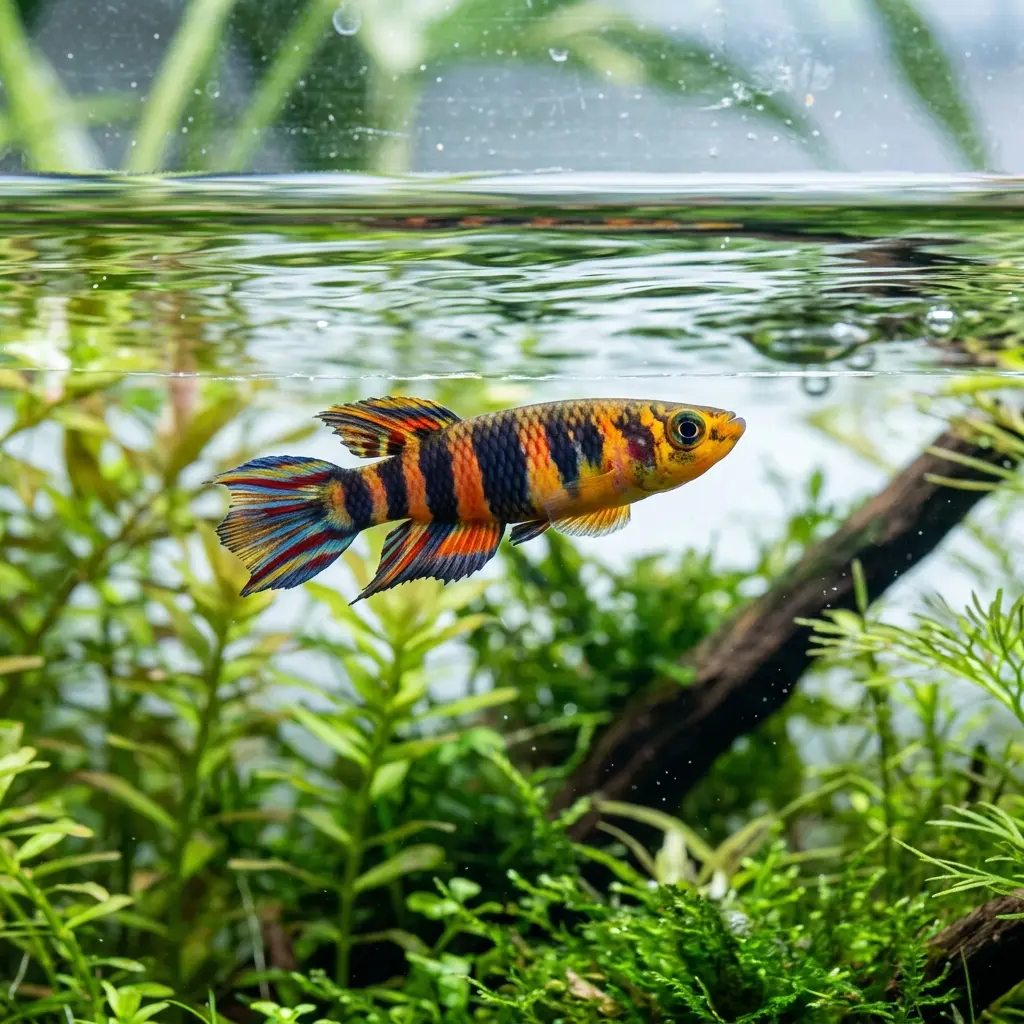
Quick Answer
Clown Killifish (Epiplatys annulatus) is a tiny, colorful surface-dwelling killifish from West Africa. It requires a minimum 10 gallon (38 liter) aquarium with a pH of 6.0 - 7.0 and temperature range of 68-78°F (20-26°C). This peaceful carnivore occupies the top zone, must be kept in groups of 8 or more, and makes an excellent addition to carefully planned nano community setups.
Quick Facts
| Scientific Name | Epiplatys annulatus |
|---|---|
| Common Names | Clown Killifish |
| Family | Nothobranchiidae |
| Genus | Epiplatys |
| Type | Freshwater |
| Temperament | peaceful |
| Care Difficulty | intermediate |
| Lifespan | 3 years |
| Maximum Size | Up to 1.5 in (4 cm) |
| Diet | Carnivore |
| Temperature | 68–78°F (20–26°C) |
| pH | 6–7 |
| Hardness | 3–8 dGH |
| Minimum Size | 10 gallons |
Key Takeaways
- Known for its peaceful temperament and spectacular rocket-like tail display in males.
- Requires a minimum 10 gallon (38 liter) aquarium with a group of 8 or more individuals.
- Sensitive to hard water; requires soft, acidic conditions (pH 6.0-7.0, GH 3-8 dGH).
- Surface-dwelling micro-predator that ignores sinking foods and requires floating or slow-sinking options.
- Expert jumper; a tight-fitting lid with no gaps over 0.2 inches is mandatory.
- Can live 2-3 years with proper care; not an annual killifish despite the name annulatus.
- Relatively easy to breed in captivity with spawning mops and proper conditioning.
Overview
Species Overview
The Clown Killifish (Epiplatys annulatus) is one of the most captivating miniature freshwater fish in the aquarium hobby. Despite their tiny size, these West African natives pack an extraordinary amount of personality, color, and behavioral intrigue into a package that rarely exceeds 1.5 inches (3.5 cm). Their common name comes from the distinctive alternating black and cream bands that encircle their slender bodies, while their alternative name, rocket killifish, references the blazing orange-and-yellow tail that resembles rocket exhaust.
Natural History
Native to the coastal regions of Sierra Leone, Guinea, and Liberia in West Africa, clown killifish inhabit shallow, slow-moving forest streams, coastal swamps, and sedentary wetlands. They are never found in large lakes or rivers with strong currents. A common feature across all their habitats is still or very slow-moving water, often under a closed canopy of vegetation where aquatic plants such as Nymphaea are abundant. They share these habitats with Norman's lampeyes (Poropanchax normani), jelly bean tetras (Ladigesia roloffi), adonis tetras (Lepidarchus adonis), and African butterfly cichlids (Anomalochromis thomasi).
Physical Characteristics
Males reach 1.0 - 1.5 inches (2.5 - 3.5 cm) in length, while females are smaller at 0.75 - 1.25 inches (2.0 - 3.0 cm). They possess small heads with striking, bright neon-blue eyes that seem almost comically large for their tiny bodies. The elongated, slender body is adorned with four vertical dark stripes alternating with cream or yellowish bars running from the snout to the caudal fin. Males develop extended rays in the caudal, dorsal, and anal fins, creating a spectacular rocket-like tail display in shades of orange, red, and yellow. Females have shorter, plainer fins, typically clear or yellowish in coloration.
Key Identification Features
- Four vertical black bands alternating with cream/yellow bars
- Striking neon-blue eyes
- Males: extended fin rays creating rocket-like tail
- Females: shorter, plainer fins, smaller body size
- Elongated, slender body shape resembling bumblebee gobies
- Color intensity varies by population and stress level
Important Taxonomic Note
The scientific name annulatus means ringed and refers to the banded body pattern. It is not related to the word annual, and clown killifish are not annual killifish. Unlike true annual killifish that lay drought-resistant eggs in temporary pools, clown killifish are perennial, non-annual killifish that live and breed continuously in permanent water bodies. The similarity to annual is purely coincidental.
Diet
Dietary Requirements
Clown Killifish are obligate surface micro-predators. In the wild, they are ambush hunters that wait just below the water surface until a flying insect alights on the water, then strike with explosive speed to capture the prey. Their diet consists primarily of small insects, mosquito larvae, tiny crustaceans, and zooplankton. They are not scavengers and will ignore food that sinks to the substrate.
Recommended Foods
- Live foods: fruit flies (Drosophila), mosquito larvae, small daphnia, grindal worms, microworms, copepods
- Frozen foods: baby brine shrimp, daphnia, cyclops, bloodworms (chopped to appropriate size)
- Dry foods: high-quality crushed flakes, micro pellets, and powdered fry food formulated for small tropicals
- Enrichment foods: live brine shrimp, vinegar eels, and small nematodes for conditioning
Feeding Schedule
Feed small portions 2-3 times daily. Offer only what the fish can consume in 2-3 minutes. Because they are small, active fish with high metabolisms, frequent small feedings are superior to large, infrequent meals. Target feeding at the surface ensures they receive adequate nutrition before faster or larger tank mates consume the food. In community tanks, feed the clown killifish first with floating foods, then add sinking foods for bottom-dwelling tank mates.
Foods to Avoid
- Large pellets or flakes that cannot fit in their tiny mouths
- Sinking foods that pass the surface before they can feed
- Beef heart or mammalian proteins (inappropriate for micro-predators)
- Overfeeding, which fouls water rapidly in nano tanks
Transitioning Picky Eaters
Wild-caught or newly imported clown killifish may initially refuse dry foods. Begin with live fruit flies or baby brine shrimp to stimulate the feeding response. Gradually mix in frozen foods, then transition to high-quality crushed flakes over 1-2 weeks. Be patient; some individuals require 7-14 days to accept non-live foods. A well-fed clown killifish has a slightly rounded belly, while a hungry fish appears thin with a concave profile.
Health
Health and Disease Management
Clown Killifish are relatively hardy for their size but are vulnerable to diseases common in small, soft-water fish. Their primary weaknesses are sensitivity to poor water quality in nano tanks, susceptibility to velvet disease, and stress-related immune suppression. Preventive care through stable parameters, quarantine, and gentle handling is far more effective than reactive treatment.
Water Quality Sensitivity
These fish are notably sensitive to nitrate accumulation and pH swings. In small tanks, parameters can shift dangerously within hours. Nitrates above 20 ppm cause chronic stress and reduced immunity. Sudden pH drops greater than 0.3 units cause shock and can be fatal. Maintain weekly 20% water changes and test parameters regularly with a quality liquid test kit. Nano tanks require more vigilant maintenance than larger systems.
Small Fish Medication Protocol
Because of their small size and delicate gill structure, clown killifish require reduced-strength medications. Standard dosages designed for larger fish can be lethal. Always calculate medication doses based on the actual water volume (accounting for substrate and decor displacement). Copper is effective but must not exceed 0.1 mg/L. Formalin should be used at quarter-strength or avoided entirely. Acriflavine is a safer alternative for velvet. Salt treatments should not exceed 3 ppt. When in doubt, treat at half the recommended dose and extend the treatment duration.
Freshwater Velvet (Piscinoodinium)
A dinoflagellate parasite that is particularly dangerous for small fish. It attacks the skin and gills, causing rapid breathing and death if untreated promptly.
- Dusty gold, brown, or rust-colored coating on skin and fins, clamped fins, labored breathing, flashing against decor, lethargy, loss of appetite. Gill infestation may occur without visible skin symptoms.
Introduction via new fish, plants, or equipment. The parasite has a photosynthetic stage, making it more virulent in well-lit tanks. Spreads rapidly in warm water. Triggered by stress, temperature fluctuations, or poor water quality.
Quarantine all new specimens for 2-4 weeks. Maintain stable temperature between 73-76°F (23-25°C). If infected, treat immediately with acriflavine (safer for small fish) or copper at reduced dosage (0.1 mg/L max). Darken the tank during treatment to inhibit the parasite’s photosynthetic stage. Increase temperature slightly to speed the parasite life cycle. A 3-week treatment period is required.
Ich (Ichthyophthirius multifiliis)
A ciliated protozoan parasite causing white salt-like spots on the body and fins. Common during temperature fluctuations or stress.
- White cysts resembling salt grains on skin and fins, flashing against decor, rapid breathing, clamped fins, rubbing against substrate.
Introduction via new fish, plants, or equipment. Triggered by temperature drops below 70°F (21°C) or stress weakening immune response. The parasite has a complex life cycle with free-swimming infectious stages.
Quarantine all new additions for 2-4 weeks. Maintain stable temperature at 74-76°F (23-24°C). If infected, raise temperature gradually to 82°F (28°C) and treat with half-dose malachite green or aquarium salt (1 tablespoon per 5 gallons). For severe cases, use copper at 0.1 mg/L in a hospital tank. Avoid full-strength formalin.
Bacterial Fin Rot (Aeromonas / Pseudomonas)
Bacterial infection causing frayed, discolored, or receding fins. Often secondary to poor water quality or physical damage.
- Frayed or ragged fin edges, redness at fin base, fins appearing shorter than normal, possible white edge on fin margins, lethargy, reduced surface activity.
Maintain nitrates below 15 ppm through regular water changes. Avoid aggressive tank mates. Treat with broad-spectrum antibiotics (e.g., kanamycin, nitrofurazone) at half-strength in a hospital tank. Clown killifish tolerate antibiotics well at reduced dosage.
Color Loss and Stress Syndrome
Temporary or chronic loss of coloration due to environmental stress, not a pathogen. Can lead to immune suppression if prolonged.
- Pale or washed-out body bands, faded fin coloration, hiding behavior, reduced feeding, clamped fins, rapid breathing when exposed to bright light.
Bright, unshaded lighting triggering camouflage response, hard water above 10 dGH, insufficient group size, aggressive tank mates, sudden parameter changes, inadequate plant cover, or recent shipment stress.
Provide dense floating plant cover and dim lighting. Maintain soft, acidic water (pH 6.0-7.0, GH 3-8). Keep groups of 8+ with proper sex ratio. Acclimate new fish slowly over 1-2 hours using drip method. Color typically returns within 1-2 weeks in optimal conditions.
Internal Parasites (Hexamita / Nematodes)
Common in wild-caught or poorly conditioned specimens. Internal protozoans or worms cause wasting and reduced immunity.
- Weight loss despite normal appetite, white stringy feces, sunken belly, lethargy, faded coloration, reduced breeding activity.
Introduction via wild-caught fish or contaminated live foods. More common in specimens collected from natural habitats than tank-bred fish. Poor quarantine practices allow introduction to the main tank.
Quarantine all new specimens for 2-4 weeks. Prophylactic treatment with praziquantel during quarantine is safe and effective. Purchase tank-bred specimens when possible. Maintain high-quality varied diet to support immune function.
Breeding
Breeding Clown Killifish
Clown killifish are among the easier killifish to breed in captivity and will spawn almost continuously when provided with proper conditions. They are non-annual, plant-spawning killifish that deposit adhesive eggs on vegetation, spawning mops, or floating plant roots. Unlike annual killifish that require dry incubation, clown killifish eggs hatch directly in water after 8-14 days.
Sexual Dimorphism
Males are approximately 50% larger than females and significantly more colorful. Males develop extended rays in the caudal, dorsal, and anal fins, creating the spectacular rocket-like tail. Their body bands are darker and more sharply defined. Females are smaller, with shorter, plainer fins that are typically clear or yellowish. Some females may show slight color in their fins, though never as intense as males. Older literature insists females always have clear fins, but captive breeding may have inadvertently selected for slightly more colorful females.
Conditioning for Breeding
Condition a group of 6-8 adults (maintaining a 1 male:3 female ratio) with live foods for 2 weeks. Live baby brine shrimp, microworms, grindal worms, and fruit flies are ideal conditioning foods. Well-conditioned females will develop a noticeably rounded belly when gravid. Males will intensify their coloration and increase displaying behavior at the surface.
Spawning Methods
There are two primary approaches to breeding clown killifish:
- Community Tank Method: Allow spawning to occur naturally in a heavily planted tank with floating vegetation and java moss. Some eggs and fry will survive among dense plant cover, though survivorship is low due to predation by adults and older fry. This method requires no intervention and will maintain a steady, low-level population.
- Controlled Breeding Method: Set up a dedicated 5-gallon (19 liter) breeding tank with 4 inches (10 cm) of water depth, a spawning mop or floating yarn bundle, and java moss. Introduce conditioned breeders for 1-2 days, then remove them. Collect eggs from the mop every 2-3 days and incubate in a separate container with gentle aeration and methylene blue (half-strength) to prevent fungal infection. Eggs hatch in 8-14 days at 74-76°F (23-24°C).
Egg and Fry Care
Eggs are tiny, nearly transparent, and adhesive. They are laid individually or in small clusters on mop fibers or plant roots. Fertile eggs develop visible eyes after 3-5 days. Infertile eggs turn white and should be removed promptly to prevent fungal spread. Upon hatching, fry are approximately 0.15 inches (4 mm) and extremely delicate. They require infusoria for the first 3-4 days, then graduate to microworms, vinegar eels, and newly hatched baby brine shrimp. Fry grow rapidly on a nutritious diet and will display coloration within 4-6 weeks. Keep the rearing tank covered, as fry are also expert jumpers.
Natural Spawning Triggers
In the wild, spawning is triggered by atmospheric pressure rises and early morning sunlight striking the water surface. In captivity, simulate this by performing small water changes in the morning and ensuring the tank receives gentle morning light. Some aquarists report success using distilled water additions to simulate rainy season conditions, though this is less reliable than consistent good care.
Compatible Tank Mates






Species Comparison
| Feature | Clown Killifish | Celestial Pearl Danio | Chili Rasbora | Ember Tetra |
|---|---|---|---|---|
| Maximum Size | 1.5 in (3.5 cm) | 1.0 in (2.5 cm) | 0.8 in (2.0 cm) | 0.8 in (2.0 cm) |
| Temperament | Peaceful, social, surface-oriented | Peaceful, slightly territorial | Peaceful, tight schooling | Peaceful, active schooling |
| Minimum Tank Size | 10 gal (38 L) for 8-12 | 10 gal (38 L) for 8-10 | 10 gal (38 L) for 10-20 | 10 gal (38 L) for 8-10 |
| Primary Diet | Carnivore: insects, larvae, micro-crustaceans | Omnivore: small invertebrates, plants | Omnivore: micro-crustaceans, zooplankton | Omnivore: small invertebrates, flakes |
| pH Range | 6.0 - 7.0 | 6.5 - 7.5 | 4.0 - 7.0 | 5.0 - 7.0 |
| Unique Feature | Surface micro-predator; rocket tail; blue eyes | Galaxy spots; bottom-dwelling; territorial displays | Deep scarlet red with black lateral stripe | Bright orange-red; most beginner-friendly nano fish |