
Silver Arowana (Osteoglossum bicirrhosum)
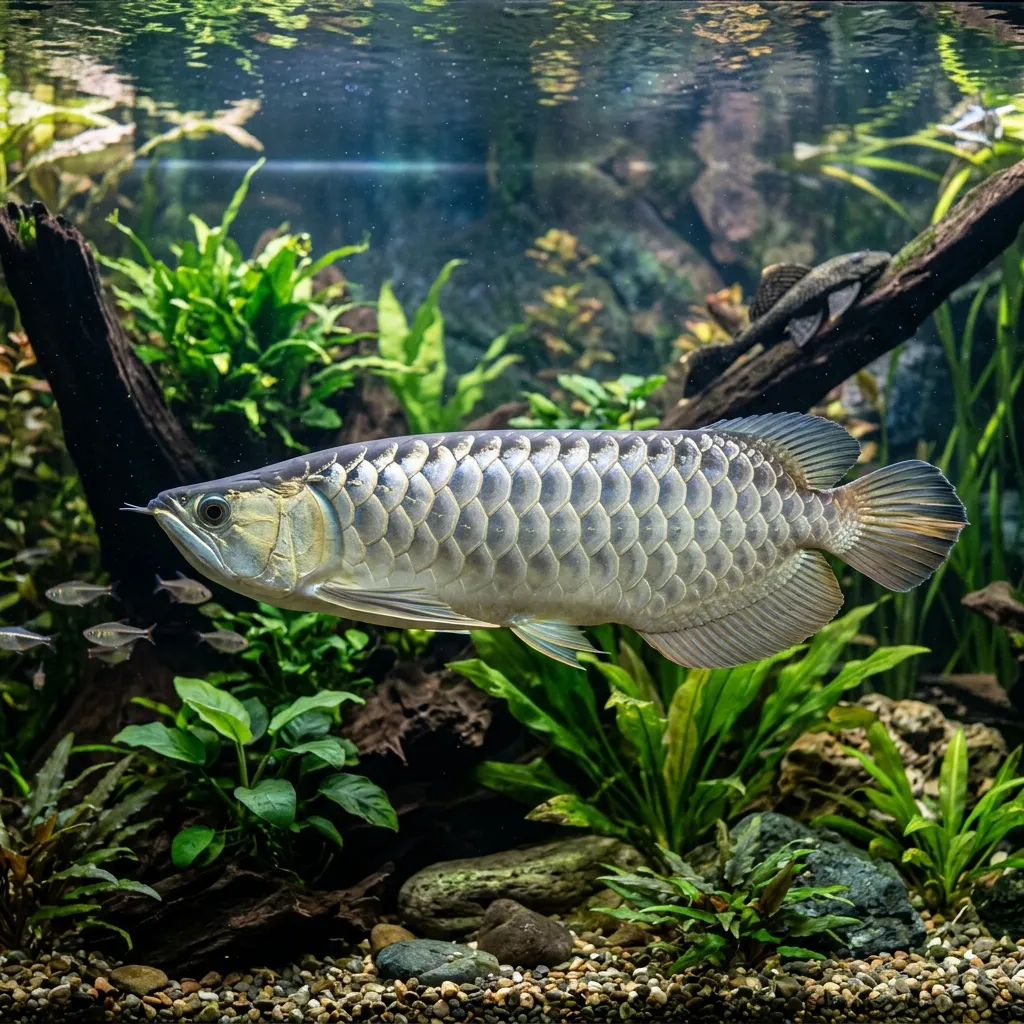
Quick Answer
Silver Arowana (Osteoglossum bicirrhosum) is a large, ancient bony-tongued fish from the Amazon River Basin. It requires a minimum 250-gallon (946-liter) aquarium with a pH of 6.0 to 7.0 and a temperature range of 75°F to 82°F (24°C to 28°C). As an obligate carnivore with aggressive tendencies, it must be housed alone or with carefully selected large tank mates. Not suitable for beginners.
Quick Facts
| Scientific Name | Osteoglossum bicirrhosum |
|---|---|
| Common Names | Silver Arowana |
| Family | Osteoglossidae |
| Genus | Osteoglossum |
| Type | Freshwater |
| Temperament | aggressive |
| Care Difficulty | advanced |
| Lifespan | 15 years |
| Maximum Size | Up to 36 in (91 cm) |
| Diet | Carnivore |
| Temperature | 75–82°F (24–28°C) |
| pH | 6–7 |
| Hardness | 2–8 dGH |
| Minimum Size | 250 gallons |
Key Takeaways
- Requires minimum 250 gallons with 8-foot length and 30-inch width.
- Obligate carnivore - floating pellets, krill, and silversides are ideal.
- Highly prone to Drop Eye - prevention through lean diet is essential.
- Notorious jumper - weighted, gap-free lid is mandatory.
- Keep only one per tank - fatal aggression between adults.
- Highly nitrate-sensitive - maintain under 10 ppm at all times.
- Growth rate of 2 inches per month in year one - plan tank size before purchase.
Overview
Species Overview
The Silver Arowana (Osteoglossum bicirrhosum) is one of the most iconic and consistently mis-sold fish in the aquarium hobby. A member of the ancient bony-tongued family Osteoglossidae, this species traces its lineage back over 150 million years. In the wild, Silver Arowanas inhabit the slow backwaters, flooded forests (varzea), and oxbow lakes of the Amazon and Essequibo river basins across Brazil, Peru, Colombia, Guyana, Suriname, and French Guiana.
The Water Dragon Morphology
The Silver Arowana's body plan is purpose-built for surface ambush predation. The mouth tilts almost vertically upward, forming a near-90-degree hinge that opens like a drawbridge. A pair of fleshy barbels extends from the lower jaw, serving as sensory organs that detect surface vibrations and movement of prey on or just above the waterline. The dorsal and anal fins fuse into a long, continuous ribbon along the rear two-thirds of the body, propelling the fish with the slow, sinuous undulation that earned it the Water Dragon nickname.
Their iridescent silver scales are among the largest of any freshwater fish, arranged in a mosaic that catches light from below as the fish patrols the surface. Juveniles carry a yellow-orange tag near the anal fin, a vestige of the yolk sac, which fades by the time the fish reaches approximately 8 inches (20 cm).
Natural Habitat and Behavior
During the wet season, when river levels rise 30 feet (9 meters) or more, arowanas swim into the flooded jungle and hunt insects, spiders, frogs, and small vertebrates among submerged tree branches. Their famous jumping ability is not a quirk; it is a primary feeding strategy. Documented leaps of 6 feet (1.8 meters) out of the water to snatch beetles or roosting birds are routine in the wild.
Native water is soft, warm (78°F to 86°F or 25.5°C to 30°C seasonally), and stained brown by tannins. pH typically sits between 5.5 and 6.8. While you do not need to recreate blackwater conditions in captivity, the fish is built for warm, soft, slightly acidic water and is unforgiving of high-pH, hard-water swings that accompany neglected large-tank water changes.
Diet
Diet and Feeding Strategy
Silver Arowanas are obligate carnivores with one of the most specialized feeding niches in the aquarium hobby: surface-only predation. Anything that sinks past the first few inches is generally ignored. You must train your fish on floating foods early.
Health
Health and Disease Management
Most arowana health problems trace back to two root causes: tank dimensions that are too small, and a diet too heavy on fatty live foods. Get those two right and the species is surprisingly hardy. Get them wrong and you will spend years fighting Drop Eye, spinal curvature, and recurring head trauma.
Drop Eye (Ptosis)
The signature ailment of captive arowanas where the eyeball rotates downward in the socket, leaving a permanent downward stare. Almost never reversible once established.
- One or both eyes rotated downward in the socket, asymmetrical gaze, visible fatty deposits behind the eyeball in advanced cases.
Excess body fat from high-fat diets (goldfish, beef heart, overfeeding), constant downward gaze from bottom-dwelling tank mates or sinking food, genetic predisposition in some specimens.
Feed exclusively floating foods at the surface, maintain lean high-protein diet, provide surface-level visual enrichment, keep nitrates under 10 ppm, feed adults once daily only.
Jump Injuries and Head Trauma
A spooked arowana strikes the lid hard enough to bruise the rostral region, dislodge scales, and in worst cases break its spine.
- Bruising around the snout and head, missing scales, bent or damaged barbels, lethargy, refusal to eat, spinal curvature in severe cases.
Inadequate lid weight, sudden movements near the tank, bright reflections off glass canopies, inconsistent lighting, harassment from tank mates.
Use weighted polycarbonate or acrylic lids secured with cinder blocks or dive weights, approach the tank slowly, maintain consistent room lighting, avoid sharp reflections, diagnose and remove harassment triggers.
Barbel Erosion and Loss
Damage to the sensitive barbels from abrasion, poor water quality, or bacterial infection. Barbels are critical sensory organs for surface hunting.
- Shortened, curled, or missing barbels, reddened tissue at the barbel base, reluctance to feed at the surface, repeated scraping against tank walls.
Tank width insufficient for turning, sharp decor, chronic exposure to nitrates above 20 ppm, bacterial infection secondary to physical trauma.
Provide minimum 30-inch tank width, use only smooth decor, maintain nitrates under 10 ppm, treat water with antibacterial agents if infection is suspected.
Ammonia Burn and Nitrate Sensitivity
Adult arowanas in undersized or under-filtered tanks show fin erosion, mucus stripping, and reddened gill plates from chronic exposure to nitrogenous waste.
- Fin erosion and fraying, excess mucus production, reddened gill plates, rapid breathing, lethargy, loss of appetite, clamped fins.
Inadequate filtration for bioload, infrequent water changes, overstocking, failure to cycle the tank properly before adding the fish.
Internal Parasites
Common in wild-caught specimens and fish fed live feeders from pet store tanks. Can cause chronic weight loss and digestive issues.
- Weight loss despite normal feeding, stringy white feces, bloating, lethargy, reduced growth rate, visible worms in feces in severe cases.
Feeding live feeder fish from untrusted sources, wild-caught specimens carrying endemic parasites, cross-contamination from new tank mates.
Never feed pet-store feeder fish, quarantine all new specimens for 4 weeks, use praziquantel as a prophylactic dewormer at 2.5 mg/L for 3 days, maintain pristine water quality to support immune function.
Fatty Liver Disease (Hepatic Lipidosis)
Obesity-driven liver dysfunction caused by overfeeding and high-fat diets. A primary contributor to Drop Eye and shortened lifespan.
- Distended abdomen, lethargy, loss of appetite in advanced stages, pale feces, downward eye rotation (Drop Eye), reduced activity.
Overfeeding, diets heavy in goldfish or beef heart, lack of exercise in cramped tanks, genetic predisposition.
Feed adults once daily or every other day, use lean floating pellets as the dietary staple, avoid goldfish and beef heart entirely, provide adequate swimming space for exercise.
Breeding
Breeding Silver Arowanas in Captivity
Breeding Silver Arowanas in captivity is extremely rare and requires facilities far beyond the reach of home aquarists. This section covers the biological facts for educational purposes and conservation awareness.
Compatible Tank Mates






Species Comparison
| Feature | Silver Arowana | Asian Arowana | Black Arowana | Jardini Arowana |
|---|---|---|---|---|
| Maximum Size | 36 inches (91 cm) | 24 to 32 inches (61 to 81 cm) | 36 inches (91 cm) | 24 inches (61 cm) |
| Temperament | Aggressive predator, solitary | Territorial but calmer | Aggressive, less prone to Drop Eye | Highly aggressive, genuinely nasty |
| Minimum Tank Size | 250 gallons (946 L), 8 ft length | 200 gallons (757 L) | 250 gallons (946 L) | 180 gallons (681 L) |
| Diet | Floating carnivore pellets, krill, silversides | High-quality pellets, live food, insects | Carnivore pellets, whole prey, insects | Carnivore pellets, crustaceans, fish |
| pH Range | 6.0 to 7.0 | 6.5 to 7.5 | 6.0 to 7.0 | 6.5 to 7.5 |
| Drop Eye Proneness | High - primary health concern | Moderate | Low - rarely develops | Moderate |
| Price Range (Juvenile) | $30 to $80 USD | $300 to $3,000+ USD | $150 to $400 USD | $100 to $300 USD |