
Quick Answer
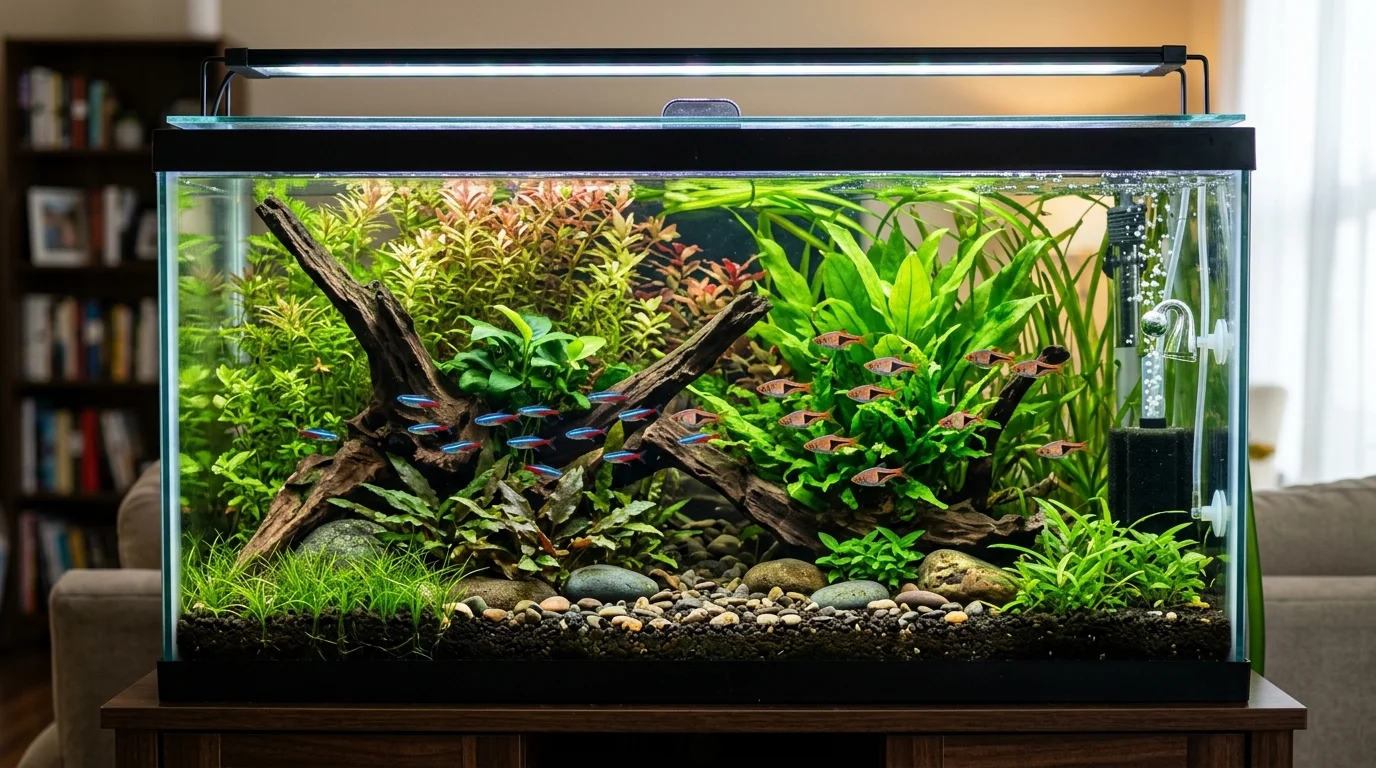
A standard 29-gallon tank (30″ L × 12″ W × 18″ H) shares the footprint of a 20-gallon long but adds 6 vertical inches, making it ideal for distinct swimming tiers. A balanced stocking plan includes one peaceful centerpiece fish (such as a Honey Gourami or a pair of German Blue Rams), an 8–10 fish mid-water school (like Cardinal Tetras or Harlequin Rasboras), a bottom crew of 6–8 Corydoras or Kuhli Loaches, and 1 Bristlenose Pleco or Nerite snails. Ensure your filter provides 150–250 GPH turnover to handle the mature bioload.
A standard 29-gallon aquarium measures approximately 30.25″ L × 12.5″ W × 18.75″ H. While it provides an accessible entry point into medium-sized fishkeeping, its stocking dynamics are often misunderstood. Because it shares the identical 360-square-inch footprint of a 20-gallon long, its carrying capacity for territorial species is bounded by horizontal floor space rather than raw volume.
Understanding the 29-Gallon Footprint and Swimming Tiers
The extra 6 inches of vertical height in a 29-gallon tank compared to a 20-long creates 9 gallons of additional water volume without expanding bottom territory. Floor-dwelling species such as dwarf cichlids, loaches, and catfishes establish horizontal territories along physical boundaries; they do not occupy open vertical water columns. To stock a 29-gallon tank effectively, divide the livestock across three distinct vertical ecological tiers:
- Top Strata (Surface to 4 inches): Inhabited by surface-oriented species with upturned mouths, such as Hatchetfish, Halfbeaks, or labyrinth fish like Honey Gouramis.
- Mid-Water Strata (4 to 12 inches): The primary swimming corridor for schooling characins, cyprinids, and rasboras that rely on open lateral depth for shoaling.
- Substrate Strata (Bottom 6 inches): Foraging grounds for Corydoras, Kuhli Loaches, and dwarf cichlids. Hardscape breaks are required here to segment visual boundaries.
20-Gallon Long vs. 29-Gallon: Strategic Footprint Comparison
Both aquariums share a 30″ × 12″ base perimeter. The 20-gallon long provides superior light penetration to the substrate (12-inch depth) and lower flow resistance, making it an exceptional choice for shallow-water rheophilic species and carpeting plants. The 29-gallon tank justifies its added weight and deeper light penetration requirements when housing tall-bodied species (such as Pterophyllum scalare or full-sized Gouramis) and deep background plants like Vallisneria americana or large Echinodorus swords that demand vertical growth clearance.
Why the 'One Inch Per Gallon' Rule Fails
The classic 'one inch of fish per gallon' guideline fails because metabolic waste production scales with body mass (volumetric displacement), not linear length. A single 4-inch Angelfish produces exponentially greater organic nitrogenous waste than four 1-inch Neon Tetras. Furthermore, after accounting for substrate displacement (30–40 lbs of sand or gravel), hardscape stones, and internal equipment, the true water volume of a 29-gallon tank drops to roughly 24–25 gallons. Bioload capacity must be calculated using adult metabolic requirements, surface gas exchange, and effective biological filter media capacity.
Carrying Capacity and Number of Fish
Rather than relying on linear measurements, allocate stocking based on adult bioload impact: budget approximately 1 small fish (under 2 inches adult length) per 2.5 to 3 gallons of actual water volume, and 1 medium centerpiece fish (3 to 4 inches) per 8 to 10 gallons. Under this protocol, a mature 29-gallon system comfortably supports 15 to 22 community fish distributed across all three water strata without overwhelming a standard weekly maintenance schedule.
Best Centerpiece Fish for a 29-Gallon Setup
A centerpiece fish anchors the visual aesthetic of the aquarium while remaining behaviorally compatible with mid-water schooling dither fish. The top options for a 29-gallon footprint include:
- Honey Gourami (Trichogaster chuna): Maximum adult size of 2 inches; peaceful, non-territorial labyrinth fish suitable for heavily planted, low-flow environments.
- Dwarf Gourami (Trichogaster lalius): Grows to 3 inches; colorful and active in the upper-mid tier, though males can display mild intra-species territoriality.
- German Blue Ram (Mikrogeophagus ramirezi) or Bolivian Ram (Mikrogeophagus altispinosus): A compatible bonded pair forms an engaging substrate-level centerpiece, displaying parental care without claiming the entire floor perimeter outside of active spawning.
Top 4 Stocking Combinations for a 29-Gallon Aquarium
1. The Classic Planted Community (Beginner-Friendly)
A resilient, community setup distributing bioload across all ecological tiers (pH 6.5–7.5, Temperature 74–78°F):
- Top/Centerpiece: 1× Honey Gourami (Trichogaster chuna) or 1× Dwarf Gourami (Trichogaster lalius)
- Mid-Water School: 10–12× Cardinal Tetras (Paracheirodon axelrodi) or Harlequin Rasboras (Trigonostigma heteromorpha)
- Substrate Crew: 6–8× Panda Corydoras (Corydoras panda)
- Algae Management: 1× Bristlenose Pleco (Ancistrus sp.) or 3× Nerite Snails (Neritina sp.)
2. The South American Dwarf Cichlid Setup
Optimized for dwarf cichlid behaviors; avoids substrate competition to prevent territorial stress (pH 6.0–6.8, Temperature 78–82°F):
- Centerpiece: 1 Mated Pair of Apistogramma cacatuoides or German Blue Rams (Mikrogeophagus ramirezi)
- Upper/Mid Dither School: 10× Rummy-Nose Tetras (Hemigrammus rhodostomus) or Marbled Hatchetfish (Carnegiella strigata)
- Biofilm & Algae Crew: 6× Otocinclus Catfish (Otocinclus vestitus)
3. The Planted Nano Schooler Showcase
Emphasizes shoaling mechanics and minimal individual waste production (pH 6.5–7.2, Temperature 72–76°F):
- Centerpiece: Trio of Sparkling Gouramis (Trichopsis pumila) — 1 male, 2 females
- Mid-Water School: 15× Ember Tetras (Hyphessobrycon amandae)
- Substrate Foragers: 8× Kuhli Loaches (Pangio kuhlii)
- Invertebrate Cleaners: 10–15× Neocaridina Shrimp (Cherry Shrimp) and 2× Amano Shrimp (Caridina multidentata)
4. The Hard-Water Livebearer Community
Tailored for municipal tap water sources with elevated carbonate hardness (pH 7.5–8.2, GH 10–18 dGH, Temperature 74–78°F):
- Upper/Mid Colony: 2 Males / 4 Females Platies (Xiphophorus maculatus)
- Mid-Water School: 8× Male Endler's Livebearers (Poecilia wingei) — all-male group to prevent unchecked breeding
- Substrate Scavengers: 6× Zebra Loaches (Botia striata) or 6× Bronze Corydoras (Corydoras aeneus)
- Algae Control: 3× Zebra Nerite Snails
Filtration, Flow Rates, and Water Movement
A populated 29-gallon tank requires a biological and mechanical turnover capacity of 150 to 250 gallons per hour (GPH), equivalent to a 5× to 8× hourly volume cycle. A Hang-On-Back (HOB) filter rated for 50–70 gallons (e.g., Aquaclear 50 or Seachem Tidal 55) or a compact canister filter (e.g., OASE FiltoSmart 100) provides sufficient biological media volume. Avoid single small internal sponge filters or low-capacity cartridge systems, as they saturate rapidly under adult waste loads.
Species to Avoid in a 29-Gallon Tank
- Common Plecostomus (Hypostomus plecostomus): Attains lengths of 15–20 inches; generates extreme metabolic waste incompatible with medium biological filters.
- Bala Shark (Balantiocheilos melanopterus): High-velocity open-water fish requiring a minimum 6-foot lateral run to prevent stress collisions.
- African Rift Lake Cichlids (Mbuna): Territorial rock-dwellers that require a minimum 4-foot footprint (55+ gallons) to dissipate intra-specific hyper-aggression.
- Adult Angelfish (Groups): While a single specimen or bonded pair can be housed, juvenile groups will fight violently upon reaching sexual maturity within a 30-inch run.
The Problem
Aquarists frequently overstock 29-gallon aquariums or cause territorial clashes by treating the tank's 18-inch height as usable surface area for bottom-dwellers, leading to territorial aggression and water quality spikes.
When to Use This Tool
Use this guide when planning livestock for a newly cycled 29-gallon setup, converting an existing setup into a tiered planted community, or balancing bioload across top, middle, and substrate zones.
Who is this for?
- Beginner and intermediate freshwater aquarists looking for balanced stocking combinations, compatibility rules, and filtration guidelines for a 29-gallon aquarium.
29-Gallon Stocking Archetypes Compared
| Setup Archetype | Centerpiece Species | Schooling Species | Bottom Dwellers | Bioload Impact | Difficulty |
|---|---|---|---|---|---|
| Peaceful Community | 1× Dwarf or Honey Gourami | 10× Neon or Cardinal Tetras | 6× Corydoras Catfish | Moderate | Beginner |
| Dwarf Cichlid Biotope | 1 Pair Apistogramma / Rams | 10× Rummy-Nose Tetras | None (avoid territorial fights) | Low to Moderate | Intermediate |
| Planted Nano Haven | Trio Sparkling Gourami | 15× Ember Tetras / CPDs | 8× Kuhli Loaches + Shrimp | Low | Beginner |
| Hard Water Livebearer | Platy Breeding Group (1M/3F) | 8× Male Endler's Livebearers | 1× Bristlenose Pleco | Moderate to High | Beginner |
Troubleshooting Guide
1 Schooling fish stay clumped near the bottom substrate rather than utilizing the mid-water column.
This behavior indicates lack of top cover or excessive flow. Add floating plants (like Amazon Frogbit or Salvinia) and lower the filter return flow. Secure top cover reduces open-water predatory stress for mid-water tetras.
2 Corydoras catfish fins look frayed and dwarf cichlids are charging them.
Your cichlids are spawning or defending cave territory. Because a 29-gallon footprint is only 30 inches long, Corydoras will unknowingly violate cichlid breeding grounds. Relocate the Corydoras or move cichlid caves to opposite corners buffered by tall plants and driftwoods.
3 Nitrate levels regularly climb above 40 ppm within 5 days of a water change.
The bioload exceeds the current biological processing capacity. Reduce feeding to once daily, clean the mechanical filter sponges in tank water, and recheck your total stock numbers with a stocking calculator. Supplement nutrient removal by adding fast-growing stem plants like Hornwort or Water Wisteria.
4 Fish gasping at the surface early in the morning in a heavily planted setup.
Plants consume oxygen and release carbon dioxide at night, driving down dissolved oxygen levels in deep 18-inch tanks. Position your filter outflow to create surface agitation or add an air stone connected to a check-valved air pump running overnight.
Frequently Asked Questions
How many fish can I put in a 29-gallon tank?
Is a 29-gallon tank better than a 20-gallon long?
Can an Angelfish live in a 29-gallon tank?
What is the best centerpiece fish for a 29-gallon tank?
What size filter do I need for a 29-gallon fish tank?
Can I keep African Cichlids in a 29-gallon tank?
Glossary of Terms
- Water Column Tiers
- The vertical stratification of an aquarium into top, middle, and bottom ecological zones, dictating where different species naturally swim, feed, and stake out territory.
- Footprint
- The horizontal dimensions (length multiplied by width) of an aquarium base, which governs swimming run-length, territorial division, and gas exchange surface area.
- Dither Fish
- Calm, active schooling fish whose constant presence in open water signals to shy or territorial species (like dwarf cichlids) that no predators are nearby.
- Bioload
- The cumulative biological burden placed upon an aquarium's nitrogen cycle and filtration system by the respiration, organic waste, and feeding requirements of its inhabitants.
- Water Displacement
- The reduction in actual water volume caused by the space occupied by gravel, sand, rocks, wood, and internal filter equipment inside the aquarium.
Scientific References
- Aquarium Dimensions, Spatial Geometry, and Carrying Capacity Relationships
- Behavioral Ecology and Spatial Distribution of Freshwater Community Fishes
- Resource Allocation, Territorial Agonism, and Microhabitat Partitioning in Small Cichlids