
Quick Answer
A standard 55-gallon aquarium (48″ L × 13″ W × 21″ H) provides four linear feet of horizontal swimming space, making it exceptional for high-energy schooling fish like Boesemani Rainbowfish or active Lake Malawi Mbuna cichlids. However, its narrow 12.75-inch width severely restricts the turning radius of deep-bodied, large species exceeding 7–8 inches. To maintain water stability, utilize canister or dual Hang-On-Back filtration delivering at least 350–550 GPH (6× to 10× turnover), and structure livestock around open lateral corridors rather than heavy, thick-bodied solitary fish.
The standard 55-gallon aquarium measures approximately 48.25″ L × 12.75″ W × 21″ H. Its four-foot length makes it the classic entry point into large-format fishkeeping, offering exceptional lateral swimming space for high-velocity schooling fish. However, managing this setup requires navigating its narrow footprint, calculating true volumetric bioload, and matching species to horizontal swimming corridors.
The 55-Gallon Footprint Challenge: Turning Radius and Surface Area
While 48 inches of horizontal length provides phenomenal swimming room, the narrow 12.75-inch width presents significant physical constraints. The base provides 615 square inches of surface area—identical to a 4-foot tank, but with a restricted turning radius. Rigid, deep-bodied fish exceeding 7 to 8 inches (such as adult Oscars or large Severums) cannot pivot comfortably without grazing glass walls or hardscape decor. When planning a 55-gallon setup, the focus must remain on streamlined, active lateral swimmers or species that claim localized territories along the 4-foot bottom plane.
Why the 'One Inch Per Gallon' Rule Fails at 55 Gallons
Applying the archaic 'one inch of fish per gallon' guideline to a 55-gallon aquarium invites rapid ecological instability. A single 10-inch adult cichlid carries vastly more biological mass, metabolic demand, and waste output than ten 1-inch tetras. Furthermore, after accounting for 50–60 pounds of substrate, rockwork, and driftwood displacement, a 55-gallon tank holds only 46 to 48 gallons of actual water. Safe stocking hinges on factoring in adult volumetric biomass, oxygenation requirements, and territorial margins using our Stocking Calculator rather than linear fish lengths.
Swimming Tiers and Boundary Mapping Across 4 Feet
The 48-inch span permits aquarists to layer fish across three distinct vertical and horizontal zones:
- Top Strata (Surface to 6 inches depth): Surface dwellers, hatchetfish, and labyrinth species utilize this plane. Maintaining moderate surface agitation ensures consistent gas exchange across the four-foot boundary.
- Mid-Water Strata (6 to 15 inches depth): The primary visual focal point. Fast, open-water schooling characins, rainbowfish, and cyprinids leverage the full 48-inch lateral sprint length.
- Substrate Strata (Bottom 6 inches): Sifting catfish, loaches, and dwarf cichlids occupy this floor plan. Because depth is narrow, hardscape barriers like slate and driftwood must be arranged to break visual sightlines horizontally.
4 Proven Stocking Archetypes for a 55-Gallon Tank
1. The Australian & New Guinea Rainbowfish River
An active, vibrant biotope tailored to high-energy open-water swimmers (pH 7.0–7.8, Temperature 75–80°F):
- Centerpiece School: 6× Boesemani Rainbowfish (Melanotaenia boesemani) — 2 males, 4 females
- Secondary School: 8× Praecox / Dwarf Neon Rainbowfish (Melanotaenia praecox)
- Bottom Dwellers: 8× Sterbai Corydoras (Corydoras sterbai) or 6× Zebra Loaches (Botia striata)
- Algae Management: 1× Bristlenose Pleco (Ancistrus sp.) and 3× Nerite Snails
2. The Controlled Lake Malawi Mbuna Biotope
Mbuna cichlids require intentional, controlled overstocking supported by robust filtration to diffuse territorial aggression across rock formations (pH 7.8–8.6, dGH 12–20, Temperature 76–82°F):
- Primary Colony: 5× Yellow Lab Cichlids (Labidochromis caeruleus) — 1 male, 4 females
- Secondary Colony: 5× Rusties (Iodotropheus sprengerae) — 1 male, 4 females
- Tertiary Colony: 5× Pseudotropheus Acei (Pseudotropheus sp. 'Acei')
- Substrate & Hardscape: Extensive stacked limestone or lace rock forming caves along the back glass, keeping the front run open.
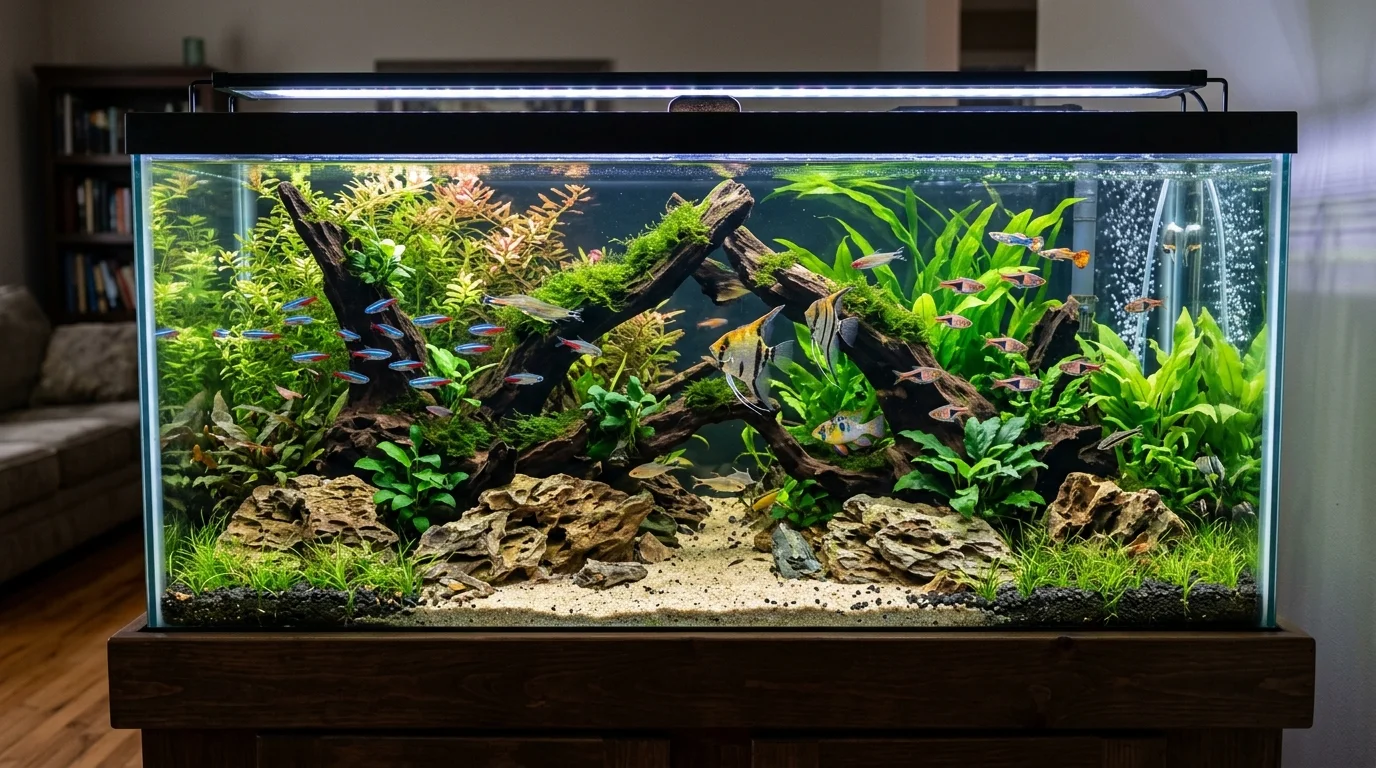
3. The Heavily Planted Amazonian Community
A tranquil, vertical aquascape balancing tall stem plants and broadleaf swords with calm schooling dynamics (pH 6.2–7.0, Temperature 76–80°F):
- Centerpiece: 1 Established Mated Pair of Angelfish (Pterophyllum scalare) or 1 Pair of Pearl Gouramis (Trichopodus leerii)
- Schooling Dithers: 15–18× Rummy-Nose Tetras (Hemigrammus rhodostomus) or Cardinal Tetras (Paracheirodon axelrodi)
- Bottom Scavengers: 8–10× Panda Corydoras (Corydoras panda)
- Cleanup Specialist: 1× Whiptail Catfish (Rineloricaria sp.) or 6× Otocinclus Catfish
4. The South American Dwarf Eartheater Biotope
Focuses on peaceful substrate-sifting dwarf cichlids paired with deep-bodied schooling characins (pH 6.5–7.2, Temperature 77–81°F):
- Centerpiece Group: 4× Red Hump Eartheaters (Geophagus steindachneri)
- Mid-Water School: 12× Bleeding Heart Tetras (Hyphessobrycon erythrostigma)
- Mid-Water Accent: 1× Festivum Cichlid (Mesonauta festivus)
- Substrate Cleaners: 6× Emerald Green Corydoras (Brochis splendens)
Filtration, Flow Dynamics, and Water Turnover
Filtering a 4-foot tank requires preventing stagnant dead zones at opposite ends. Aim for a turnover rate of 350 to 550 gallons per hour (GPH), representing 6× to 10× total volume turnover hourly. A dedicated canister filter (such as a Fluval 407 or Sicce Whale 500) paired with a spray bar guarantees linear circulation. Alternatively, run dual Hang-On-Back filters placed at opposite ends of the rim to balance intake and mechanical debris removal.
Species That Should Avoid a Standard 55-Gallon
- Oscar (Astronotus ocellatus): Reaches 12–14 inches in length and over 2 inches in width; adult specimens cannot turn comfortably within a 12.75-inch frame.
- Common Plecostomus (Hypostomus plecostomus): Exceeds 18 inches at maturity and generates excessive biological waste.
- Silver Arowana (Osteoglossum bicirrhosum): Surface-gliding predators that quickly surpass 30 inches and easily breach tank lids.
- Bala Shark (Balantiocheilos melanopterus): High-velocity open-water schooling fish reaching 12–14 inches that require a minimum 6-foot swimming run.
The Problem
Aquarists frequently treat the 55-gallon tank as an all-purpose large tank, buying wide-bodied, high-bioload fish like Oscars or Common Plecos that quickly outgrow the narrow 12-inch depth and create severe turning and waste issues.
When to Use This Tool
Use this guide when transitioning from nano setups to your first 4-foot tank, mapping territorial boundaries for semi-aggressive species, or balancing bioload calculations across the 48-inch water column.
Who is this for?
- Intermediate freshwater aquarists, planted tank hobbyists, and cichlid enthusiasts looking to optimize horizontal run length while working within a narrow tank footprint.
55-Gallon Tank Stocking Archetypes Compared
| Setup Archetype | Centerpiece Species | Schooling Species | Bottom Dwellers | Bioload Impact | Difficulty |
|---|---|---|---|---|---|
| Rainbowfish River | 6× Boesemani Rainbowfish | 8× Dwarf Neon Rainbowfish | 8× Sterbai Corydoras | Moderate | Beginner |
| Malawi Mbuna Biotope | 5× Yellow Lab Cichlids | 10× Mixed Mbuna (Rusties / Acei) | None (territorial rocks) | High | Intermediate |
| Amazon Planted Community | 1 Pair Pterophyllum scalare (Angelfish) | 18× Rummy-Nose Tetras | 10× Panda Corydoras | Moderate | Intermediate |
| Eartheater & Tetra Biotope | 4× Geophagus steindachneri | 12× Bleeding Heart Tetras | 6× Emerald Green Corydoras | Moderate to High | Intermediate |
Troubleshooting Guide
1 Severe territorial chasing and fin-nipping in a 55-gallon cichlid community.
The 12-inch width leaves limited retreat space. Break long horizontal sightlines by dividing the tank into two distinct rock piles separated by open space or tall driftwood, ensuring line-of-sight is completely broken across the 4-foot span.
2 Accumulation of detritus and dead zones at the far end opposite the filter intake.
A single intake cannot sweep a 48-inch tank floor. Install an auxiliary circulating wavemaker (200–500 GPH) or a second HOB filter on the opposite rim to sweep organic debris toward the primary filtration intake.
3 Schooling fish tightly bunching in top corners rather than exploring the full 4-foot length.
This reflects predatory stress, lack of overhead cover, or excessive laminar water current. Add floating plants (like Amazon Frogbit), incorporate tall background stems (Vallisneria), and diffuse the main filter return with a spray bar.
4 Chronic nitrate elevation (>40 ppm) despite 25% weekly water changes in an Mbuna setup.
Intentionally overstocked African cichlid tanks require greater water turnover and dilution. Increase weekly water changes to 40–50%, vacuum detritus from deep within rock crevices, and rinse mechanical filter sponges weekly in removed tank water.
Frequently Asked Questions
How many fish can I safely keep in a 55-gallon aquarium?
Can an adult Oscar live in a 55-gallon tank?
Which is better: a 55-gallon or a 75-gallon aquarium?
What size filter is needed for a 55-gallon fish tank?
Can you keep Angelfish in a 55-gallon tank?
Can African Cichlids thrive in a 55-gallon tank?
Glossary of Terms
- Turning Radius
- The horizontal clearance required for a fish to rotate 180 degrees comfortably without contacting glass walls or structural decor; critically limited by the 55-gallon tank's 12.75-inch width.
- Overstocking (Controlled)
- A deliberate husbandry strategy used in African Mbuna cichlid tanks where fish density is kept high to disperse territorial aggression, requiring heavy biological filtration.
- Lateral Swimming Space
- The uninterrupted horizontal length of an aquarium (48 inches in a 55-gallon) that permits active, high-velocity schooling species to exhibit natural migratory swimming patterns.
- Line of Sight
- An uninterrupted optical path between territorial specimens; disrupting it with hardscape reduces chasing and persistent social stress.
- Turnover Rate
- The ratio of total hourly filtration flow volume (GPH) relative to actual aquarium water volume; ideally 6× to 10× hourly for medium-to-large aquariums.
Scientific References
- Design and Management of Recirculating Aquaculture Systems: Mass Balance and Oxygen Dynamics
- Space Use, Territoriality, and Agonistic Encounters in Captive Lake Malawi Cichlids (Pseudotropheus)
- Effects of Water Current and Spatial Geometry on Schooling Cohesion in Stream-Dwelling Teleosts