
Green Fire Tetra (Aphyocharax rathbuni)
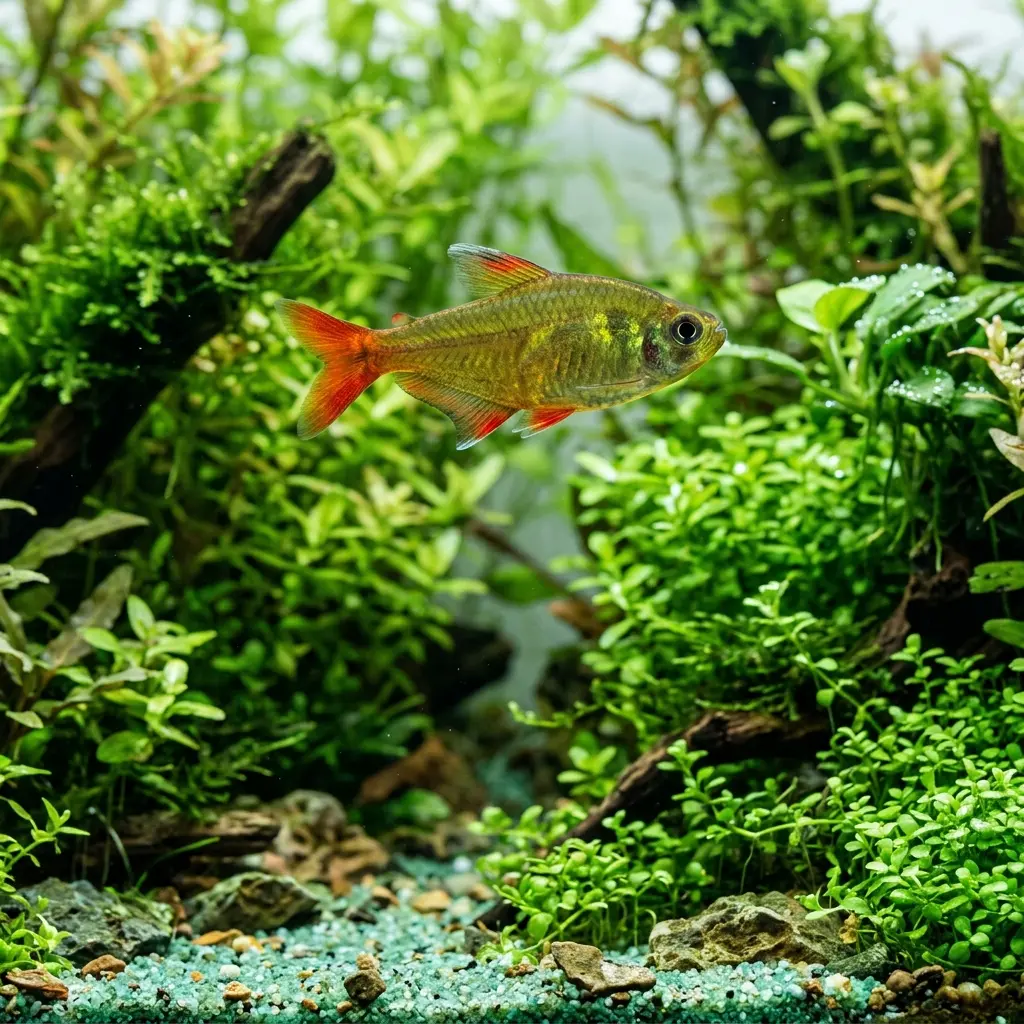
Quick Answer
Green Fire Tetra (Aphyocharax rathbuni) is a lively, hardy tetra native to the Paraguay, Parana, and Uruguay river basins of South America. It requires a minimum 20-gallon (76 liter) long aquarium with a pH of 6.0 to 7.5 and a temperature range of 72°F to 80°F (22°C to 27°C). This omnivorous micro-predator occupies the middle water column and makes an exceptional addition to peaceful community setups when maintained in schools of 8 or more.
Quick Facts
| Scientific Name | Aphyocharax rathbuni |
|---|---|
| Common Names | Green Fire Tetra |
| Family | Characidae |
| Genus | Aphyocharax |
| Type | Freshwater |
| Temperament | peaceful |
| Care Difficulty | beginner |
| Lifespan | 5 years |
| Maximum Size | Up to 2 in (5 cm) |
| Diet | Omnivore |
| Temperature | 72–80°F (22–27°C) |
| pH | 6–7.5 |
| Hardness | 4–15 dGH |
| Minimum Size | 20 gallons |
Key Takeaways
- Requires schools of 8 or more for natural behavior, security, and full color display
- Minimum 20-gallon (76 liter) long aquarium with 24-inch (60 cm) footprint
- Omnivorous micro-predator requiring 35% protein with live, frozen, and vegetable supplementation
- Peaceful but documented fin-nipper in undersized groups or cramped tanks
- Breeds readily as egg-scatterer in soft, acidic water with spawning mops
- Sensitive to formalin; use half-dose malachite green for ich treatment
- Dark substrate and floating plants are essential for color enhancement
Overview
Species Overview
The Green Fire Tetra (Aphyocharax rathbuni), also known as Rathbun's Bloodfin or Redflank Bloodfin, is a small, active characin native to the Paraguay, Parana, and Uruguay river drainages of Brazil, Paraguay, Argentina, and Uruguay. This species is celebrated among aquarists for its striking metallic green body sheen contrasted by vivid red, orange, and black fin markings. Despite its visual appeal, the Green Fire Tetra remains surprisingly underrated in the aquarium trade, often overshadowed by more common tetras such as the Neon and Cardinal Tetra.
Green Fire Tetras are hardy, adaptable fish that suit beginner to intermediate aquarists. They are obligate schooling fish that demand groups of 8 or more to display natural behavior, secure coloration, and minimize stress-induced fin-nipping. When provided with a dark substrate, subdued lighting, and open swimming lanes, these fish transform into one of the most dynamic midwater displays in the freshwater hobby.
Appearance
Appearance and Sexual Dimorphism
Adult Green Fire Tetras reach 1.5 to 2 inches (3.8 to 5.1 cm) in standard length. Their bodies are slender and spindle-shaped with a translucent, metallic greenish-silver base color. A bright yellow-gold lateral stripe runs from the gill plate to the caudal peduncle. The dorsal fin carries a distinct black patch, while the pelvic, anal, and caudal fins flash red to orange. Males develop characteristic white tips on the dorsal, anal, and pelvic fins at sexual maturity. Females are fuller-bodied, particularly when gravid, and lack the white fin tips. Juveniles often appear washed-out in dealer tanks; their full coloration develops only after several weeks in a stable, planted environment with appropriate tank mates.
Natural Habitat
Natural Habitat and Distribution
Green Fire Tetras inhabit slow-moving streams, rivers, and tributaries within the Paraguay, Parana, and Uruguay river systems. They are found across Brazil, Paraguay, Argentina, and Uruguay. Their preferred microhabitats include shaded areas beneath floating vegetation and overhanging riparian canopy, where leaf litter, submerged roots, and driftwood create complex refuges. Water in these habitats is typically clear to slightly tannin-stained, soft to moderately hard, and slightly acidic to neutral. Seasonal flooding expands their range into floodplain forests and temporary pools, making them highly adaptable to fluctuating water conditions in captivity.
Diet
Diet and Nutrition
Green Fire Tetras are omnivorous micro-predators with small mouths adapted for capturing tiny invertebrates and grazing on periphyton in the wild. In captivity, they require a varied diet that balances animal protein with plant matter and fiber.
Health
Health and Disease Management
Green Fire Tetras are generally hardy but share the typical tetra vulnerability to protozoan and bacterial pathogens. Preventive care through water quality maintenance, quarantine protocols, and nutritional support is far more effective than reactive treatment.
Ich (White Spot Disease)
Ichthyophthirius multifiliis is a ciliated protozoan that causes white salt-like granules on fins, gills, and body. It is the most common external parasite encountered in Green Fire Tetra aquariums.
- White cysts visible on fins and body
- Scratching against decor (flashing)
- Labored breathing and clamped fins
- Loss of appetite and hiding
Introduced via contaminated water, plants, or new fish. Triggered by temperature fluctuations below 70°F (21°C) or stress from poor water quality.
Quarantine all new additions for 14 days. Maintain temperature above 72°F (22°C). Treat with half-dose malachite green (0.05 mg/L) or raise temperature to 86°F (30°C) for 72 hours combined with increased aeration. Avoid full-strength formalin treatments.
Neon Tetra Disease (Pleistophorosis)
Caused by the microsporidian parasite Pleistophora hyphessobryconis. This disease is incurable and highly contagious within characin communities. Green Fire Tetras are susceptible due to their close taxonomic relationship to other tetras.
- Progressive color loss starting from the lateral stripe
- Spinal curvature and skeletal deformities
- Erratic swimming or difficulty maintaining buoyancy
- White necrotic patches under the skin
- Lethargy and refusal to eat
Spores enter through ingestion of infected tissue or contaminated food. Stress from overcrowding, temperature swings, or poor nutrition increases susceptibility.
There is no cure. Euthanize affected fish immediately using clove oil to prevent spore release. Sterilize nets and equipment with bleach solution. Source fish from reputable breeders rather than mass-market suppliers. Maintain pristine water conditions and avoid mixing tetra species from different sources without quarantine.
Fin Rot (Bacterial and Fungal)
Fin rot manifests as frayed, discolored, or receding fin tissue caused by opportunistic bacteria such as Pseudomonas or Aeromonas, often secondary to fungal invasion. It is common in tanks with poor water circulation or high organic waste.
- Frayed or ragged fin edges with white or red margins
- Progressive fin tissue loss exposing fin rays
- Reddening at the fin base indicating systemic infection
- Lethargy and reduced schooling behavior
Perform 25% water changes every 48 hours until parameters stabilize. Treat with broad-spectrum antibiotics such as kanamycin or erythromycin for bacterial fin rot, or methylene blue for fungal involvement. Remove sharp or abrasive decor. Increase school size to reduce intraspecific nipping.
Columnaris (Cotton Wool Disease)
Columnaris is caused by Flavobacterium columnare, a gram-negative bacterium that produces white or grayish patches resembling cotton wool on the mouth, fins, or body. It progresses rapidly and can be fatal within 48 hours in warm water.
- White or grayish fluffy patches on mouth, gills, or body
- Ulcerated skin lesions
- Gill discoloration and rapid breathing
- Sudden death in advanced cases
Stress from overcrowding, high temperatures above 82°F (28°C), poor water quality, or introduction via infected fish. The bacterium thrives in warm, oxygen-depleted water.
Treat immediately with kanamycin combined with nitrofurazone. Lower temperature to 75°F (24°C) to slow bacterial replication. Increase surface agitation and aeration. Perform daily 20% water changes during treatment. Disinfect all equipment after use.
Breeding
Breeding Guide
Green Fire Tetras are group-spawning egg scatterers that breed readily in captivity with minimal intervention. Success depends on proper conditioning, a dedicated spawning environment, and prompt removal of adults to prevent egg predation.
Tips
Common Mistakes to Avoid
- Insufficient school size: Keeping 3 to 5 individuals is the most common mistake. This guarantees chronic stress, faded colors, and fin-nipping.
- Wrong tank shape: Using tall, narrow tanks instead of long, shallow tanks denies them the horizontal swimming space essential for natural behavior.
- Overfeeding dry foods: Excessive flake food causes bloating and constipation. Dry foods should never exceed 60% of the diet.
- Mixing with long-finned fish: Housing with Betta splendens or veil-tail guppies results in shredded fins within 48 hours, regardless of how peaceful the tetras appear initially.
- Skipping water changes: Nitrates above 20 ppm suppress immune function and cause stunted growth, even if the fish appear active.
- High lighting without plant cover: Bright, unfiltered lighting causes washed-out colors and persistent hiding. Always provide floating plant cover.
Pro Aquarist Tips
- Use botanicals: Add Indian almond leaves or alder cones at 1 leaf per 10 gallons (38 liters) to release tannins that acidify water, suppress pathogens, and intensify green coloration.
- Dark substrate mandate: Never use white or light gravel. Dark sand or black gravel creates a psychological security blanket that triggers full color expression within 2 weeks.
- Feed rotation: Rotate 5 different food types weekly to prevent nutritional deficiencies that manifest as washed-out colors and thin bodies.
- Dawn simulation: Use a programmable light timer that ramps up over 30 minutes each morning. This reduces startle responses and mimics their natural photoperiod.
- Quarantine rigor: Green Fire Tetras are often wild-caught or farm-raised in high-density systems. A strict 14-day quarantine with methylene blue prophylaxis prevents 90% of common disease introductions.
Compatible Tank Mates






Species Comparison
| Feature | Green Fire Tetra | Ember Tetra | Cardinal Tetra | Neon Tetra |
|---|---|---|---|---|
| Adult Size | 1.5 - 2 inches (3.8 - 5.1 cm) | 0.8 inches (2 cm) | 2 - 2.5 inches (5 - 6.4 cm) | 1 - 1.5 inches (2.5 - 3.8 cm) |
| Temperament | Peaceful; occasional fin-nipper in small groups | Very peaceful; shy | Peaceful; docile | Peaceful; docile |
| Minimum Tank Size | 20 gallons (76 liters) long | 10 gallons (38 liters) | 20 gallons (76 liters) | 10 gallons (38 liters) |
| Diet Type | Omnivore; micro-predator | Omnivore | Omnivore | Omnivore |
| Optimal pH Range | 6.0 - 7.5 | 5.5 - 7.0 | 5.5 - 7.0 | 6.0 - 7.0 |
| Temperature Range | 72°F - 80°F (22°C - 27°C) | 68°F - 82°F (20°C - 28°C) | 73°F - 81°F (23°C - 27°C) | 70°F - 81°F (21°C - 27°C) |
| Schooling Requirement | 8+ minimum; 12+ recommended | 6+ minimum; 10+ recommended | 6+ minimum; 10+ recommended | 6+ minimum; 10+ recommended |