
Panda Garra (Garra flavatra)
Quick Answer
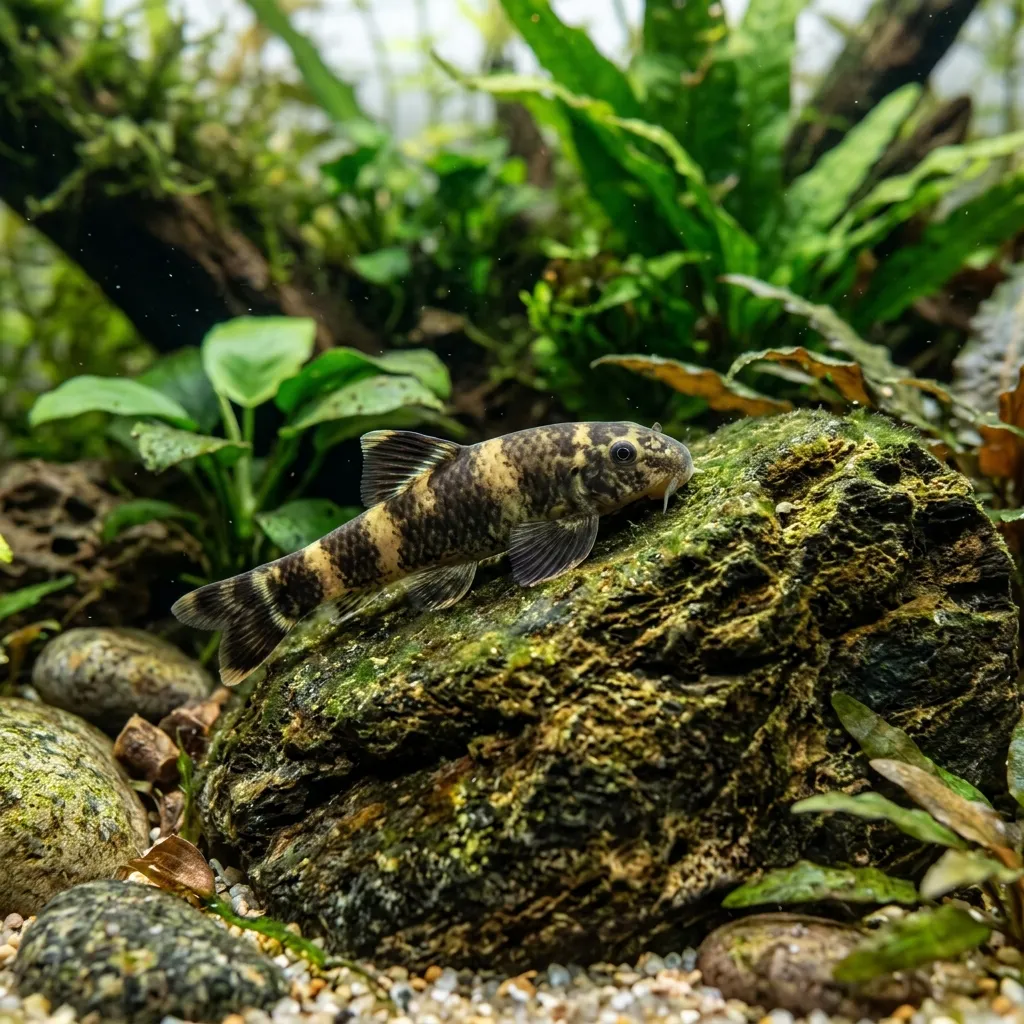
The Panda Garra (Garra flavatra) is a small, active hillstream cyprinid native to western Myanmar. It reaches 3.5 inches (9 cm) and requires a minimum 20-gallon (75 liter) aquarium with strong water flow, high oxygenation, and water parameters of pH 6.0-7.5 and temperature 70°F-77°F (21°C-25°C). Not a true schooling fish, it is best kept solitary or in groups of 5-6. Known for its sucker mouth, glass-climbing behavior, and ability to consume Black Beard Algae.
Quick Facts
| Scientific Name | Garra flavatra |
|---|---|
| Common Names | Panda Garra |
| Family | Cyprinidae |
| Genus | Garra |
| Type | Freshwater |
| Temperament | semi-aggressive |
| Care Difficulty | beginner |
| Lifespan | 5 years |
| Maximum Size | Up to 3.5 in (9 cm) |
| Diet | Omnivore |
| Temperature | 68–79°F (20–26°C) |
| pH | 6–7.5 |
| Hardness | 2–12 dGH |
| Minimum Size | 20 gallons |
Key Takeaways
- Keep solitary OR in groups of 5-6; groups of 2-4 trigger chronic aggression
- Requires high water flow (10-15x turnover) and strong oxygenation
- One of few aquarium fish documented to eat Black Beard Algae (BBA)
- Scaleless fish with medication sensitivity; avoid formalin and high salt
- Notorious escape artist; tight-fitting lid with zero gaps is mandatory
- Wild-caught from Myanmar; 14-day quarantine with parasite treatment essential
- Sucker mouth allows climbing glass walls; normal behavior, not distress
Overview
Species Overview
The Panda Garra (Garra flavatra) is a captivating hillstream cyprinid endemic to the Rakhine state of western Myanmar, specifically within the drainage systems of the Arakan and Rakhine Yoma mountain ranges. First collected in 1998 by Dr. Sven Kullander and Dr. Ralf Britz and formally described in 2004, this species entered the aquarium trade in 2005 and has since become one of the most sought-after algae-grazing specialists for freshwater aquarists.
Taxonomy and Classification
Garra flavatra belongs to the genus Garra within the family Cyprinidae (order Cypriniformes). The genus Garra comprises over 140 species of loach-like cyprinids distributed across South and Southeast Asia, Africa, and the Middle East. The specific epithet flavatra references the yellow (flavus) coloration present in the species. Commonly marketed as Panda Loach, Banded Butterfly Loach, Rainbow Loach, or Panda Nibblefish, it is important to note that this is not a true loach (family Cobitidae or Botiidae) but a cyprinid with convergent bottom-dwelling morphology.
Physical Characteristics
Panda Garras possess a slender, slightly compressed cylindrical body reaching 3.5 inches (8.9 cm) in aquarium conditions. Their most distinctive feature is the highly modified lower lip, which forms a fleshy, transverse suction disc capable of adhering to smooth surfaces—a remarkable adaptation for maintaining position in torrential hill streams. The coloration consists of alternating vertical bands of dark brown to black and cream to golden-yellow, creating the panda-like pattern that gives the species its common name. Males develop prominent tubercles on the head, lateral line, and caudal peduncle during breeding condition, while females remain plumper with a rounder abdominal profile.
Natural Habitat
Wild populations inhabit fast-flowing, well-oxygenated streams and rivers over substrates of sand, gravel, pebbles, and smooth boulders. These waters are typically clear, cool, and rich in dissolved oxygen, with abundant periphyton, biofilm, and aufwuchs communities coating rock surfaces. The current in their native habitat is substantial, and the fish use their sucker mouths to cling to rocks while grazing in flows that would dislodge conventional bottom-dwellers.
Conservation and Trade
The IUCN has not evaluated Garra flavatra for conservation status. All specimens in the aquarium trade are wild-caught from Myanmar, as captive breeding remains extremely rare. Their popularity has increased steadily since 2005, and they are frequently sold out at specialty retailers. When available, they command a premium price compared to common algae eaters due to their striking appearance and engaging behavior.
Care
Housing and Environmental Requirements
Tank Size and Dimensions
The absolute minimum tank size for a single Panda Garra is 10 gallons (38 liters), but this is only acceptable if equipped with a powerful circulation pump. For a socially stable group, you must provide a minimum 20-gallon (75 liter) tank with a footprint of at least 30x12 inches (75x30 cm). A 30-gallon (113 liter) or larger tank is strongly recommended for groups of 5 to 6 individuals, as this provides adequate territory distribution and reduces conspecific aggression. The general rule is one Panda Garra per 5 gallons (19 liters) of water. Tall narrow tanks are unsuitable; horizontal footprint and water volume are the critical factors.
Filtration and Water Flow
Water flow is the single most critical environmental parameter for Panda Garras. You must provide filtration and circulation equivalent to 10-15x the tank volume per hour. Use a high-capacity canister filter with a spray bar, supplementary powerheads, or dedicated circulation pumps to create laminar flow patterns. Hillstream-style setups with unidirectional flow from one end of the tank to the other most closely replicate their natural habitat. High flow serves dual purposes: it maintains the oxygen saturation they require and prevents detritus accumulation on grazing surfaces. Air stones or bubble wands are beneficial additions to boost dissolved oxygen.
Substrate and Hardscape
Use smooth gravel, sand, or a mixture of pebbles and small river rocks. Avoid sharp-edged substrates that could damage their delicate sucker mouths during grazing. Hardscape is essential: provide multiple smooth, flat rocks and boulders of varying sizes to create grazing stations and territorial boundaries. Stack rocks to form caves and crevices where individuals can retreat from conspecific disputes. Driftwood provides additional grazing surface and tannins that mildly acidify the water. Ensure all rockwork is stable; these fish will push against hardscape while grazing and can topple insecure piles.
Plant Recommendations
Select plants that tolerate strong water flow and moderate to high lighting. Anubias species (nana, barteri, coffeefolia) attached to rocks and driftwood are ideal, as they thrive in current and provide excellent biofilm substrate. Java fern, Bolbitis heudelotii, and Cryptocoryne species tolerate moderate flow and create shaded retreats. Amazon swords and Vallisneria establish well in the substrate. Avoid delicate floating plants such as duckweed or guppy grass, which will be shredded by current or drawn into filter intakes. Java moss is excellent for fry rearing and biofilm production. Leave substantial open areas for active swimming and grazing.
Cover and Security
A tight-fitting lid is absolutely mandatory. Panda Garras are notorious escape artists that climb aquarium glass using their sucker mouths and will squeeze through gaps as small as 0.25 inches (0.6 cm). They are also capable jumpers when startled. Use glass canopies, mesh screens, or custom covers, and seal all filter cutouts, cable holes, and feeding ports. Check lid security after every maintenance session.
Diet
Feeding and Nutritional Requirements
Dietary Composition
Panda Garras are specialized omnivorous grazers adapted to scrape periphyton, biofilm, and algae from rock surfaces. Their natural diet consists of approximately 50% algae and biofilm microorganisms, 30% protein from small invertebrates and insect larvae, and 20% detrital plant matter. In captivity, you must replicate this balance to prevent malnutrition and maintain their striking coloration.
Primary Food Sources
Their sucker mouth is not designed for capturing floating food from the water column. They prefer to pick food that lands on the substrate or hardscape. Feed sinking algae wafers, spirulina-based pellets, and high-quality omnivore granules as the dietary staple. These should be offered daily in amounts consumed within 2 minutes. Their grazing on tank surfaces supplements prepared foods significantly; a mature tank with established biofilm reduces the quantity of prepared food required.
Protein Supplements
Rotate frozen or live foods including bloodworms, brine shrimp, daphnia, and blackworms 3-4 times weekly. Grindal worms are an excellent live food that they will take from the substrate. These protein sources support growth, breeding condition, and immune function. Chop large food items to fit their small mouths; if food is too large, they will push it around the tank attempting to break it into manageable pieces.
Vegetable Matter
Offer blanched zucchini, cucumber, spinach, peas, and melon as weekly supplements. All vegetables must be pesticide-free and thoroughly rinsed. These provide essential fiber, prevent constipation, and supply carotenoids for color maintenance. Vegetable matter is particularly important for long-term digestive health in a species adapted to high plant fiber intake.
Algae and Biofilm Management
Panda Garras are one of the few aquarium fish documented to consume Black Beard Algae (BBA), a notoriously resilient red algae. They also graze effectively on diatoms, green spot algae, and soft green algae. However, you must not rely on them as the sole algae control method. In tanks with insufficient natural algae, they require daily prepared food. In heavily algae-coated tanks, reduce prepared feeding accordingly. They do not consume hair algae or staghorn algae effectively.
Feeding Schedule
- Daily: Sinking algae wafers or spirulina pellets, supplemented by tank biofilm
- 3-4x weekly: Frozen bloodworms, brine shrimp, or daphnia
- Weekly: Blanched vegetables (zucchini, spinach, cucumber)
- Fast day: Skip prepared food once weekly to encourage natural grazing
Health
Health Management and Disease Prevention
Panda Garras are generally hardy in well-maintained aquariums but exhibit specific vulnerabilities related to their reduced scale coverage, hillstream physiology, and wild-caught origin. All specimens in the trade are wild-caught from Myanmar, making them potential carriers of internal parasites and subclinical infections. A 14-day quarantine is mandatory. Their sensitivity to medications and requirement for high oxygen levels demand careful treatment protocols.
General Health Maintenance
Maintain pristine water quality with weekly 25% water changes and nitrates below 15 ppm. Monitor for early signs of stress including faded coloration, reduced grazing activity, or hiding behavior. Ensure dissolved oxygen remains high through surface agitation, air stones, or circulation pumps. Temperatures above 78°F (25.5°C) reduce oxygen solubility and increase metabolic stress.
Ichthyophthirius multifiliis (Ich / White Spot Disease)
A protozoan parasite causing white cysts on skin, fins, and gills. Common in wild-caught specimens during the stress of importation and acclimation.
- White salt-like spots across body and fins, flashing against substrate, labored breathing, clamped fins, reduced grazing activity
Introduction via infected wild-caught stock, temperature fluctuations during shipping, stress from poor acclimation weakening immune response
Quarantine all new specimens for 14 days; treat with Seachem Cupramine (copper-based) at 0.15-0.20 mg/L, which is safe for scaleless fish; raise temperature gradually to 78°F-80°F (25.5°C-26.5°C) for 4 days to accelerate parasite life cycle; perform daily 25% water changes during treatment
Bacterial Fin Rot (Aeromonas / Pseudomonas infection)
Bacterial degradation of fin tissue, often secondary to conspecific pushing damage or poor water quality in high-flow systems.
- Frayed or receding fin edges, white or red inflamed margins, lethargy, loss of appetite, reduced climbing behavior
Minor fin damage from territorial pushing contests, elevated nitrates above 20 ppm, ammonia or nitrite spikes, inadequate water change frequency in high-bioload tanks
Maintain nitrates below 15 ppm with disciplined water changes; treat with broad-spectrum antibiotics such as Seachem KanaPlex or API Erythromycin in hospital tank; avoid salt baths exceeding 3 ppt; remove carbon during medication; improve territory distribution with additional rock piles
Internal Parasites (Nematodes / Trematodes)
Common in wild-caught hillstream fish. Camallanus worms and intestinal flukes frequently infect imported Panda Garras.
- Wasting despite normal appetite, stringy or white feces, bloated abdomen, lethargy, reduced color intensity, visible red worms at vent (camallanus)
Introduction via wild-caught specimens, contaminated live food, intermediate host organisms in tank substrate
Quarantine all new specimens and treat prophylactically with Praziquantel for flukes; use levamisole at 2 ppm for 24 hours for nematodes if red worms are visible; feed medicated food containing metronidazole for flagellates; avoid wild-caught live foods such as tubifex from unreliable sources
Oxygen Deprivation / Hypoxia
Respiratory distress caused by insufficient dissolved oxygen, often in tanks with inadequate flow, warm temperatures, or overcrowding.
- Gasping at the water surface, rapid gill movement, lethargy, loss of appetite, faded coloration, hanging near filter outflows
Inadequate water flow and surface agitation, temperatures above 78°F (25.5°C) reducing oxygen solubility, overstocking, filter failure, excessive organic load from overfeeding
Increase water flow immediately with powerheads or air stones; lower temperature to 72°F-74°F (22°C-23°C); perform 30% water change with cool, aerated water; reduce stocking density; ensure canister filter output creates surface turbulence; add battery-powered air pumps as emergency backup
Sucker Mouth Injury
Physical abrasion or laceration of the modified lower lip from sharp substrates, rough handling during netting, or aggressive grazing on coarse surfaces.
- Frayed or bleeding lower lip, reluctance to graze on surfaces, hanging in mid-water instead of bottom grazing, white patches on mouth tissue, refusal to eat
Sharp gravel or crushed coral substrate, rough handling with coarse nets, scraping against rough concrete decorations, bacterial infection secondary to physical trauma
Use only smooth sand or rounded gravel substrate; handle with soft mesh nets only; remove rough concrete or ceramic decorations; treat with aquarium salt at 1 ppt and broad-spectrum antibiotics in hospital tank; feed soft foods such as bloodworms until healing occurs; ensure water quality is pristine during recovery
Breeding
Captive Breeding Protocol
Challenges and Realistic Expectations
Captive breeding of Panda Garras is exceptionally rare and should be considered an advanced project. They are seasonal breeders tied to monsoon cycles, and the precise environmental triggers required are difficult to replicate in home aquariums. Most aquarists should not attempt breeding and should instead focus on providing optimal long-term care. The following protocol represents the best-documented approach based on limited successful reports and analogies with related Garra species.
Broodstock Selection and Conditioning
Select sexually mature fish aged 18-24 months with a minimum size of 2.5 inches (6.5 cm). Sexing is challenging: males develop breeding tubercles on the head, lateral line, and caudal peduncle and have a slender, streamlined profile, while females are noticeably plumper with a rounded abdomen. Condition a proven pair or a group of 6-8 individuals with live blackworms, bloodworms, and high-protein granules for 4 weeks. Feed three times daily to bring females into gravid condition.
Spawning Tank Setup
Configure a dedicated 20-gallon (75 liter) breeding tank with smooth flat rocks, a gentle sponge filter, and highly oxygenated water. Set parameters to pH 7.0, TDS 40-60 ppm, conductivity approximately 80 μS/cm, and temperature 70°F (21°C). The substrate should be smooth sand or bare bottom. Install multiple flat, smooth rocks tilted at slight angles to serve as egg deposition sites. Strong water flow is essential; use a circulation pump directed across the rock surfaces.
Spawning Trigger
Simulate the onset of the rainy season (May-July in Myanmar) by lowering the tank temperature to 65°F (18°C) over 24 hours. Perform a 50% water change with cool, soft water (TDS below 50 ppm) dripped slowly over 3 hours. Increase water flow by 50% and add an additional air stone. These combined stimuli—temperature drop, conductivity reduction, and flow increase—mimic the monsoon influx that triggers natural spawning.
Spawning Behavior and Egg Management
If triggered successfully, spawning occurs in the early morning. The female deposits 100-300 adhesive eggs on the smooth flat rock surfaces. The male may guard the eggs for 3-5 days, though this behavior is inconsistent. You must remove both parents immediately after spawning is observed, as Panda Garras possess no parental instinct and will consume the eggs. Eggs hatch in 24-36 hours at 70°F (21°C).
Fry Rearing
Fry measure approximately 0.15 inches (4 mm) at hatching and absorb their yolk sacs for 3 days. They require a sponge filter to prevent suction into filtration. Feed powdered egg yolk or commercial liquid fry food for the first 3-5 days. Transition to microworms and infusoria by day 5, then newly hatched brine shrimp nauplii by day 7-10. Grow-out tanks require strong water flow and biofilm-covered rocks for grazing, as the fry are adapted to scraping microorganisms from surfaces. Daily 10% water changes with aged, matched-parameter water are essential for preventing developmental deformities. Sexual maturity is reached at 18-24 months.
Tips
Expert Tips and Common Mistakes
Critical Success Factors
- Water Flow is Non-Negotiable: Panda Garras are hillstream fish physiologically adapted to high current. Tanks with inadequate flow produce lethargic, pale fish with suppressed immune systems. Canister filters, powerheads, and circulation pumps are essential equipment, not accessories.
- The Group Size Paradox: Unlike most social fish, Panda Garras do worse in pairs and trios than as solitary specimens. Keep one alone or five to six together. Groups of two to four guarantee chronic aggression and stress.
- Biofilm as Primary Food: A mature tank with established periphyton and aufwuchs communities reduces feeding costs and supports natural grazing behavior. New, sterile tanks cannot support Panda Garras adequately.
- Secure the Lid Completely: Their climbing ability is extraordinary. They will escape through gaps you assumed were too small. Check lid fit after every water change and maintenance session.
Common Mistakes to Avoid
- Housing in Small Groups: The most common mistake is purchasing two or three Panda Garras. This triggers relentless territorial warfare. Either buy one or buy five to six.
- Insufficient Water Flow: Standard hang-on-back filters providing 4-5x turnover are inadequate. These fish require hillstream-level flow of 10-15x turnover with directional current.
- Sharp Substrate: Crushed coral, sharp gravel, or rough ceramic decorations abrade the delicate sucker mouth, causing feeding refusal and secondary infections. Use smooth sand or rounded pebbles exclusively.
- Overfeeding Protein: Diets lacking algae, biofilm, and vegetable matter cause constipation, fatty liver, and faded coloration. Their digestive system is adapted for high plant fiber intake.
- Treating as a Standard Loach: Despite common names, Panda Garras are cyprinids, not loaches. They do not share the nocturnal, secretive behavior of true loaches and require different social dynamics.
- Skipping Quarantine: As wild-caught fish, they frequently carry internal parasites. Always quarantine for 14 days minimum and treat prophylactically for flukes and nematodes.
Advanced Techniques
- Hillstream Biotope Setup: Create a dedicated hillstream aquascape with unidirectional flow, smooth river rocks, minimal plants, and a bare sand channel. This showcases their natural behavior and reduces maintenance.
- BBA Control Squad: In planted tanks with Black Beard Algae problems, one or two Panda Garras can significantly reduce BBA coverage within 4-6 weeks. Combine with CO2 injection and reduced photoperiod for best results.
- Hand-Feeding Training: Panda Garras tame quickly and will learn to take food from your fingers. Hold bloodworms or algae wafers just below the water surface and allow them to graze from your hand. This builds trust and allows close health inspection.
- Territory Management: If minor aggression persists in groups of five to six, add one or two additional smooth flat rocks to increase grazing station availability. Territorial disputes are almost always about prime rock surfaces, not open water.
Compatible Tank Mates






Species Comparison
| Feature | Panda Garra | Siamese Algae Eater | Otocinclus | Bristlenose Pleco |
|---|---|---|---|---|
| Scientific Name | Garra flavatra | Crossocheilus oblongus | Otocinclus affinis | Ancistrus cirrhosus |
| Adult Size | 3 - 3.5 inches (7.5 - 9 cm) | 6 inches (15 cm) | 1.5 - 2 inches (3.8 - 5 cm) | 4 - 5 inches (10 - 13 cm) |
| Temperament | Semi-aggressive (conspecifics) / Peaceful (others) | Semi-aggressive / Territorial | Peaceful / Shy | Peaceful / Territorial |
| Minimum Tank Size | 20 gallons (75 L) for group | 30 gallons (113 L) | 10 gallons (38 L) | 30 gallons (113 L) |
| Algae Control Ability | Excellent; consumes BBA, diatoms, green spot | Good; hair algae, red algae | Good; soft green algae, diatoms | Moderate; general algae, wood fiber |
| Special Requirements | High water flow (10-15x turnover); tight lid | Large tank; may become aggressive with age | Established tank with algae; sensitive to parameters | Driftwood required; cave for breeding |
| Social Behavior | Solitary or groups of 5+; territorial in small groups | Solitary or pairs; aggressive to own kind | Groups of 6+; schooling behavior | Solitary; pairs only for breeding |