
Buenos Aires Tetra (Psalidodon anisitsi)
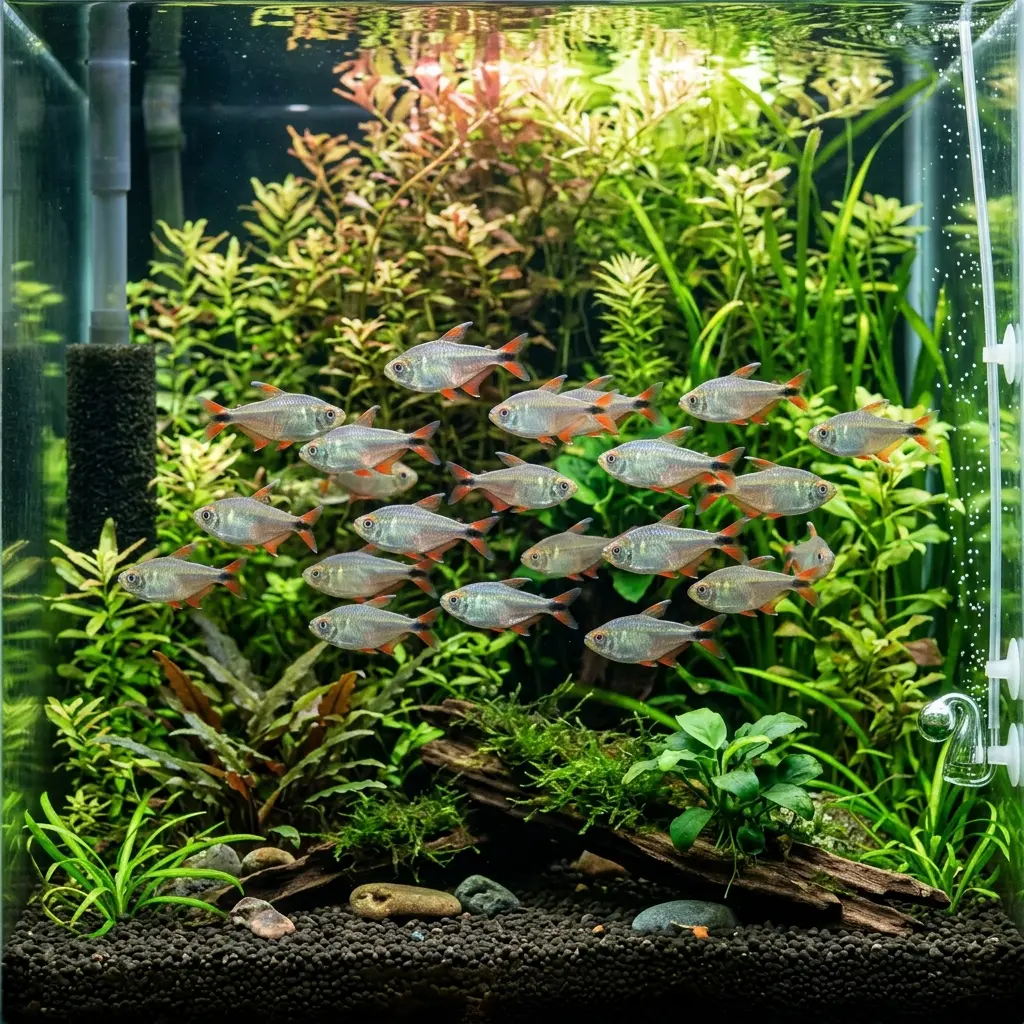
Quick Answer
Buenos Aires Tetra (Psalidodon anisitsi) is a robust, active cool-water characin from the La Plata basin of South America. It reaches 2.8 inches (7.1 cm) and requires a minimum 30 gallon (113 liter) aquarium with pH 6.0 to 8.0 and temperature 64 to 78 degrees Fahrenheit (17.8 to 25.6 degrees Celsius). Known for plant-eating behavior and fin nipping in small groups, it must be kept in schools of 8 or more with robust, fast-swimming tank mates.
Quick Facts
| Scientific Name | Psalidodon anisitsi |
|---|---|
| Common Names | Buenos Aires Tetra |
| Family | Acestrorhamphidae |
| Genus | Psalidodon |
| Type | Freshwater |
| Temperament | semi-aggressive |
| Care Difficulty | beginner |
| Lifespan | 6 years |
| Maximum Size | Up to 2.8 in (7 cm) |
| Diet | Omnivore |
| Temperature | 64–78°F (18–26°C) |
| pH | 6–8 |
| Hardness | 5–20 dGH |
| Minimum Size | 30 gallons |
Key Takeaways
- Cool-water species thriving at 68 to 74 degrees Fahrenheit; often needs no heater.
- Notorious plant eater; systematically destroys soft-leaved aquarium plants.
- Reaches 2.8 inches (7.1 cm); requires schools of 8 to 15 for natural behavior.
- Fin nipping occurs in small groups or with long-finned tank mates.
- Extremely hardy and adaptable to standard tap water without modification.
- Ideal companion for Rosy Barbs in unheated community tanks.
Overview
Taxonomy and Classification
Buenos Aires Tetra, scientifically known as Psalidodon anisitsi, belongs to the family Acestrorhamphidae, the American characins, within the order Characiformes. The species was first formally described in 1907 by the German-American ichthyologist Carl H. Eigenmann as Hemigrammus anisitsi, with the type locality given as Villarica on the Rio Tebicuary in the Guaira Department of Paraguay. A 2020 phylogenetic revision transferred the species from Hyphessobrycon to the genus Psalidodon, though many aquarium references still list it under the older name.
Synonyms include Hemigrammus anisitsi, Hyphessobrycon anisitsi, Hemigrammus caudovittatus, and Hyphessobrycon erythrurus. The common name derives from Argentina's capital city, Buenos Aires, situated on the western shore of the Rio de la Plata, though the species is not actually endemic to Buenos Aires Province. A similar-looking fish, Hyphessobrycon togoi, largely replaces it in that region. Alternative common names include Diamond Spot Characin and Red Cross Fish, referring to the black marking on the caudal peduncle and the vivid red fins respectively.
Natural Distribution and Habitat
The Buenos Aires Tetra is native to the Rio de la Plata Basin in South America, with confirmed populations in Argentina, Paraguay, Uruguay, and southeastern Brazil. It is widely distributed throughout the Parana and Paraguay river systems as well as the Uruguay watershed. The species inhabits alluvial plain environments subject to seasonal influences, including small rivers, ponds, lagoons, and artificial reservoirs. It frequents calm waters or those with low currents in floodplain areas, typically in shallow habitats with access to plant material and invertebrate prey.
In the wild, these fish are commonly found in rivers, ponds, lakes, and streams with substrates of sand, gravel, and detritus. They are strictly freshwater fish and do not tolerate brackish or polluted conditions. They swim in schools and are highly social, always remaining together with their own kind. Most specimens in the aquarium trade are now captive-bred at fish farms in Florida, though wild-caught imports still occur.
Physical Characteristics
Adult Buenos Aires Tetras reach a maximum length of 2.8 inches (7.1 cm), with some specimens approaching 3 inches (7.6 cm) under optimal conditions. The body is elongated and laterally compressed with the typical silhouette of a small characin. The base coloration is silvery with small iridescent reflections on the belly that pick up neon highlights depending on light angle. A narrow blue line extends from behind the gill cover to the tail fin, ending in a bold black diamond-shaped or cross-shaped spot on the caudal peduncle. Two smaller black humeral spots appear more contrasted on mature specimens.
The fins are the species' most striking feature. The anal, pelvic, and caudal fins are vivid orange to red, with the dorsal fin often showing a hint of red at the very tip. The top of the eye is adorned with a touch of red. Sexual dimorphism is subtle but present: females are deeper-bodied, plumper, and slightly larger, particularly when gravid, while males are slimmer and may display slightly more intense coloration. Breeders have developed color variations including yellow-tailed and albino types. Average lifespan in captivity is 5 to 7 years, with documented cases exceeding 10 years under optimal cool-water conditions.
Care
Aquarium Requirements
Buenos Aires Tetras demand more horizontal space than their small size suggests due to their active, fast-swimming nature. The absolute minimum tank size for a school of 8 to 10 individuals is 30 gallons (113 liters) with a footprint of 36 by 12 inches (90 by 30 cm). For schools of 12 to 15, provide 40 to 55 gallons (151 to 208 liters) with a length of at least 39 inches (100 cm). These fish dart from one end of the tank to the other constantly and require open swimming lanes. Tall, narrow tanks are unsuitable regardless of volume.
Filtration and Water Flow
Strong filtration with good flow is essential. Buenos Aires Tetras are active fish that produce significant waste for their size. Use a canister filter or hang-on-back filter rated for at least 6 to 8 times the tank volume per hour. Good oxygenation with surface agitation suits this active, cool-water species; a spray bar or powerhead benefits both water quality and their activity level. Avoid stagnant water, which causes lethargy and suppressed coloration.
Substrate and Hardscape
Use fine gravel or sand substrate. Buenos Aires Tetras do not dig aggressively, so substrate choice is primarily aesthetic. Dark-colored substrate enhances their silver body and red fin coloration. Provide driftwood, smooth rocks, and caves for decoration and security. Because they will eat most soft-leaved plants, hardscape becomes the primary decorative element. Arrange driftwood and rocks to create visual barriers that break line of sight, which helps reduce chasing behavior within the school.
Plant Decor
This species is notoriously incompatible with delicate planted tanks. They will systematically consume soft-leaved plants including Ludwigia, Cabomba, Cryptocoryne, Rotala, Elodea, and most stem plants. Hardy, tough-leaved species such as Java Fern, Anubias, and Amazon Sword may survive if well-established and attached to driftwood or rocks, though even these are occasionally nibbled. Floating plants such as Amazon Frogbit or Salvinia are generally safe and provide shade and security. If you require a densely planted aquascape, choose a different species entirely.
Water Parameter Stability
Buenos Aires Tetras are among the most water-chemistry-tolerant aquarium fish available. Standard tap water in most areas is perfectly suitable without modification. However, stability remains important. Sudden temperature swings greater than 5 degrees Fahrenheit (2.8 degrees Celsius) or pH shifts greater than 0.5 units induce stress. Perform weekly water changes of 25 percent to maintain nitrates below 20 ppm. Their robustness means minor lapses are tolerated, but consistent maintenance produces the best color and health.
Diet
Dietary Requirements
Buenos Aires Tetras are opportunistic omnivores with a notably strong appetite for plant matter. In the wild, their diet consists of worms, insects, small crustaceans, zooplankton, plant material, and organic detritus. In captivity, they accept virtually any aquarium food offered, but a balanced diet is essential for vibrant coloration, proper growth, and reduction of plant predation in the aquarium.
Staple Foods
Provide high-quality tropical flakes or small sinking pellets as the dietary foundation. Select products with visible vegetable or spirulina content. Feed 1 to 2 times daily, offering only what the fish can consume in 2 to 3 minutes. They are enthusiastic, fast feeders that compete aggressively for food at the surface, so ensure food is distributed across the tank to prevent dominant individuals from monopolizing it.
Supplemental Foods
Supplement with frozen foods including bloodworms, brine shrimp, and daphnia twice weekly. These protein sources enhance the red fin coloration and support breeding condition. Live foods such as mosquito larvae, daphnia, and baby brine shrimp stimulate natural hunting behavior and are particularly effective for conditioning breeders. Vegetable matter is critical for this species. Offer blanched zucchini, spinach, lettuce, cucumber, and nori sheets at least 3 times per week. Providing vegetable matter in the diet may slightly reduce plant predation in the aquarium, though it will not eliminate it entirely.
Feeding Behavior and Competition
These fish are bold, aggressive feeders at the surface. In community tanks, they may outcompete slower or more timid species for floating flakes. Use sinking pellets in addition to flakes to ensure all tank inhabitants receive nutrition. Their constant activity means they have high metabolic demands relative to their size. Underfed Buenos Aires Tetras are significantly more likely to nip fins and consume aquarium plants.
Prohibited Foods
Never feed beef heart, pork, or other mammalian proteins. Characins lack the digestive enzymes to process mammalian fats, leading to fatty liver degeneration. Avoid dried foods past their expiration date, as vitamin degradation causes deficiency disorders within weeks. Do not rely exclusively on flake foods; the lack of vegetable fiber increases plant predation and reduces digestive health.
Health
General Health and Immunity
Buenos Aires Tetras are remarkably hardy and resistant to most common aquarium diseases when maintained in clean, stable water. Their cool-water tolerance actually provides an advantage, as many parasites and pathogens proliferate more rapidly in warmer water. However, they are not immune to disease, and their active nature means injuries from chasing or fin nipping can become entry points for bacterial infections. All new specimens must undergo a 14-day quarantine in a bare-bottom hospital tank with sponge filtration.
Quarantine Protocol
Quarantine all new fish for 14 days minimum. Perform a 7-day treatment with methylene blue at 2 mg per liter to eliminate external protozoans and fungal spores. Observe for intestinal worms; treat with praziquantel if white segments are visible in feces. Buenos Aires Tetras tolerate standard medications well, but always verify water parameters in the quarantine tank match the display tank to prevent shock during transfer.
Ich (White Spot Disease)
A protozoan infection caused by Ichthyophthirius multifiliis, characterized by white cysts on fins and body.
- Small white salt-like granules on fins, body, and gills; rubbing against decor; rapid breathing; clamped fins; flashing against substrate.
Introduced via infected fish or plants; triggered by temperature fluctuations or stress from poor water quality, small school size, or incompatible tank mates.
Quarantine all new arrivals for 14 days. Maintain stable temperature between 68 and 74 degrees Fahrenheit. Ensure robust filtration and weekly water changes. Keep schools of 8 or more to reduce stress.
Velvet (Gold Dust Disease)
A parasitic infection caused by Piscinoodinium or related dinoflagellates, presenting as a fine yellow-gold dust on the body.
- Yellowish gold or rust-colored dusting on body and fins; scratching against substrate; lethargy; rapid gill movement; difficulty breathing; clamped fins; loss of appetite.
Introduced via new fish or contaminated equipment; exacerbated by poor water quality, low oxygen, and stress from bright lighting or inadequate school size.
Quarantine new fish. Maintain excellent water quality with nitrates below 20 ppm. Provide adequate surface agitation and aeration. Use moderate lighting with floating plants to reduce stress. Keep proper school sizes.
Fin Rot and Tail Rot
A bacterial infection typically caused by Aeromonas, Pseudomonas, or Flexibacter species, attacking the fin rays and tail tissue.
- Frayed or ragged fin edges; white or blackened fin margins; receding fin tissue; red streaks at fin base in advanced cases; lethargy; loss of appetite.
Poor water quality with elevated nitrates or ammonia; fin nipping from territorial disputes within the school or from incompatible tank mates; injury during chasing; stress from inadequate group size.
Maintain weekly 25 percent water changes. Keep schools of 8 or more to disperse aggression. Avoid long-finned tank mates that trigger nipping. Provide adequate swimming space to reduce intraspecific chasing.
Columnaris (Mouth Fungus)
A bacterial infection caused by Flavobacterium columnare, often mistaken for fungal growth due to its cottony appearance.
- White or grayish cotton-like patches on mouth, fins, or body; frayed fins; ulcers on body; rapid breathing; loss of appetite; clamped fins; lethargy.
High organic load from overfeeding; overcrowding; temperature spikes above 78 degrees Fahrenheit; stress from transport or poor acclimation.
Avoid overfeeding and remove uneaten food after 3 minutes. Maintain robust filtration. Perform regular gravel vacuuming to remove organic waste. Keep temperature stable between 65 and 74 degrees Fahrenheit.
Dropsy (Bloat)
A symptom of severe internal fluid accumulation caused by kidney failure, bacterial infection, or internal parasites, not a specific disease itself.
- Severely bloated, pinecone-like appearance with scales protruding; sunken eyes; loss of appetite; lethargy; clamped fins; difficulty swimming; floating at surface or resting on bottom.
Poor water quality with high nitrates or ammonia; internal bacterial infection; intestinal parasites; kidney failure from chronic stress or old age; sudden temperature fluctuations.
Maintain pristine water quality with weekly 25 percent water changes. Quarantine new fish for 14 days. Feed a varied, high-quality diet. Avoid sudden parameter changes. Treat internal parasites prophylactically during quarantine.
Internal Parasites (Hexamita and Nematodes)
Intestinal parasitic infections common in farm-raised or poorly quarantined specimens, leading to malnutrition and wasting.
- Wasting despite normal appetite; stringy white feces; bloated or sunken abdomen; lethargy; faded coloration; flashing against substrate.
Introduction via infected live foods or new fish; poor quarantine protocols; overcrowded farm conditions facilitating parasite transmission; feeding untreated tubifex or bloodworms.
Quarantine all new specimens for 14 days minimum. Avoid feeding untreated live tubifex from questionable sources. Treat prophylactically with praziquantel during quarantine. Use frozen rather than live foods from unknown origins.
Breeding
Captive Breeding Overview
Breeding Buenos Aires Tetras is considered easy among egg-scattering characins and serves as an excellent introduction to breeding aquarium fish. They are prolific spawners with no parental care, meaning the aquarist must intervene to protect eggs and fry from predation. Their willingness to breed in captivity, combined with the large number of eggs produced, makes them rewarding for hobbyists interested in observing the complete reproductive cycle.
Pair Formation and Conditioning
Select 10 to 12 mature fish at least 1 year old. Sexing is subtle; choose slimmer, more intensely colored individuals as males and deeper-bodied, fuller fish as females. Condition the group with live blackworms, spirulina flakes, high-quality granules, and baby brine shrimp for 2 weeks. Gradually increase the water temperature by 3 degrees Fahrenheit (1.7 degrees Celsius) over 3 days to simulate seasonal warming, which stimulates gonadal development.
Breeding Tank Setup
Set up a dedicated 20 gallon (75 liter) breeding tank with 5 inches (12.7 cm) of water depth to concentrate the fish and make egg collection easier. Use a sponge filter with gentle flow to avoid sucking up eggs. Provide a spawning mop, fine-leaved plants such as Java moss, or a substrate of glass marbles or a mesh bottom that allows eggs to fall out of reach of the adults. Maintain pH at 6.8, dGH at 6, and temperature at 75 degrees Fahrenheit (24 degrees Celsius). Dim lighting reduces stress and encourages spawning.
Spawning Behavior
Simulate dawn over 30 minutes using a dimmer switch or gradual timer. Spawning occurs in the early morning hours, typically within the first 2 hours of light. Males chase females vigorously, driving them into the plants or spawning mop. The female scatters 500 to 1,000 small adhesive eggs among the fine-leaved vegetation or substrate. Males fertilize the eggs simultaneously. The spawning event may last 1 to 2 hours with multiple females releasing eggs. Once spawning activity ceases, remove all adults immediately, as they will consume every egg and fry they can find.
Egg and Fry Development
Eggs hatch in 20 to 24 hours at 75 degrees Fahrenheit (24 degrees Celsius). The fry are extremely small, measuring approximately 0.08 inches (2 mm) at hatching. They absorb their yolk sacs over the first 24 to 36 hours. Begin feeding infusoria, paramecium, or commercially available liquid fry food 3 to 4 times daily for the first 3 days. After day 3, transition to microworms and vinegar eels. Introduce baby brine shrimp nauplii after day 7, by which time the fry are large enough to accept them. Raise the fry in dim lighting for the first 5 days to reduce stress and prevent developmental issues. Perform small daily water changes of 10 percent to maintain pristine water quality without shocking the delicate fry.
Grow-Out
By 3 weeks, the fry reach 0.25 inches (6 mm) and display the characteristic silver body with faint red fin coloration. By 8 weeks, they reach 0.75 inches (1.9 cm) and begin showing the black caudal peduncle spot. By 6 months, juveniles reach 1.5 inches (3.8 cm) and are sexually mature. Sort fry by size weekly to prevent larger individuals from outcompeting smaller siblings for food.
Tips
Expert Tips for Long-Term Success
Cool Water is Critical
The single most important factor for Buenos Aires Tetra health and longevity is temperature. These are not tropical fish. Keeping them at 78 degrees Fahrenheit (25.6 degrees Celsius) or above shortens their lifespan significantly, causes color loss, and increases aggression. They thrive at 68 to 74 degrees Fahrenheit (20 to 23.3 degrees Celsius). In most temperate homes, an unheated aquarium at room temperature is perfect. This makes them one of the most energy-efficient and low-maintenance schooling fish available.
School Size Determines Behavior
A group of 5 Buenos Aires Tetras is a fin-nipping menace. A group of 15 is a beautiful, coordinated, relatively peaceful school. The difference is dramatic. If you cannot accommodate at least 8 to 10 individuals in a tank of 30 gallons (113 liters) or more, do not purchase this species. Their social behavior and aggression levels transform completely in proper numbers.
Do Not Trust Them with Plants
Do not attempt to keep Buenos Aires Tetras in a carefully aquascaped planted tank. They will eat your Ludwigia, Cabomba, Cryptocoryne, Rotala, and Elodea. They may leave Java Fern and Anubias alone if well-fed with vegetables, but there are no guarantees. Accept that this is a fish for hardscape-focused tanks, or choose a different species. Many aquarists deliberately add them to overgrown tanks as biological pruning tools before rehoming them.
Rosy Barbs Are the Perfect Companion
For a stunning cool-water community display, pair Buenos Aires Tetras with Rosy Barbs. Both species share identical temperature preferences, similar size, comparable activity levels, and complementary red coloration. In a 55 gallon (208 liter) unheated tank, a school of 10 Buenos Aires Tetras, 8 to 10 Rosy Barbs, and 8 Peppered Corydoras creates a dynamic, colorful, low-maintenance community that requires no heater in most homes.
Feed Vegetables Religiously
Blanched vegetables are not a treat for this species; they are a dietary necessity. Offer zucchini, spinach, lettuce, or nori sheets at least 3 times per week. This satisfies their natural plant-eating drive, improves digestive health, enhances coloration, and reduces though does not eliminate their predation on aquarium plants. Fish fed adequate vegetable matter display more intense red fins and calmer behavior.
Secure the Lid
Buenos Aires Tetras are active jumpers when startled, particularly during water changes or when the lights switch on abruptly. A tight-fitting lid prevents escape and reduces stress from overhead movement. Use a glass canopy rather than a feeding-hood-only cover, as these fish can launch with surprising force.
Compatible Tank Mates






Species Comparison
| Feature | Buenos Aires Tetra | Cardinal Tetra | Serpae Tetra | Rosy Barb |
|---|---|---|---|---|
| Maximum Size | 2.8 inches (7.1 cm) | 2 inches (5 cm) | 1.75 inches (4.5 cm) | 3 inches (7.6 cm) |
| Temperament | Semi-aggressive; boisterous; fin nipper in small groups | Peaceful; strictly schooling | Semi-aggressive; notorious fin nipper | Peaceful; active; may nip in small groups |
| Minimum Tank Size | 30 gallons (113 L) for 8 to 10 fish | 20 gallons (75 L) | 20 gallons (75 L) | 30 gallons (113 L) for 6 to 8 fish |
| Diet | Omnivore; strong plant-eating tendency | Omnivore; microfoods, flakes, frozen | Omnivore; flakes, frozen, live foods | Omnivore; vegetables, flakes, frozen |
| Temperature Range | 64 to 78 degrees Fahrenheit (17.8 to 25.6 degrees Celsius); cool water | 74 to 82 degrees Fahrenheit (23.3 to 27.8 degrees Celsius); tropical | 72 to 82 degrees Fahrenheit (22.2 to 27.8 degrees Celsius); tropical | 64 to 78 degrees Fahrenheit (17.8 to 25.6 degrees Celsius); cool water |
| Plant Compatibility | Poor; eats soft-leaved plants systematically | Excellent; safe with all plants | Good; may nibble but does not destroy plants | Moderate; may nibble soft plants |