
Rainbow Shark (Epalzeorhynchos frenatum)
Quick Answer
The Rainbow Shark (Epalzeorhynchos frenatum) is a semi-aggressive, territorial bottom-dwelling cyprinid native to Thailand. It reaches 6 inches (15 cm) and requires a minimum 55-gallon (208 liter) tank. Only one shark per aquarium is permitted due to lethal conspecific aggression. Water parameters: pH 6.5-7.5, temperature 72°F-79°F (22°C-26°C). Omnivorous grazer requiring algae, vegetables, and protein. Must be added last to established community tanks.
Quick Facts
| Scientific Name | Epalzeorhynchos frenatum |
|---|---|
| Common Names | Rainbow Shark |
| Family | Cyprinidae |
| Genus | Epalzeorhynchos |
| Type | Freshwater |
| Temperament | semi-aggressive |
| Care Difficulty | intermediate |
| Lifespan | 6 years |
| Maximum Size | Up to 6 in (15 cm) |
| Diet | Omnivore |
| Temperature | 72–79°F (22–26°C) |
| pH | 6.5–7.5 |
| Hardness | 5–15 dGH |
| Minimum Size | 55 gallons |
Key Takeaways
- One Rainbow Shark per tank only; conspecifics will fight to the death
- Minimum 55 gallons (208 L) for adults; 75+ gallons strongly recommended for communities
- Must be added LAST to established tanks to minimize territorial aggression
- Fast mid-water tank mates required; avoid all bottom-dwellers except Bristlenose Plecos
- Never house with Red Tail Sharks, Bala Sharks, or Flying Foxes
- Scaleless fish with medication sensitivity; avoid formalin and high salt concentrations
- Notorious jumpers; tight-fitting lid with no gaps is mandatory equipment
- Color fades naturally with age beyond 3-4 years; maximize longevity with pristine water
Overview
Species Overview
The Rainbow Shark (Epalzeorhynchos frenatum) is a striking freshwater cyprinid native to the river basins of Thailand, including the Mekong, Chao Phraya, and Mae Klong systems. Despite its common name, it is not a true shark (order Selachimorpha) but a member of the carp family Cyprinidae. Its common name derives from the prominent triangular dorsal fin and streamlined body shape that superficially resembles a marine shark silhouette. First described by Fowler in 1934, this species has been a staple of the aquarium trade since the 1970s.
Taxonomy and Classification
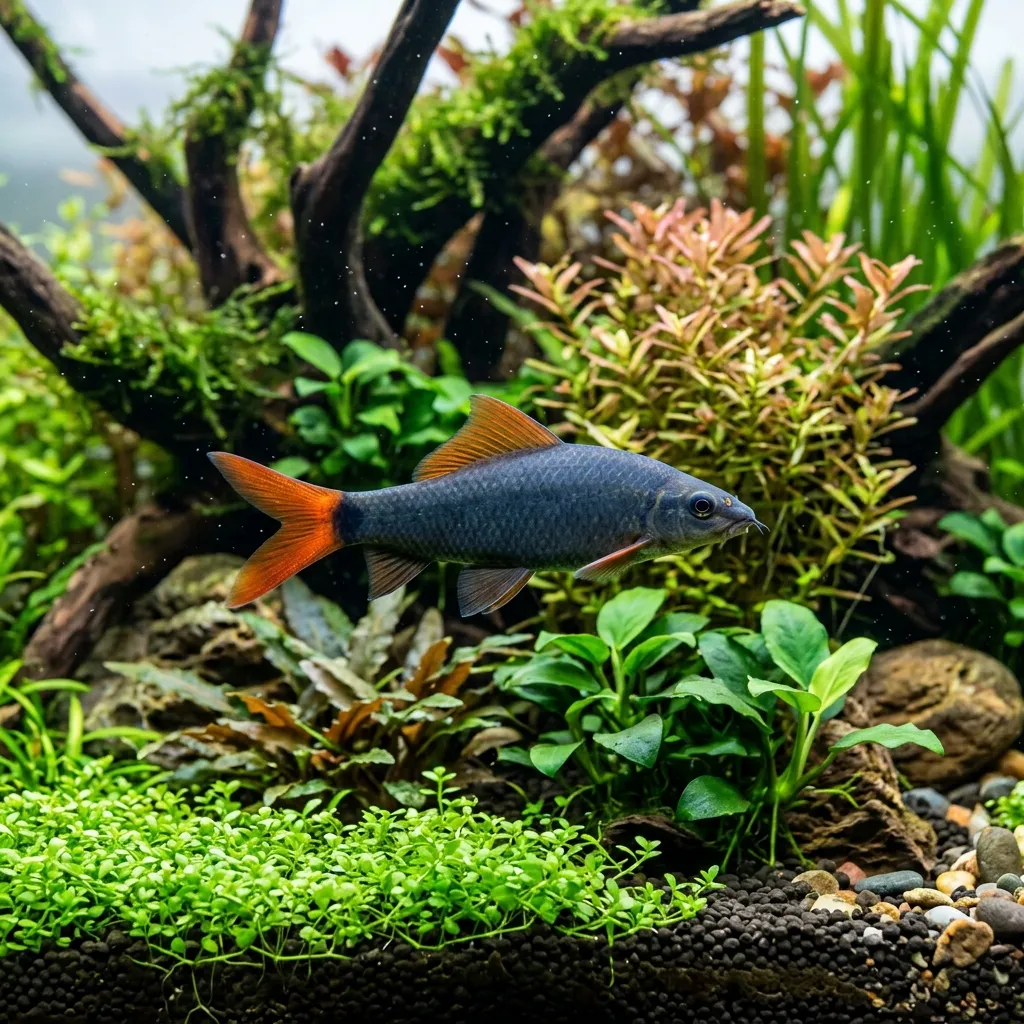
Epalzeorhynchos frenatum belongs to the genus Epalzeorhynchos within the family Cyprinidae (order Cypriniformes). The genus contains only two widely traded species: the Rainbow Shark and the Red Tail Shark (E. bicolor). These two species are frequently confused at the retail level, but the Rainbow Shark displays red-orange coloration on all fins, while the Red Tail Shark has red coloration restricted to the caudal fin. An albino variant of the Rainbow Shark exists with a milky-white body and red fins, and GloFish genetically modified variants are also available in the trade.
Physical Characteristics
Rainbow Sharks possess an elongated, slightly laterally compressed body with a flat ventral surface adapted for bottom-dwelling. They reach a maximum length of 6 inches (15 cm) in aquarium conditions, with some exceptional specimens approaching 7 inches (18 cm). The body coloration is a deep gunmetal gray to charcoal black, providing dramatic contrast against the brilliantly colored fins. All fins—dorsal, pectoral, pelvic, anal, and caudal—display vivid red to orange-red coloration. Males tend to have a more slender profile with slightly darker fin margins, while females develop a thicker, fuller body, particularly when gravid. Juveniles under 2 inches (5 cm) appear pale and washed-out, with color intensifying significantly as they mature and establish territory.
Natural Habitat
Wild populations inhabit warm, moderately flowing freshwater rivers and streams with sandy or rocky substrates across central and western Thailand. Their natural environment features abundant submerged wood, rock piles, and root systems that provide territorial boundaries and grazing surfaces. The water is typically clear to slightly turbid with moderate current and high dissolved oxygen. Seasonal monsoon flooding expands their range into flooded forests and agricultural areas, exposing them to wide parameter fluctuations that contribute to their hardiness in captivity.
Conservation and Trade
The IUCN has not evaluated Epalzeorhynchos frenatum for conservation status. The species is abundant in its native range and faces no major population threats. All specimens in the aquarium trade are commercially bred, primarily in Southeast Asian fish farms. The species is not collected from the wild for the ornamental trade in significant numbers. Albino and GloFish variants are produced through selective breeding and genetic modification respectively.
Care
Housing and Environmental Requirements
Tank Size and Dimensions
A single adult Rainbow Shark requires a minimum 55-gallon (208 liter) aquarium with a footprint of at least 48x15 inches (120x38 cm). The 30-gallon (113 liter) figure sometimes cited is only acceptable for a juvenile under 2.5 inches (6 cm) during a brief grow-out period. Housing an adult Rainbow Shark in a tank smaller than 55 gallons is one of the most common and destructive mistakes in freshwater aquaculture. In inadequate space, their territorial instincts escalate into chronic aggression, stress, and premature death. The critical dimension is horizontal length, not height. A standard 55-gallon long tank (48x13x21 inches / 122x33x53 cm) is the absolute minimum. A 75-gallon (284 liter) tank is strongly recommended for community setups, as the additional width provides essential territory buffer. For mixed-species communities with active schools, 75-100 gallons (284-378 liters) is the responsible starting point.
Filtration and Water Flow
Rainbow Sharks originate from moderately flowing rivers and appreciate gentle to moderate water current. Use a canister filter or hang-on-back filter rated for at least 1.5x the tank volume, providing 8-10x turnover per hour. They position themselves in current lanes and appreciate oxygen-rich water. Ensure the filter outflow does not create turbulent surface conditions that prevent their surface-breathing behavior. Air stones or bubble wands provide supplementary oxygenation that supports their active metabolism. In tanks with heavy planting or large schools, increase filtration capacity to maintain nitrates below 15 ppm.
Substrate and Hardscape
Use smooth sand or fine rounded gravel substrate to prevent abrasion of their ventral surface. Rainbow Sharks constantly patrol and occasionally dig in the substrate while foraging. Hardscape is absolutely critical: provide multiple caves, rock piles, driftwood tunnels, and PVC pipe shelters distributed across the entire bottom area. Each cave should have only one entrance to prevent the shark from being trapped. Territorial boundaries must be clearly defined with visual barriers; dense plant borders, tall driftwood pieces, and stacked rock walls break lines of sight and create distinct zones. Without adequate hardscape, the shark claims the entire tank bottom as a single territory and harasses everything that enters.
Plant Recommendations
Provide dense planting along the sides and rear of the aquarium while leaving a central open swimming lane. Use robust species such as java fern, anubias, cryptoryne, and vallisneria attached to hardscape. Stem plants including hornwort, water sprite, and elodea create floating canopies that diffuse light and provide surface security. Avoid delicate carpeting plants that the shark may uproot during digging. Plants serve dual purposes: they create visual barriers that reduce territorial aggression and absorb nitrates to maintain the pristine water quality this species demands.
Cover and Security
Rainbow Sharks are capable jumpers and will clear the water surface when startled, during water changes, or when chased by tank mates. You must install a tight-fitting lid with no gaps exceeding 0.25 inches (0.6 cm). Check filter cutouts, cable entry points, and feeding hatches for escape routes. Jumping is most common during the first 48 hours after introduction and during aggressive encounters with tank mates. A secure lid is mandatory equipment, not an optional accessory.
Diet
Feeding and Nutritional Requirements
Dietary Composition
Rainbow Sharks are omnivorous bottom-dwelling grazers with a strong herbivorous bias. Their natural diet consists primarily of algae, biofilm, periphyton, and detritus scraped from rock and wood surfaces, supplemented with insect larvae, small crustaceans, and organic debris. In captivity, you must provide a diet comprising approximately 40% protein, 10% fat, and 50% plant matter and algae. This balance supports their active metabolism, maintains coloration, and prevents the digestive disorders common in protein-heavy feeding regimens.
Staple Foods
Feed sinking algae wafers, spirulina-based pellets, and high-quality omnivore granules as the dietary base. These should be offered daily in amounts consumed within 2-3 minutes. Their sucker-like mouth is adapted for scraping food from surfaces, not capturing floating items from the water column. Place wafers directly on the substrate or against the glass where the shark can graze naturally. Select products containing spirulina, kelp, and vegetable matter as primary ingredients.
Protein Supplements
Rotate frozen or live foods including bloodworms, brine shrimp, daphnia, and mysis shrimp 3-4 times weekly. These provide essential amino acids for growth and color maintenance. Live blackworms are excellent for conditioning but must be sourced from reliable suppliers to avoid parasite transmission. Avoid tubifex worms due to contamination risk. Protein foods should be offered in moderation; excessive protein causes constipation and fatty liver disease in their herbivore-adapted digestive system.
Vegetable Matter
Plant fiber is non-negotiable for long-term health. Offer blanched zucchini, cucumber, spinach, peas, or lettuce twice weekly. These provide essential fiber, prevent constipation, and supply carotenoids for fin coloration. You must never feed beef heart, mammalian meat, or bread products; cyprinids lack the digestive enzymes to process these materials, leading to fatty liver disease and organ failure. Vegetable matter should constitute the majority of their intake.
Feeding Behavior and Competition
Rainbow Sharks are aggressive feeders that will outcompete slower bottom-dwellers during feeding. Target feed by placing their food near their established cave or territory to minimize conflict. In community tanks, ensure mid-water and surface feeders receive adequate nutrition by using feeding rings or target feeding at different tank levels. Their constant grazing on biofilm and algae makes them useful algae consumers, though they will not eliminate established algae outbreaks.
Health
Health Management and Disease Prevention
Rainbow Sharks are generally hardy in well-maintained aquariums but exhibit specific vulnerabilities related to their reduced scale coverage, territorial stress, and commercial breeding origins. Their active metabolism and bottom-dwelling habit mean they are exposed to substrate-borne pathogens and detritus accumulation. Quarantine all new specimens for a minimum of 14 days before introduction to the display tank. Maintain pristine water quality with weekly 25% water changes and nitrates below 15 ppm.
General Health Maintenance
Monitor for early warning signs including faded coloration, reduced patrolling activity, hiding behavior, or loss of appetite. Rainbow Sharks are stoic and will mask illness until advanced stages; behavioral changes are your primary diagnostic tool. Ensure dissolved oxygen remains high through surface agitation and filtration. Temperatures above 80°F (26.5°C) increase metabolic stress and aggression. During quarantine, treat prophylactically for external parasites and observe for intestinal worm infections common in farm-raised cyprinids.
Ichthyophthirius multifiliis (Ich / White Spot Disease)
A protozoan parasite causing white cysts on skin, fins, and gills. Common in commercially bred specimens stressed during shipping and acclimation.
- White salt-like spots across body and fins, flashing against substrate, labored breathing, clamped fins, reduced territorial patrolling
Stress from shipping and poor acclimation, temperature fluctuations, introduction of infected tank mates, immunosuppression from territorial stress
Quarantine all new specimens for 14 days; treat with Seachem Cupramine (copper-based) at 0.15-0.20 mg/L safe for reduced-scale fish; raise temperature gradually to 80°F (26.5°C) for 4 days to accelerate parasite life cycle; perform daily 25% water changes during treatment; maintain stable parameters
Bacterial Fin Rot (Aeromonas / Pseudomonas / Flavobacterium infection)
Bacterial degradation of fin tissue, frequently secondary to minor damage from territorial chasing, digging, or rough substrate.
- Frayed or receding fin edges, white or red inflamed margins, lethargy, loss of appetite, fins appearing shorter than normal, reluctance to patrol territory
Fin damage from territorial chasing or digging in rough substrate, elevated nitrates above 20 ppm, ammonia or nitrite spikes, inadequate water change frequency
Maintain nitrates below 15 ppm with weekly water changes; use smooth sand substrate to prevent abrasion; treat with broad-spectrum antibiotics such as erythromycin, kanamycin, or Seachem KanaPlex in hospital tank; add 1 teaspoon aquarium salt per gallon to support osmoregulation; remove carbon during medication
Dropsy (Ascites / Bacterial Septicemia)
Clinical manifestation of severe internal bacterial infection causing fluid accumulation. Advanced and difficult to treat in Rainbow Sharks.
- Severe abdominal distension, raised scales giving pinecone appearance, popeye (exophthalmia), lethargy, loss of equilibrium, pale body coloration, faded fin color
Chronic poor water quality with elevated nitrates, internal bacterial infection by Aeromonas or Pseudomonas species, immunosuppression from chronic territorial stress or inadequate diet
Epsom salt baths at 1-2 teaspoons per 10 gallons to reduce fluid retention; treat with broad-spectrum antibiotics such as kanamycin or oxytetracycline in medicated food; prognosis is guarded; euthanasia is often the most humane option for advanced cases using clove oil
Internal Parasites (Nematodes / Trematodes / Cestodes)
Common in commercially farm-raised cyprinids. Camallanus worms, intestinal flukes, and tapeworms frequently infect Rainbow Sharks from mass-production facilities.
- Wasting despite normal appetite, stringy or white feces, bloated abdomen, lethargy, reduced color intensity, visible red worms protruding from vent (camallanus), scratching against objects
Introduction via farm-raised stock, contaminated live food, poor quarantine protocols, accumulation of organic detritus in substrate
Quarantine all new specimens for 14 days minimum; treat prophylactically with Praziquantel for flukes and tapeworms; use levamisole at 2 ppm for 24 hours if camallanus worms are visible; feed medicated food containing metronidazole for flagellates; vacuum substrate thoroughly during water changes; avoid tubifex worms from unreliable sources
Velvet Disease (Piscinoodinium pillulare)
A parasitic dinoflagellate infection resembling ich but with much smaller gold-dust cysts. Highly contagious and photosynthetic. Common in stressed new arrivals.
- Fine gold or rust-colored dusting on skin and fins, scratching against rocks and substrate, clamped fins, rapid breathing, lethargy, refusal to eat, hanging near filter outflows
Introduction via infected farm-raised stock, stress from shipping and poor acclimation, the parasite utilizes photosynthesis making lighted tanks more susceptible, inadequate quarantine
Darken the tank completely for 48 hours to inhibit parasite photosynthesis; treat with copper sulfate at 0.15-0.20 mg/L for 10-14 days; increase aeration during treatment; quarantine all new specimens for 14 days; maintain pristine water quality to reduce stress
Breeding
Captive Breeding Protocol
Realistic Expectations
Breeding Rainbow Sharks in home aquariums is not a realistic goal for hobbyists. All specimens in the aquarium trade are produced commercially using hormonal stimulation techniques that are not available to home aquarists. The species is an egg-scattering free spawner with no parental care, and successful natural spawning in captivity is virtually undocumented outside of professional breeding facilities. The following protocol is provided for informational purposes and advanced experimental attempts only.
Broodstock Selection
Sexing Rainbow Sharks is difficult and unreliable in juveniles. Mature females develop a noticeably thicker, fuller body profile, particularly when gravid, while males remain more slender with slightly darker fin margins. Select fish aged 18-24 months with a minimum size of 4 inches (10 cm). Condition a group of 4-5 individuals with high-protein foods including live blackworms, bloodworms, krill, and quality granules for 4 weeks. Feed three times daily to bring females into reproductive condition.
Spawning Tank Setup
Configure a dedicated 75-gallon (284 liter) breeding aquarium with multiple PVC pipes, smooth flat stones, and dense plant borders. Set parameters to pH 7.0, dGH 8, and temperature 76°F (24.5°C). Use a high-capacity canister filter with spray bar to provide moderate current. The substrate should be smooth sand. Provide multiple caves with single entrances to serve as potential spawning sites and territorial boundaries.
Spawning Trigger
Simulate the onset of the rainy season by lowering the tank temperature to 68°F (20°C) over 24 hours. Perform a 50% water change with cool reverse-osmosis water dripped slowly over 6 hours. Increase water flow by 50% and add additional aeration. These combined stimuli—temperature drop, conductivity reduction, and flow increase—mimic the monsoon conditions that trigger natural spawning in their native Thai river systems.
Spawning Behavior and Egg Management
If spawning occurs, it typically happens in the early morning. The female scatters 1,000-3,000 adhesive eggs among hardscape, plant leaves, and substrate. The male may attempt to fertilize eggs as they are released, but no parental care follows. You must remove all adults immediately after spawning is complete, as they will consume every egg within hours. Eggs hatch in 24-36 hours at 75°F (24°C).
Fry Rearing
Newly hatched fry are extremely small and require green water (suspensions of single-celled algae) or infusoria for the first 5 days. Transition to microworms and powdered fry food from day 5-7, then newly hatched brine shrimp nauplii by day 10. Perform daily 10% water changes with aged, temperature-matched water. Grow-out tanks require pristine water quality, gentle filtration, and abundant hiding places. Mortality rates in home-reared fry are extremely high. Sexual maturity is reached at 12-18 months under optimal conditions.
Tips
Expert Tips and Common Mistakes
Critical Success Factors
- One Per Tank is Absolute: This cannot be overstated. Two Rainbow Sharks will fight to the death. One shark with one Red Tail Shark will also fight to the death. No tank size resolves this. One shark per tank, period.
- Add the Shark LAST: This is the single most effective aggression-reduction technique. Adding the shark to an established community forces it to navigate around existing residents rather than defending fresh territory. The difference in behavior is dramatic.
- Tank Size is Territory: A 55-gallon tank is the survival minimum. A 75-gallon tank produces measurably calmer behavior. A 100-gallon tank allows genuine community integration. The shark's territory scales with tank size.
- Hardscape Defines Boundaries: Without caves, rocks, and visual barriers, the shark claims the entire bottom. With adequate hardscape, it claims a specific zone and ignores the rest. Territory definition is the aquascaper's most powerful tool.
Common Mistakes to Avoid
- Undersized Tanks: Housing an adult Rainbow Shark in a 20, 30, or 40-gallon tank is a guaranteed failure. The fish will become a relentless bully, and tank mates will die from stress. Plan for the adult size from day one.
- Adding the Shark First: When added first, the shark claims every inch of bottom space as its own. Every subsequent fish is treated as an invader. This creates a permanent stress environment that no amount of aquascaping can fix.
- Bottom-Dwelling Tank Mates: Corydoras, loaches, dwarf cichlids, and other bottom-dwellers will be harassed continuously. The shark does not share the substrate. Choose mid-water and upper-water species exclusively, with the exception of Bristlenose Plecos.
- Similar-Shaped Fish: Red Tail Sharks, Bala Sharks, Flying Foxes, and even some loaches trigger maximum aggression due to body shape similarity. The shark's territorial response is visually mediated.
- Skipping the Lid: Rainbow Sharks are powerful jumpers. Open-top tanks result in dried specimens on the floor. Secure lids are mandatory, not optional.
- Overfeeding Protein: Diets lacking algae and vegetable matter cause constipation, fatty liver, and faded coloration. Their digestive system is adapted for high plant fiber intake.
Advanced Techniques
- Territory Target Feeding: Place the shark's food directly at the entrance of its cave or preferred territory. This anchors the shark to its zone during feeding and reduces the area it patrols aggressively.
- Seasonal Parameter Cycling: Simulating natural seasonal temperature variations of 74°F-79°F (23°C-26°C) over the year stimulates more natural behavior and can reduce chronic stress in long-term captivity.
- Dark Environment Enhancement: Black substrate, dark backgrounds, and dimmed perimeter lighting reduce skittishness and enhance the contrast of their red fins. Bright environments wash out their color and increase stress.
- Mirror Therapy Caution: Some aquarists use mirrors to stimulate territorial display. While this can intensify coloration temporarily, prolonged mirror exposure causes chronic stress and is not recommended.
Compatible Tank Mates






Species Comparison
| Feature | Rainbow Shark | Red Tail Shark | Bala Shark | Roseline Shark |
|---|---|---|---|---|
| Scientific Name | Epalzeorhynchos frenatum | Epalzeorhynchos bicolor | Balantiocheilos melanopterus | Sahyadria denisonii |
| Adult Size | Up to 6 inches (15 cm) | Up to 6 inches (15 cm) | Up to 14 inches (35 cm) | Up to 6 inches (15 cm) |
| Temperament | Semi-aggressive / Territorial | Aggressive / Highly Territorial | Peaceful / Skittish | Peaceful / Active |
| Minimum Tank Size | 55 gallons (208 L) for one adult | 55 gallons (208 L) for one adult | 125 gallons (473 L) for adult group | 55 gallons (208 L) for school |
| Social Behavior | Solitary; one per tank only | Solitary; one per tank only | Schooling; groups of 5+ required | Schooling; groups of 6+ required |
| Coloration | Dark gray body; all fins red-orange | Jet black body; tail fin only red | Silver body; black-edged fins | Silver body; red and black lateral stripes |
| Special Notes | Less aggressive than Red Tail; loses color with age | Extremely territorial; most aggressive freshwater shark | Grows very large; not suitable for most home tanks | Peaceful; endangered in wild; captive bred only |