
Denison Barb (Sahyadria denisonii)
Quick Answer
Denison Barb (Sahyadria denisonii), also known as Roseline Shark, Red Line Torpedo Barb, or Miss Kerala, is a fast-swimming, colorful barb endemic to the Western Ghats of India. It requires a minimum 55-gallon (208 liter) long aquarium with strong water flow (4-5x turnover), cool water temperatures of 60-77 degrees Fahrenheit (15-25 degrees Celsius), and a school of at least 6-8 individuals. Listed as Endangered by the IUCN due to overcollection, only captive-bred specimens should be purchased.
Quick Facts
| Scientific Name | Sahyadria denisonii |
|---|---|
| Common Names | Denison Barb |
| Family | Cyprinidae |
| Genus | Sahyadria |
| Type | Freshwater |
| Temperament | peaceful |
| Care Difficulty | intermediate |
| Lifespan | 8 years |
| Maximum Size | Up to 6 in (15 cm) |
| Diet | Omnivore |
| Temperature | 60–77°F (16–25°C) |
| pH | 6.5–7.8 |
| Hardness | 5–25 dGH |
| Minimum Size | 55 gallons |
Key Takeaways
- Endemic to Western Ghats, India; listed as Endangered on the IUCN Red List.
- Requires cool subtropical water: 60-77 degrees Fahrenheit (15-25 degrees Celsius); not a tropical fish.
- Minimum 55-gallon (208 L) tank; 75+ gallons (284+ L) strongly recommended with 48+ inch length.
- School of 6-8 minimum; 10+ for optimal coloration and natural behavior.
- Requires strong water flow: 4-5x turnover per hour with surface agitation.
- Omnivore; feed sinking pellets, flakes, and frozen foods with carotenoid supplementation.
- Only purchase captive-bred specimens; wild collection has driven populations to endangered status.
- Maximum size 4-6 inches (10-15 cm); sexually dimorphic with females slightly larger.
Overview
The Denison Barb (Sahyadria denisonii), also known as the Roseline Shark, Red Line Torpedo Barb, Miss Kerala, and Bleeding Eye Barb, is one of the most visually striking freshwater fish in the aquarium hobby. Endemic to the fast-flowing hill streams and rivers of the Western Ghats mountain range in southern India, this torpedo-shaped cyprinid has captured the attention of aquarists worldwide since its introduction to the global trade in 1997.
Appearance and Identification
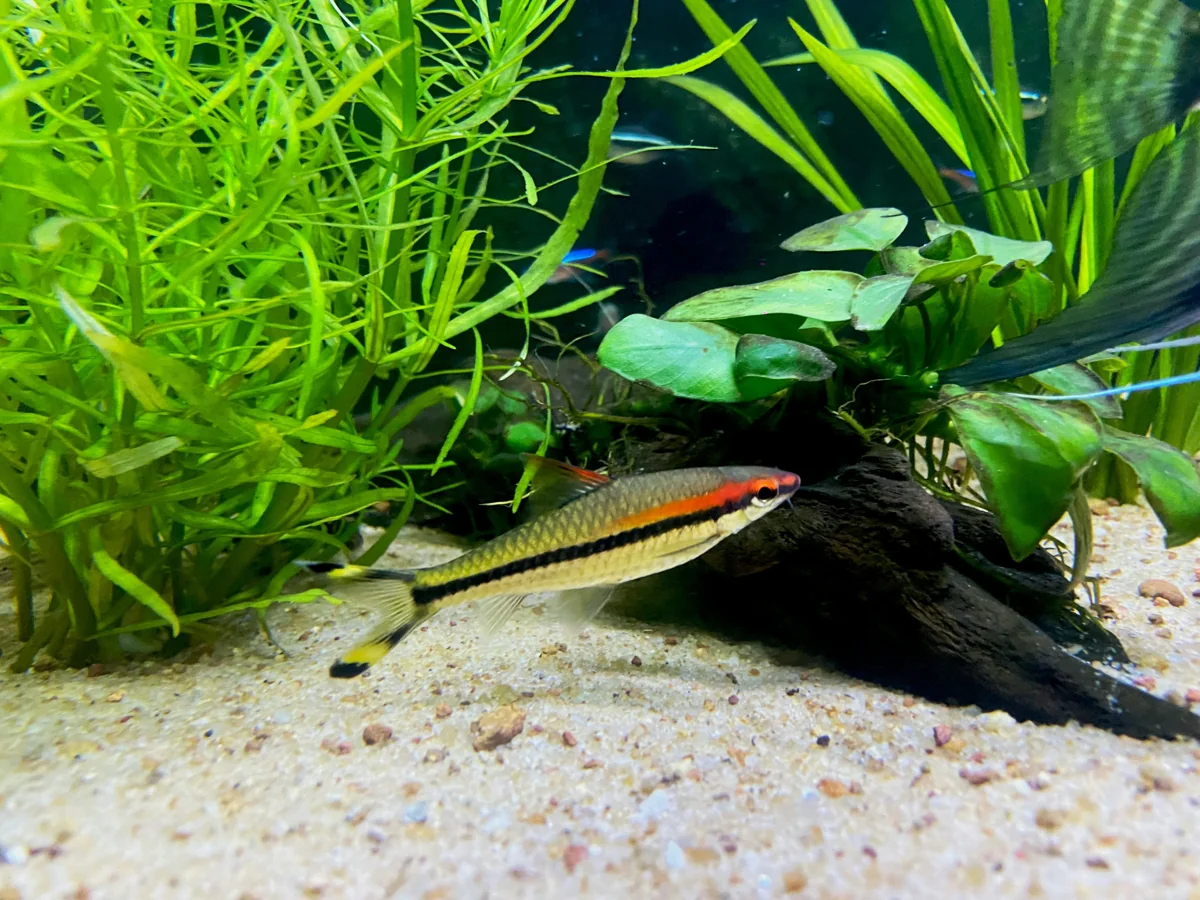
Denison Barbs possess a sleek, torpedo-shaped body covered in silver scales. A vivid red line runs from the snout, through the eye, and extends approximately halfway down the flank. Below the red line, a bold black stripe runs the entire length of the body to the tail. As they mature, a distinctive green to blue marking develops on the top of the head. The caudal fin features yellow spots with black tips, while the dorsal fin is edged in red.
Maximum length reaches 6 inches (15 cm), though most aquarium specimens remain between 4-5 inches (10-12.7 cm). Sexual dimorphism is subtle; females are reportedly slightly larger with heavier bodies and sometimes marginally duller coloration than males. Visual sexing is unreliable in aquarium conditions.
Natural Habitat
In the wild, Denison Barbs inhabit fast-flowing hill streams and rivers of the Western Ghats in the Indian states of Kerala and Karnataka. They are found in rocky pools with thick riparian vegetation along the banks at depths of 3-20 feet (1-6 meters). The substrate is a mix of sand, gravel, and larger rocks, and the current is strong enough that only well-adapted fish can hold their position. Water is cool, highly oxygenated, and shaded by overhanging vegetation.
Conservation Status
The Denison Barb is classified as Endangered on the IUCN Red List. Wild populations have declined by more than 70% since 2006 at key collection sites. After winning third prize at Aquarama 1997 in Singapore, demand exploded. By 2007-2008, Denison Barbs constituted 60-65% of India's total live ornamental fish exports, worth approximately 1.44 million US dollars annually. The Government of Kerala has instituted management practices including catch limits, gear restrictions, closed seasons, and no-take zones. The vast majority of specimens in the aquarium trade today are commercially captive-bred, primarily in Indonesia and Singapore, which has significantly reduced pressure on wild stocks.
Care
Housing & Pond Requirements
Tank Size and Dimensions
A 55-gallon (208 liter) tank is the absolute minimum for a school of 6 Denison Barbs, but a 75-gallon (284 liter) or larger tank with a footprint of at least 48x18 inches (120x45 cm) is where they truly thrive. If planning a larger group of 8-10, use a 75 to 90-gallon (284 to 340 liter) setup. The length of the tank matters far more than the height; these are horizontal swimmers that need open swimming lanes. A 20-gallon tall or cube tank is completely unsuitable regardless of how it is stocked.
Substrate and Hardscape
Use a dark-colored substrate such as black sand, dark gravel, or mixed natural substrates to bring out their vivid coloration. Pale or white substrates wash out their markings. Provide smooth river rocks and driftwood to create visual barriers and break up sight lines while maintaining open swimming corridors. Avoid sharp-edged decorations that could injure fish during high-speed swimming.
Filtration and Water Flow
This is the most critical aspect of Denison Barb husbandry. These fish originate from fast-flowing streams and require strong water movement. Aim for a turnover rate of 4-5 times your tank volume per hour. Use a canister filter rated for at least 1.5x your system volume, paired with powerheads or a wavemaker positioned to create a current running the length of the tank. The fish will actively swim into the current, displaying their most natural and impressive behavior.
Surface Agitation and Oxygenation
Excellent surface agitation is non-negotiable. Denison Barbs are sensitive to low dissolved oxygen, especially at higher temperatures. Use spray bars, air stones, or surface-skimming powerheads to maximize gas exchange. Inadequate oxygenation is a leading cause of death in home aquariums.
Lighting
Moderate to bright lighting on a 10-12 hour photoperiod is sufficient. In the wild, streams are shaded by overhanging vegetation, but in aquariums, moderate lighting enhances their coloration and supports plant growth. Floating plants can be used to diffuse light and create a more natural environment.
Water Parameters
Critical Water Parameters
Denison Barbs require cool, highly oxygenated water. Warm, stagnant conditions are fatal over time.
- Temperature: 60-77 degrees Fahrenheit (15-25 degrees Celsius). The sweet spot is 72-75 degrees Fahrenheit (22-24 degrees Celsius). Stability within 1 degree Fahrenheit (0.5 degrees Celsius) daily is ideal.
- pH: 6.5-7.8. Aim for 6.8-7.5 for optimal health.
- General Hardness (GH): 5-25 dGH (90-450 ppm).
- Carbonate Hardness (KH): 4-12 dKH (70-215 ppm).
- Total Dissolved Solids (TDS): 150-350 ppm.
- Electrical Conductivity: 300-700 microS/cm.
- Nitrates: Below 15 ppm. Ideal is below 10 ppm.
- Phosphates: Below 0.5 ppm.
- Ammonia and Nitrite: 0 ppm.
Why These Parameters Matter
Denison Barbs are subtropical fish, not true tropicals. Their native streams remain cool year-round due to elevation and shading. Keeping them at 80 degrees Fahrenheit (27 degrees Celsius) or above causes chronic metabolic stress, oxygen depletion, immune suppression, and significantly shortened lifespan. In climate-controlled homes maintaining 68-74 degrees Fahrenheit (20-23 degrees Celsius), you may not need a heater at all. Overheating is a far bigger risk than the water being too cool.
Diet
Denison Barbs are omnivores that accept a wide variety of foods. In the wild, they graze on algae, plant matter, small invertebrates, and organic debris. In captivity, a balanced and varied diet maintains health and brings out their best coloration.
Health
Denison Barbs are generally hardy and disease-resistant when provided with cool, well-oxygenated water, strong flow, and excellent water quality. However, they are susceptible to several common freshwater diseases, particularly when stressed by warm temperatures, poor water quality, or inadequate flow.
Ich (White Spot Disease / Ichthyophthirius multifiliis)
The most common parasitic infection in Denison Barbs, caused by the ciliated protozoan Ichthyophthirius multifiliis. Newly acquired specimens are particularly vulnerable.
- White salt-like spots on body and fins, rapid breathing, flashing against rocks and substrate, clamped fins, loss of appetite, and lethargy. Spots are uniformly small, the size of table salt grains, and distributed across the entire body.
Introduction via infected fish, plants, or contaminated water. Stress from warm temperatures above 78 degrees Fahrenheit (25.5 degrees Celsius), poor water quality, or inadequate flow triggers outbreaks in carriers.
Quarantine all new fish for 2-3 weeks. Treat with formalin/malachite green combination (Ich-X, Rid-Ich Plus) at standard dosing. Remove activated carbon during treatment. Do not rely on heat-only treatment; scientific studies confirm heat is ineffective against ich. Maintain treatment for 5-7 days after the last visible spot disappears.
Columnaris (Flavobacterium columnare)
A highly contagious bacterial infection that appears as white or grayish patches on the body, often starting at the mouth or fins. Can be mistaken for fungus but progresses much faster and is more deadly.
- White or grayish patches on the body, fins, or mouth. In advanced cases, the mouth may appear cottony or eroded. Fish may show lethargy, loss of appetite, and rapid breathing. Progresses from first symptoms to death within 24-72 hours if untreated.
Introduction via infected fish or contaminated water. Stress from shipping, warm temperatures, or poor water quality weakens immune defenses. Flavobacterium columnare is opportunistic and attacks stressed fish.
Quarantine all new fish. Treat with kanamycin (Kanaplex) combined with Focus in medicated food. Internal treatment is significantly more effective than water-borne antibiotics for Columnaris. Increase aeration during treatment. Maintain cool water temperatures and pristine water quality.
Bacterial Fin Rot and Septicemia
Secondary bacterial infections that typically follow physical damage, parasite infestation, or chronic stress from poor water quality.
- Frayed or disintegrating fin edges, red streaks along the body or fins, cloudy eyes, skin ulcers, and bloating.
Aeromonas, Pseudomonas, or Vibrio bacteria entering through wounds or gill damage. Stress from warm water, overcrowding, or inadequate water changes weakens immune defenses.
Maintain pristine water conditions with zero ammonia and nitrite. Perform weekly 30% water changes. Treat with broad-spectrum antibiotics such as nitrofurazone or kanamycin in a hospital tank. Improve nutrition with vitamin supplementation to boost immune response.
Oxygen Deprivation / Hypoxia
Not an infectious disease but a fatal physiological condition caused by warm water, insufficient surface agitation, overcrowding, or power failures. Denison Barbs are particularly vulnerable due to their high metabolic rate and cool-water physiology.
- Gasping at the surface, rapid breathing, lethargy, loss of coloration, and erratic swimming. Fish may congregate near filter outflows or air stones. Death can occur within hours if oxygen levels are not restored.
Water temperature above 78 degrees Fahrenheit (25.5 degrees Celsius) reduces dissolved oxygen capacity. Insufficient surface agitation, filter failure, overcrowding, or excessive organic waste depletes oxygen. Power outages are particularly dangerous for these fish.
Maintain temperature below 77 degrees Fahrenheit (25 degrees Celsius). Provide strong surface agitation via spray bars, air stones, or surface-skimming powerheads. Ensure 4-5 times turnover per hour. Install a battery-powered air pump for emergency oxygenation during power outages. Avoid overstocking.
Swim Bladder Disorder
A condition affecting buoyancy control, often caused by constipation, bacterial infection, or physical trauma from high-speed collisions in cramped tanks.
- Fish floating upside down, sinking to the bottom and unable to rise, swimming at odd angles, or listing to one side. May be accompanied by loss of appetite and lethargy.
Constipation from overfeeding dry foods, bacterial infection of the swim bladder, or physical trauma from colliding with tank decorations during high-speed swimming. Cramped tanks increase collision risk.
Feed a varied diet with adequate fiber from plant matter and daphnia. Soak dry foods before feeding to prevent constipation. Ensure adequate swimming space with smooth decorations positioned away from high-traffic swimming lanes. Treat constipation with a 24-hour fast followed by daphnia or blanched peas. Treat bacterial swim bladder infections with appropriate antibiotics in a hospital tank.
Breeding
Breeding Denison Barbs in the home aquarium is extremely difficult, and successful hobbyist reports are rare. The vast majority of Denison Barbs sold in the trade are commercially bred in farms using hormone-induced spawning techniques. Understanding why breeding is so challenging helps set realistic expectations.
Tips
Common Mistakes to Avoid
- Tank Too Short: A 20-gallon tall, 30-gallon, or cube tank is completely unsuitable. Denison Barbs require a minimum 48-inch (120 cm) long tank. Length matters more than gallons.
- Keeping Too Few: Groups under 6 cause chronic stress, fin-nipping, and faded color. A school of 8-10+ is required for natural behavior.
- Water Too Warm: Treating them like tropical fish and keeping them at 80 degrees Fahrenheit (27 degrees Celsius) or above shortens their lifespan dramatically. These are subtropical fish.
- Insufficient Flow: Without strong water movement (4-5x turnover), these fish become lethargic, lose color, and fail to display natural behavior.
- Skipping Water Changes: Denison Barbs are sensitive to dissolved organic waste. Weekly 30% water changes are mandatory, not optional.
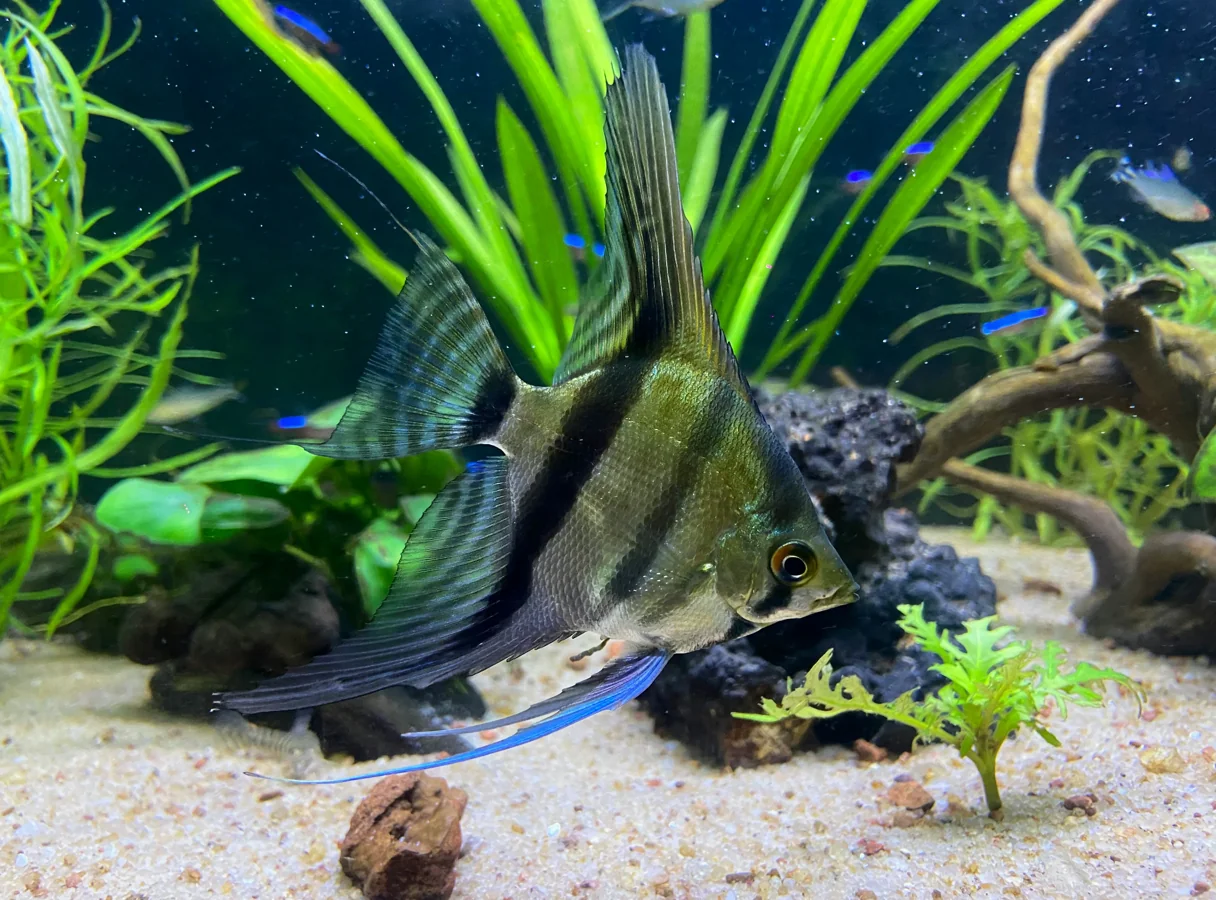
- Poor Tank Mate Selection: Bettas, angelfish, fancy guppies, and slow cichlids cannot tolerate the strong current and activity level. They will be stressed or nipped.
- Buying Wild-Caught Specimens: Always purchase captive-bred fish. Wild collection has driven this species to endangered status.
- Overfeeding Dry Foods: Excess dry food fouls the water and causes constipation. Feed only what the school consumes in 2-3 minutes.
Expert Tips for Success
- Buy the Entire School at Once: Fish from the same batch school together more readily than individuals added at different times. Purchase 6-10 fish simultaneously from the same source.
- Dark Substrate Is Essential: Black sand, dark gravel, or mixed natural substrates make their red and black striping pop. White or pale substrates wash out their coloration completely.
- Verify Captive-Bred Origin: Ask your retailer for the source of their fish. Only purchase captive-bred specimens to support conservation efforts.
- Install a Battery-Powered Air Pump: Denison Barbs are extremely vulnerable to power outages. A battery-powered air pump provides emergency oxygenation and can save the entire school during outages.
- Position Decorations Carefully: Place smooth rocks and driftwood away from high-traffic swimming lanes. These fish swim at high speed and can injure themselves on sharp or poorly positioned hardscape.
- Feed Carotenoid-Rich Foods: Spirulina pellets, krill, and astaxanthin-enriched foods transform dull fish into showpieces within 2-3 weeks.
- Monitor Temperature Religiously: Use a digital thermometer with an alarm set at 78 degrees Fahrenheit (25.5 degrees Celsius). Overheating is the single biggest killer of Denison Barbs in home aquariums.
- Provide Open Swimming Lanes: Leave at least 60% of the tank floor as open swimming space. Dense planting or excessive hardscape causes stress and glass surfing.
Compatible Tank Mates
Species Comparison
| Feature | Denison Barb | Tiger Barb | Cherry Barb | Odessa Barb |
|---|---|---|---|---|
| Scientific Name | Sahyadria denisonii | Puntigrus tetrazona | Puntius titteya | Pethia padamya |
| Maximum Size | 4-6 inches (10-15 cm) | 2-2.25 inches (5-5.7 cm) | 2 inches (5 cm) | 2-3 inches (5-7.5 cm) |
| Temperament | Peaceful / Active | Semi-aggressive | Peaceful | Peaceful to Semi-aggressive |
| Minimum Tank Size | 55 gallons (208 L) | 30 gallons (114 L) | 15 gallons (57 L) | 20 gallons (76 L) |
| Minimum School Size | 6-8 (10+ ideal) | 6 (10+ ideal) | 6 (8+ ideal) | 6 (8+ ideal) |
| Temperature Range | 60-77 degrees F (15-25 C) | 68-78 degrees F (20-26 C) | 68-80 degrees F (20-27 C) | 61-77 degrees F (16-25 C) |
| Water Flow Requirement | High (4-5x turnover) | Moderate | Low to Moderate | Moderate |
| IUCN Status | Endangered | Least Concern | Vulnerable | Least Concern |