
X-Ray Tetra (Pristella maxillaris)
Quick Answer
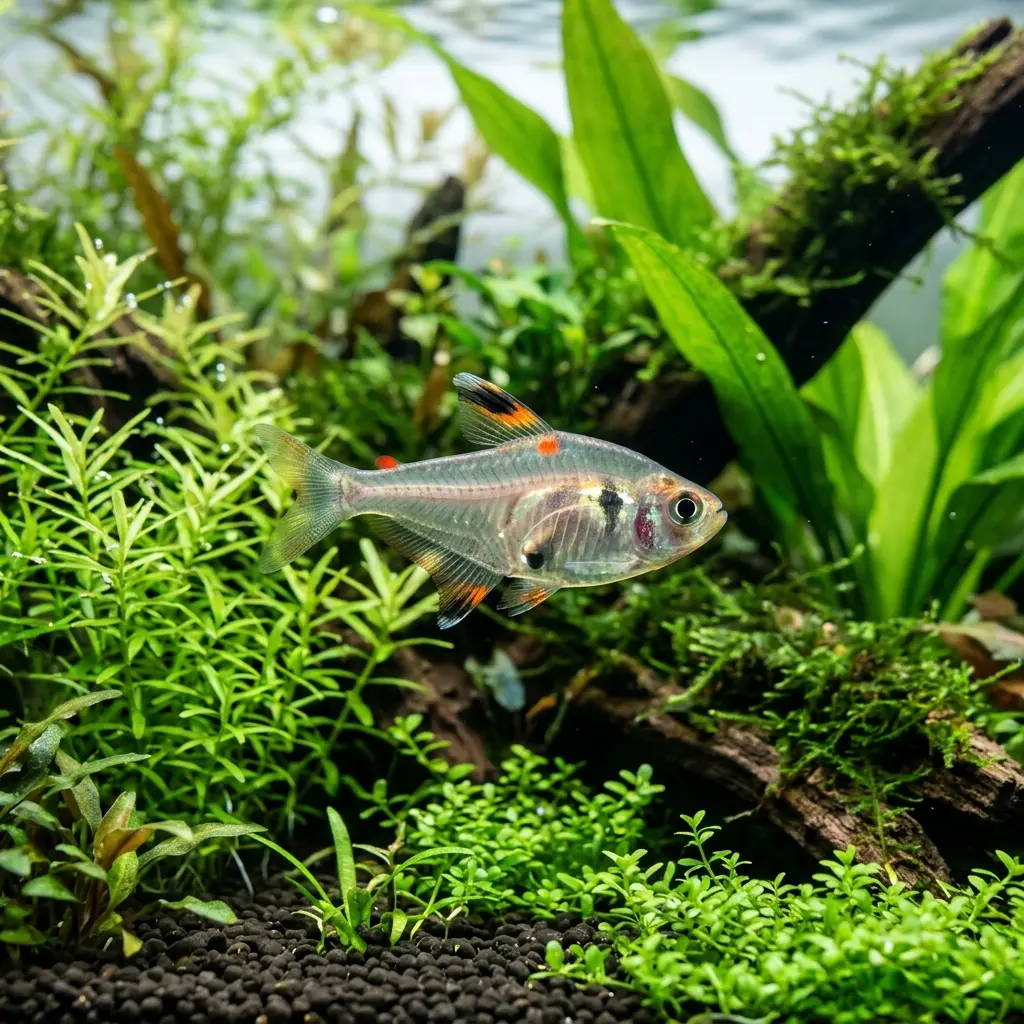
X-Ray Tetra (Pristella maxillaris) is a small, peaceful South American characin renowned for its translucent body, visible backbone, and striking yellow-black-white fin banding. It reaches 1.8 inches (4.5 cm) and lives 4 to 5 years. This exceptionally hardy species requires a minimum 15-gallon (57 liter) aquarium with a school of 8 or more, pH 6.0 to 7.5, temperature 72 to 80 degrees F (22 to 27 degrees C), and General Hardness of 4 to 20 dGH. Unlike most tetras, it tolerates hard water and slightly brackish conditions, making it ideal for beginner aquarists with challenging tap water.
Quick Facts
| Scientific Name | Pristella maxillaris |
|---|---|
| Common Names | X-Ray Tetra |
| Family | Acestrorhamphidae |
| Genus | Pristella |
| Type | Freshwater |
| Temperament | peaceful |
| Care Difficulty | beginner |
| Lifespan | 5 years |
| Maximum Size | Up to 1.8 in (5 cm) |
| Diet | Omnivore |
| Temperature | 72–80°F (22–27°C) |
| pH | 6–7.5 |
| Hardness | 4–20 dGH |
| Minimum Size | 15 gallons |
Key Takeaways
- Translucent body reveals visible backbone; diagnostic yellow-black-white fin banding and red-tipped tail
- Requires a minimum school of 8 to 10 individuals; smaller groups develop chronic stress and weakened immunity
- Exceptionally chemically adaptable: tolerates hard water up to 35 dGH and slightly brackish conditions up to 5 ppt
- Possesses a Weberian apparatus that grants acute hearing sensitivity; responds to vibrations and noise
- One of the only tetra species suitable for aquarists with naturally hard tap water
- Vulnerable to Neon Tetra Disease in mass-bred commercial stock; source from reputable breeders when possible
Overview
Species Overview
The X-Ray Tetra, scientifically known as Pristella maxillaris, is one of the most visually distinctive and behaviorally captivating characins in the aquarium hobby. Its common name derives from the almost completely translucent body wall that renders the internal backbone clearly visible from the exterior, creating an ethereal, x-ray-like appearance that fascinates observers of all experience levels. Beyond its striking appearance, this species possesses a unique combination of hardiness, adaptability, and anatomical specialization that separates it from nearly every other tetra available to aquarists.
Taxonomy & Classification
Pristella maxillaris belongs to the order Characiformes and the family Acestrorhamphidae, the American characins, within the subfamily Pristellinae. The genus Pristella is currently monospecific, meaning P. maxillaris is the sole recognized species in its genus. The genus name derives from Greek pristis, meaning one who saws, with the diminutive suffix -ella possibly referring to the minute conical teeth scattered along the maxilla. The specific epithet maxillaris also refers to these maxillary teeth. The species was first described by Albert B. Ulrey in 1894 as Aphyocharax maxillaris from specimens collected in Brazil.
Distribution & Habitat
This species is native to the Amazon and Orinoco River basins in Brazil and Venezuela, as well as coastal river drainages of the Guianas including Venezuela, Guyana, Suriname, French Guiana, and northern Brazil. It is a habitat generalist with remarkable ecological plasticity. During the dry season, it inhabits clearwater streams and tributaries with moderate vegetation. When the rains arrive, it migrates into flooded savannah areas and marshlands where the water becomes softer and more acidic. Critically, unlike nearly all other tetras, it is tolerant of and sometimes found in slightly brackish coastal waters, a trait derived from its proximity to estuarine river mouths in the Guianas.
The Weberian Apparatus
The X-Ray Tetra possesses a bony internal structure known as the Weberian apparatus, a series of modified vertebrae that connect the swim bladder to the inner ear. This anatomical innovation routes sound waves directly through the internal skeleton, granting the fish an acute sense of hearing far superior to most aquarium species. The Weberian apparatus is shared with many characin relatives but is particularly notable in this species due to the translucent body that allows observers to appreciate the skeletal complexity. In the aquarium, this acute hearing means the fish responds immediately to tapping on the glass, filter noise, and sudden vibrations, which can trigger startle responses if the environment is not sufficiently calm.
Physical Characteristics
Mature specimens reach a maximum total length of 1.8 inches (4.5 cm), with females typically slightly larger and deeper-bodied than the more slender males. The body is fusiform and laterally compressed, covered in faint yellowish-silver scales that appear almost golden under proper lighting. The most dramatic features are the fins: the dorsal fin carries a diagnostic pattern of yellow, black, and white banding, with the black spot overlaid by white above and underlined by yellow below. The anal fin displays symmetrical yellow-black-white coloration. The caudal fin is distinctly red-tipped. A small, round humeral spot approximately the size of the pupil sits just behind the gill cover. The adipose fin is completely hyaline. When viewed against a dark substrate, the translucent body reveals the full vertebral column, creating the signature x-ray effect.
Conservation Status
The IUCN lists Pristella maxillaris as Least Concern. The species has a broad distribution across the Amazon and Orinoco basins and is not threatened in the wild. Due to its popularity, it is commercially bred in huge numbers for the aquarium trade, primarily in Eastern Europe and the Far East. You are unlikely to encounter wild-caught specimens in the retail trade.
Care
Aquarium Care Requirements
X-Ray Tetra care is exceptionally forgiving, which accounts for its popularity among beginners. However, understanding the specific environmental factors that trigger their best coloration and behavior will elevate your success from mere survival to spectacular display.
Minimum Tank Specifications
The absolute minimum tank volume is 15 gallons (57 liters) for a school of 8 individuals. For a stable, visually impressive school of 10 to 12, provide 20 gallons (75 liters) or larger. The critical dimension is horizontal footprint: the tank must measure at least 24 inches by 12 inches (60 cm by 30 cm) at the base. A 20-gallon long (30 inches by 12 inches, or 76 cm by 30 cm) is ideal. Tall, narrow tanks are unsuitable because they restrict the horizontal swimming length that schooling fish require. For every additional 3 to 4 tetras beyond the base school, add 5 gallons (19 liters) of volume.
Water Parameters
Maintain the following parameters with absolute zero tolerance for ammonia and nitrite:
- Temperature: 72 degrees F to 80 degrees F (22 degrees C to 27 degrees C); optimal at 75 degrees F to 78 degrees F (24 degrees C to 26 degrees C)
- pH: 6.0 to 7.5 (tolerance range 5.8 to 8.0)
- General Hardness (GH): 4 to 20 dGH (tolerance range up to 35 dGH)
- Carbonate Hardness (KH): 3 to 12 dKH
- Total Dissolved Solids (TDS): 100 to 400 ppm
- Nitrates: Less than 20 ppm
- Ammonia and Nitrite: 0 ppm
Note on water chemistry: This species is arguably the most chemically adaptable tetra in the aquarium trade. It thrives in standard tap water across most of the Western world, including moderately hard to hard water with a GH of 10 to 20 dGH that would kill soft-water tetras such as Cardinal Tetras or Neon Tetras. It also tolerates slightly brackish conditions up to 5 ppt salinity. However, sudden parameter swings of more than 0.3 pH units or 2 degrees F (1 degree C) per day trigger stress responses. Stability is more important than precision. If attempting to breed, shift parameters toward the softer, more acidic end of the range to replicate wet-season floodplain conditions.
Filtration and Water Flow
Provide filtration rated at 4 to 5 times the tank volume per hour. Hang-on-back filters, sponge filters, or small canister filters are all suitable. Water movement must be gentle to moderate; these fish inhabit slow-flowing streams and backwaters and cannot tolerate turbulent currents. Position filter outflow to create broad, diffuse circulation rather than concentrated jets. Because they are active swimmers, oxygen demand is moderate but water must be well-oxygenated. Use air stones or sponge filters as supplemental aeration in heavily stocked community tanks.
Aquascaping and Decor
Design a South American community tank or a dedicated biotope. Use dark fine gravel or sand substrate to enhance the translucent body effect through contrast. Install driftwood roots and smooth river stones to create broken sight lines and retreat zones. Plant density should be moderate to heavy along the sides and rear, with an open central swimming lane at least 50 percent of the tank length. Floating plants such as Water Sprite, Amazon Frogbit, or Salvinia are highly beneficial for diffusing overhead light and providing security.
For a dedicated biotope, use a substrate of river sand with driftwood branches and twisted roots. Add a few handfuls of dried leaves such as beech or oak to stain the water the color of weak tea, replacing decaying leaves every few weeks. Fairly dim lighting should be used. Under these blackwater conditions, the true beauty of the translucent body and fin banding is revealed.
Lighting Requirements
Moderate-intensity LED lighting on a 10 to 12 hour photoperiod. Very bright, unshaded light causes washed-out coloration and suppresses the golden body sheen. Use floating vegetation to create dappled light zones that mimic the canopy-filtered illumination of their native streams. Dim lighting enhances the x-ray body effect and encourages bolder schooling behavior in the open water.
Diet
Diet and Nutrition
X-Ray Tetras are micropredators in nature and unfussy omnivores in captivity. Their willingness to accept virtually any food contributes significantly to their beginner-friendly reputation.
Natural Feeding Behavior
In their native South American waters, X-Ray Tetras feed primarily on small invertebrates including worms, small crustaceans, and aquatic insect larvae. They are continuous opportunistic feeders that graze the water column and surface film, capturing small prey items during brief sallies. Their acute hearing, mediated by the Weberian apparatus, allows them to detect the vibrations of struggling insects and small crustaceans at considerable distance.
Captive Diet Recommendations
For long-term health and optimal coloration, provide a varied diet consisting of:
- High-quality tropical flakes or micro-pellets (New Life Spectrum, Omega One, Hikari Micro Pellets, or Northfin Community Formula) as the daily staple, fed twice daily
- Frozen foods including daphnia, bloodworms, Mysis shrimp, and brine shrimp, offered 2 to 3 times weekly
- Live foods such as daphnia, wingless fruit flies, or baby brine shrimp for conditioning and immune stimulation
- Spirulina flakes or algae wafers once weekly to provide vegetable fiber and carotenoids for color enhancement
Daphnia is particularly valuable for this species as it supports digestion and prevents the bloating common in tetras fed exclusively on dry foods. The carotenoids in spirulina and astaxanthin-enriched foods enhance the faint golden body sheen and intensify the red tail tip coloration.
Feeding Schedule
Feed adult fish twice daily, morning and evening. Each feeding should be consumed within 2 minutes. Offer the primary flake or pellet ration in the morning and a protein or vegetable supplement in the evening. Fast the tank one day per week to clear digestive systems and reduce organic waste load. Juveniles under 6 months require three feedings daily to support their moderate growth rate.
Foods to Avoid
Never offer beef heart, pork, or other mammalian proteins. These lack the correct amino acid profile for characins and cause fatty liver degeneration. Avoid oversized pellets that cannot be swallowed whole. Freeze-dried foods should be pre-soaked to prevent intestinal blockage from rapid expansion. Tubifex worms carry parasite transmission risk and should be avoided unless commercially sterilized.
Breeding
Breeding Guide
Breeding Pristella maxillaris in home aquariums is moderately easy and represents an excellent introduction to characin spawning for intermediate aquarists. The species is an egg-scattering free spawner with no parental care.
Conditioning and Selection
Select 10 to 12 mature individuals at least 6 months old. Sexing is straightforward: mature females are larger, deeper-bodied, and rounder than the more slender males. When a female is ready to breed, her belly swells noticeably, and you may see eggs through the semi-transparent body wall. Condition the group in a separate 15-gallon (57 liter) tank for 2 weeks with a diet rich in live and frozen foods including blackworms, brine shrimp, and bloodworms. The conditioning diet triggers gonadal development and intensifies fin coloration.
Spawning Setup
Prepare a dedicated 10-gallon (38 liter) breeding tank with the following specifications:
- Water: Soft water adjusted to pH 6.5, 6 dGH, 3 dKH to replicate wet-season floodplain conditions
- Temperature: 78 degrees F (25.5 degrees C), 2 to 3 degrees above maintenance temperature
- Depth: 4 to 6 inches (10 to 15 cm) of water to concentrate spawning activity
- Substrate: Bare bottom or covered with a plastic mesh with 0.125-inch (3 mm) openings
- Spawning medium: Dense Java Moss, Cambomba, or synthetic spawning mops
- Filtration: Gentle air-driven sponge filter only
- Lighting: Dim; simulate dawn with gradual lighting increase over 30 minutes
Add peat filtration or Indian Almond leaves to achieve the soft, acidic, tannin-stained water that triggers natural spawning behavior. Some aquarists add a small net bag of aquarium-safe peat to the filter to aid in blackwater simulation.
Spawning and Egg Management
Transfer the conditioned group to the breeding tank in the evening. Spawning occurs during the simulated dawn period, with males driving females against the spawning medium. A healthy female releases 200 to 400 adhesive eggs per spawn. The adults are prolific egg predators and must be removed within 4 hours of spawning. Eggs are semi-transparent and adhesive, measuring approximately 1 mm in diameter. Fungus is the primary threat; maintain pristine water and consider a prophylactic methylene blue treatment at 3 drops per gallon to prevent fungal growth.
Fry Rearing
Eggs hatch in 24 to 30 hours at 75 degrees F (24 degrees C). Newly hatched fry measure approximately 0.1 inch (2.5 mm) and remain attached to surfaces for 24 hours while absorbing the yolk sac. Once free-swimming, typically day 3 to 4, feed infusoria or commercial liquid fry food for the first 72 hours. Transition to microworms or vinegar eels on day 4, and introduce newly hatched brine shrimp nauplii from day 7. Growth is moderate; fry reach 1 inch (2.5 cm) at 3 months and sexual maturity at 6 to 8 months. Perform daily 10 percent water changes with matched temperature and chemistry to maintain pristine conditions.
Tips
Expert Tips and Common Mistakes
Decades of collective experience with Pristella maxillaris reveal consistent patterns that separate thriving schools from stressed, short-lived groups.
Pro Tips from Experienced Keepers
Tip 1: The Hard Water Advantage. If you live in an area with naturally hard tap water and have been told that tetras are impossible to keep, the X-Ray Tetra is your solution. While Neon Tetras and Cardinal Tetras deteriorate in GH above 8 dGH, Pristella maxillaris thrives at 15 to 20 dGH. This species opens the tetra hobby to aquarists who would otherwise be restricted to livebearers and hardwater cichlids.
Tip 2: Dark Substrate Enhancement. The translucent body effect is dramatically enhanced by dark substrate. Black sand, dark gravel, or even a black-painted tank background transforms these fish from mildly interesting to genuinely spectacular. Under bright lighting with pale substrate, the x-ray effect is lost and the fish appear washed out and unremarkable.
Tip 3: False X-Ray Tetra Awareness. The species Hyphessobrycon simulatus, formerly classified as Pseudopristella simulata, is occasionally mislabeled as an X-Ray Tetra in the trade. The False X-Ray Tetra is smaller (1.2 inches or 3 cm), lacks the distinct yellow-black-white fin banding, and requires softer, more acidic water. Verify that your fish display the diagnostic fin pattern before purchase.
Tip 4: Brackish Experimentation. For advanced aquarists, X-Ray Tetras can be maintained in low-end brackish conditions up to 5 ppt salinity alongside small gobies and mollies. This is one of the very few tetra species capable of such tolerance, making it unique for specialized biotope projects. Always acclimate gradually over 7 to 10 days if attempting brackish conversion.
Critical Mistakes to Avoid
Mistake 1: Inadequate School Size. Purchasing 3 to 5 individuals is the most common failure. This triggers chronic stress, immunosuppression, and hiding behavior. The minimum functional school is 8; the optimal school is 10 to 12. A lone X-Ray Tetra in a community tank is a fish that will die prematurely from stress, not from disease.
Mistake 2: Very Bright Unshaded Lighting. Intense overhead lighting without floating plant cover washes out the translucent body effect and suppresses natural schooling behavior. The fish will hide in plant corners and lose their fin banding coloration. Always provide shade zones.
Mistake 3: Housing with Inappropriate Tetras. Do not mix X-Ray Tetras with soft-water obligate tetras such as Cardinal Tetras or Neon Tetras in an attempt to compromise on water chemistry. The soft-water tetras will suffer in the hard water that X-Ray Tetras prefer. Choose tank mates that share the same water chemistry requirements.
Mistake 4: Ignoring Neon Tetra Disease. Because this species is mass-bred in commercial facilities, NTD is a genuine risk. Faded coloration, wasting, and visible cysts are not normal aging; they are fatal microsporidian infections. Isolate affected fish immediately and source replacement stock from reputable breeders rather than big-box retailers.
Mistake 5: Overfeeding Dry Foods. A diet consisting exclusively of flakes causes constipation and bloating in tetras. Rotate in frozen daphnia or brine shrimp at least twice weekly to support digestive health and immune function. Daphnia is particularly effective at preventing the bloating common in dry-food-heavy diets.
The Weberian Apparatus in Observation
For the dedicated enthusiast, observing the Weberian apparatus through the translucent body wall is one of the most fascinating aspects of keeping this species. Under dim lighting with a dark background, the modified vertebrae connecting the swim bladder to the skull are clearly visible as a delicate bony chain. This is not merely a visual curiosity; it explains why your X-Ray Tetras scatter instantly when you tap the glass or when the filter starts up. Their world is one of vibration and sound, and your aquarium is a symphony of sensory input that they process with an acuity you cannot perceive. Respect their hearing sensitivity by maintaining a calm, low-vibration environment, and you will be rewarded with bold, continuous schooling behavior that transforms your tank into a living display of South American ecology.
Compatible Tank Mates






Species Comparison
| Feature | X-Ray Tetra | Neon Tetra | Cardinal Tetra | Rummy Nose Tetra |
|---|---|---|---|---|
| Scientific Name | Pristella maxillaris | Paracheirodon innesi | Paracheirodon axelrodi | Hemigrammus rhodostomus |
| Max Size | 1.8 inches (4.5 cm) | 1.5 inches (3.8 cm) | 2 inches (5 cm) | 2 inches (5 cm) |
| Temperament | Peaceful; non-aggressive schooling fish | Peaceful; shy without adequate cover | Peaceful; requires stable soft water | Peaceful; sensitive to parameter fluctuations |
| Minimum Tank Size | 15 gallons (57 L); 20 gal (75 L) recommended | 10 gallons (38 L); 20 gal (75 L) for schools | 20 gallons (75 L) | 15 gallons (57 L); 20 gal (75 L) for schools |
| Water Hardness Tolerance | 4 to 20 dGH; tolerates up to 35 dGH and brackish water | 1 to 8 dGH; deteriorates in hard water | 1 to 6 dGH; requires very soft water | 2 to 12 dGH; prefers soft to moderately soft water |
| Optimal pH Range | 6.0 to 7.5 (wide tolerance) | 6.0 to 7.0 (acidic to neutral) | 5.5 to 7.0 (strongly acidic to neutral) | 6.0 to 7.5 (acidic to neutral) |
| Origin | Amazon, Orinoco, and coastal Guianas (brackish tolerant) | South America (Amazon Basin, soft blackwater) | South America (Rio Negro, extremely soft blackwater) | South America (Amazon Basin, soft blackwater) |
| Special Notes | Visible backbone; Weberian apparatus for acute hearing; hardiest tetra available | Iconic blue-red stripe; extremely sensitive to water quality; prone to NTD | Larger red stripe than neon; requires pristine soft water; not beginner-friendly | Red nose indicator of water quality; schools tightly; sensitive to nitrates |