
Gold Barb (Barbodes semifasciolatus var. schuberti)
Quick Answer
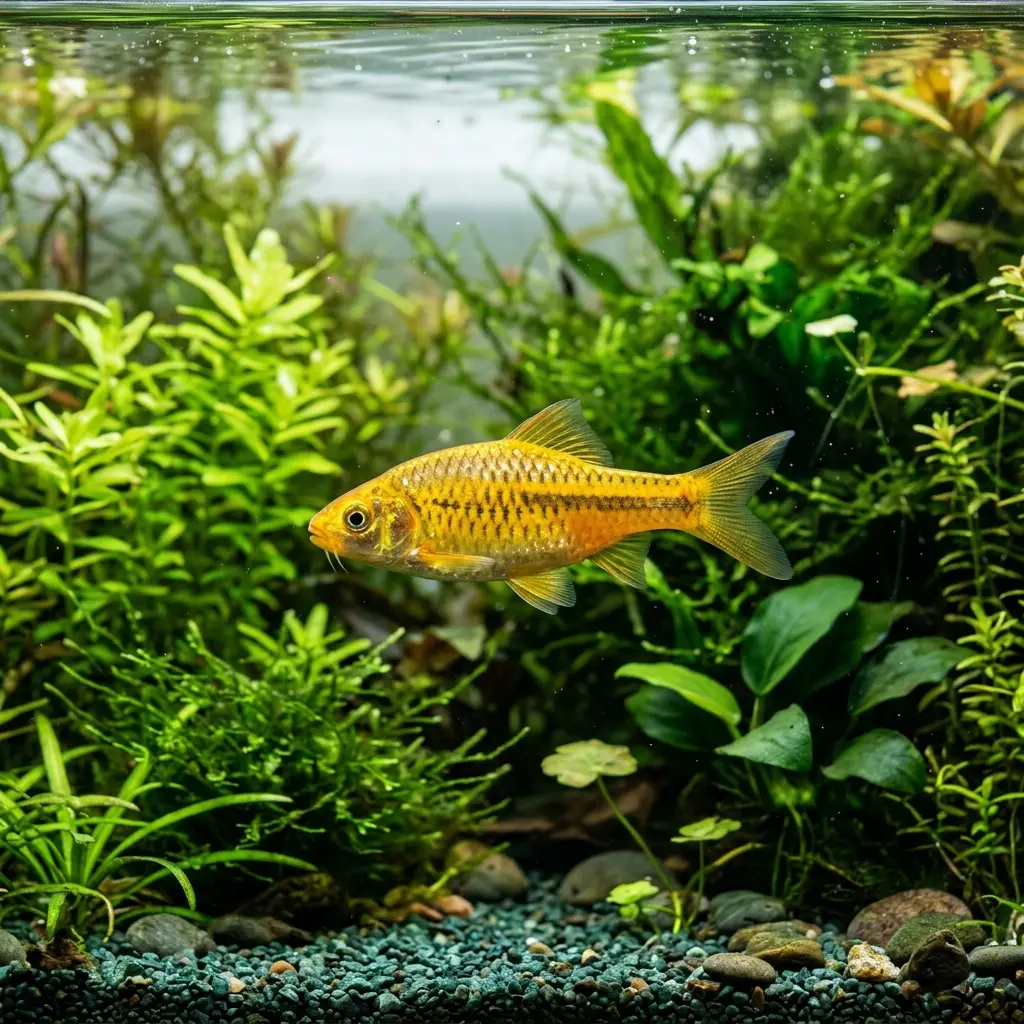
Gold Barb (Barbodes semifasciolatus var. schuberti) is a selectively bred golden color morph of the Chinese Barb. It reaches 3 inches (7.6 cm) and requires a minimum 30 gallon (113 L) aquarium for a school of 6-8. This subtropical omnivore thrives in cool water (64-75°F / 18-24°C) at pH 6.0-8.0 and is one of the best choices for unheated room-temperature aquariums.
Quick Facts
| Scientific Name | Barbodes semifasciolatus var. schuberti |
|---|---|
| Common Names | Gold Barb |
| Family | Cyprinidae |
| Genus | Barbodes |
| Type | Freshwater |
| Temperament | peaceful |
| Care Difficulty | beginner |
| Lifespan | 5 years |
| Maximum Size | Up to 3 in (8 cm) |
| Diet | Omnivore |
| Temperature | 64–75°F (18–24°C) |
| pH | 6–8 |
| Hardness | 5–25 dGH |
| Minimum Size | 30 gallons |
Key Takeaways
- Selectively bred color morph developed by Thomas Schubert in New Jersey, 1960s
- Reaches 3 inches (7.6 cm) - larger than commonly believed
- Thrives in cool water 64-75°F (18-24°C); NOT a tropical fish
- Requires minimum school of 6; optimal 8-12 for best behavior
- Highly adaptable pH 6.0-8.0 and hardness 5-25 dGH
- One of the least picky eaters in the aquarium hobby
- May nip long fins in small groups; safe with proportionate tank mates
- Documented lifespan 4-6 years; up to 7 with optimal care
- Best kept in unheated or subtropical community tanks
- Dark substrate essential for best golden coloration
Overview
Species Overview
The Gold Barb (Barbodes semifasciolatus var. schuberti) is one of the most reliable and underappreciated community barbs in the freshwater aquarium hobby. Developed in the 1960s by Thomas Schubert in New Jersey, this golden color morph of the Chinese Barb has become a staple of the trade due to its hardiness, cool-water tolerance, and striking reflective golden-yellow coloration.
History and Origin
The Gold Barb is not a naturally occurring species. It is a selectively bred color variant of the wild-type Chinese Barb or Green Barb (Barbodes semifasciolatus), which is olive-green with dark lateral markings and is rarely seen in aquariums. Thomas Schubert developed the golden morph through selective breeding in the 1960s, though some aquarists have speculated that hybridization may have been involved. The exact method remains unknown, as Schubert reportedly never allowed colleagues into his breeding room.
The wild-type species is native to the Red River basin in Southeast Asia, flowing from China's Yunnan province through Vietnam to the South China Sea. Wild populations also occur in Laos and Taiwan. Introduced populations exist in Singapore and Hawaii, USA. All aquarium Gold Barbs are commercially bred; wild specimens are virtually never exported.
Physical Description
Adult Gold Barbs reach a maximum total length of 3 inches (7.6 cm), though 2-2.5 inches (5-6.5 cm) is more common in aquariums. The body is elongated and moderately deep with a brilliant golden-yellow to copper base color. Mature specimens display highly reflective scales that catch light dramatically, especially against dark substrate. Small dark or black patches run along the lateral line, remnants of the wild-type patterning. The fins are typically red or orange, particularly in males.
Males are smaller, more slender, and more intensely colored than females. During breeding condition, males develop a reddish-orange belly. Females are larger, rounder, and slightly duller in coloration. Sexing is reliable only in mature, well-conditioned specimens.
Diet
Diet and Nutrition
Gold Barbs are among the least picky eaters in the aquarium hobby. Their enthusiastic appetite and tolerance for varied foods make them exceptionally easy to feed, but dietary variety is still essential for optimal coloration and long-term health.
Health
Health and Disease Management
Gold Barbs are generally hardy and disease-resistant when provided with stable, cool water parameters and adequate space. Their primary vulnerability is stress-induced illness from overheated water, poor water quality, or inadequate school size.
Ichthyophthirius multifiliis (Ich / White Spot Disease)
The most common protozoan parasite in freshwater aquariums. Presents as small white salt-like spots on skin and fins. Highly contagious and potentially fatal if untreated.
- Small white nodules (0.5-1.0 mm) on skin, fins, and gills; flashing against rocks and substrate; rubbing on decorations; respiratory distress; clamped fins; loss of appetite
Introduction via contaminated water, plants, or infected fish. Triggered by temperature fluctuations, transport stress, or immune suppression from poor water quality or overheating.
Quarantine all new livestock for 2-4 weeks. Avoid temperature swings greater than 2°F (1.1°C) daily. Treatment: raise temperature gradually to 78-82°F (25.5-27.5°C) and add aquarium salt at 1 tablespoon per 5 gallons (3.8 L). Maintain for 14 days. For severe infections, use copper-based medication (Cupramine at 0.2 mg/L) or formalin at 25 ppm. Remove activated carbon during treatment.
Columnaris (Cotton Wool Disease / Mouth Fungus)
A bacterial infection caused by Flavobacterium columnare. Often mistaken for fungal infection due to cottony appearance. Progresses rapidly and can kill within 48 hours in warm water.
- White or grayish cotton-like patches on mouth, fins, or body; frayed fins with white margins; lethargy; loss of appetite; rapid breathing; ulcers on skin
Stress from poor water quality (elevated nitrates, ammonia spikes), overcrowding, or aggressive tank mates. Overheated water above 78°F increases susceptibility dramatically.
Maintain nitrates below 20 ppm through weekly 25% water changes. Avoid overcrowding. Keep temperature below 75°F. Treatment: immediate water change (50%) followed by antibiotic therapy. Effective medications include Kanamycin (5 mg/L), Nitrofurazone (25 ppm bath), or API Furan-2. Remove carbon during treatment. Increase aeration as medications reduce dissolved oxygen.
Fin Rot (Bacterial)
A bacterial infection causing progressive erosion of fin tissue. Usually indicates underlying water quality issues or stress. Early stages are easily reversible; advanced stages can infect the body wall.
- Frayed, ragged, or receding fin edges; white or red discoloration at fin margins; inflammation at fin base; in advanced cases, body ulcers and systemic infection
Maintain pristine water parameters with zero ammonia and nitrite. Use smooth-edged decorations. Treat primary infections promptly. Early-stage fin rot often resolves with 50% water changes every 48 hours and improved filtration. Advanced cases require antibiotics: Maracyn (Erythromycin) or Maracyn 2 (Minocycline) for 5-7 days.
Internal Parasites (Nematodes and Protozoa)
Common in farm-raised fish. Nematodes (roundworms), trematodes (flukes), and flagellates (Hexamita, Spironucleus) infect the gastrointestinal tract. Often asymptomatic until fish is stressed.
- White stringy feces; weight loss despite normal appetite; sunken belly; lethargy; reduced coloration; sporadic appetite; wasting disease appearance
Ingestion of contaminated food or introduction via infected livestock. Overcrowding and poor diet exacerbate parasite loads. Stress from transport or water quality issues triggers symptomatic outbreaks.
Quarantine new fish for 2-4 weeks. Purchase from reputable breeders when possible. Treatment: medicated food containing Praziquantel (25 mg/kg food) and Metronidazole (50 mg/kg food) for 10-14 days. Use Seachem Focus to bind medication to food. For severe cases, bath treatment with Levamisole (2 mg/L) for 24 hours.
Velvet Disease (Piscinoodinium pillulare)
A dinoflagellate parasite similar to marine velvet but adapted to freshwater. Less common than Ich but more virulent. Often fatal within 72 hours if untreated due to heavy gill infestation.
- Fine gold, rust, or velvety dusting on skin and fins; lethargy; rapid gill movement; clamped fins; refusal to eat; fish may scratch against substrate; respiratory distress is often first sign
Introduction via infected fish or plants. The dinospore stage is motile and seeks hosts. Outbreaks are common in tanks with poor gas exchange, warm temperatures, and stressed fish.
Quarantine all new arrivals. Maintain excellent surface agitation and gas exchange. Treatment: raise temperature to 78-82°F (25.5-27.5°C), darken tank (cover with blanket), and add copper-based medication (Cupramine at 0.2 mg/L) for 14 days. Alternatively, use acriflavine or Victoria Green-based medications. Salt treatment alone is ineffective against velvet.
Breeding
Captive Breeding Protocol
Gold Barbs are relatively easy to breed in captivity. They are egg-scattering free spawners with no parental care. The reproductive cycle is believed to be closely tied to seasonal cues, particularly cooler temperatures and large water changes simulating the onset of the rainy season.
Compatible Tank Mates
Species Comparison
| Feature | Gold Barb (Barbodes semifasciolatus) | Tiger Barb (Puntius tetrazona) | Cherry Barb (Puntius titteya) | Rosy Barb (Pethia conchonius) |
|---|---|---|---|---|
| Maximum Size | 3 inches (7.6 cm) | 3 inches (7.5 cm) | 2 inches (5 cm) | 3 inches (7.5 cm) |
| Temperament | Peaceful; may nip long fins in small groups | Semi-aggressive; notorious fin-nipper | Peaceful; very mild | Peaceful to semi-aggressive |
| Minimum Tank Size | 30 gallons (113 L) for school | 20 gallons (75 L) | 20 gallons (75 L) | 30 gallons (113 L) |
| Temperature Range | 64-75°F (18-24°C) subtropical | 72-82°F (22-28°C) tropical | 73-81°F (23-27°C) tropical | 64-75°F (18-24°C) subtropical |
| Diet | Omnivore; highly unfussy | Omnivore; protein-biased | Omnivore; accepts all foods | Omnivore; grazes soft plants |
| Plant Safety | May nibble soft plants | May nibble soft plants | Generally plant-safe | Will graze soft plants actively |
| Lifespan | 4-6 years typical | 5-7 years typical | 4-6 years typical | 5-7 years typical |
| Origin | Captive-bred color morph (China/Vietnam wild type) | Indonesia, Sumatra, Borneo | Sri Lanka | India, Nepal, Pakistan |